- 304 pages
- English
- ePUB (mobile friendly)
- Available on iOS & Android
eBook - ePub
Introduction to Linear Algebra
About this book
Introduction to Linear Algebra stresses finite dimensional vector spaces and linear transformations. Intended for undergraduate majors in mathematics, applied mathematics, chemistry, and physics, the treatment's only prerequisite is a first course in calculus. Proofs are given in detail, and carefully chosen problems demonstrate the variety of situations in which these concepts arise.
After a brief Introduction, the text advances to chapters on the plane, linear dependence, span, dimension, bases, and subspaces. Subsequent chapters explore linear transformations, the dual space in terms of multilinear forms and determinants, a traditional treatment of determinants, and inner product spaces. Extensive Appendixes cover equations and identities; variables, quantifiers, and unknowns; sets; proofs; indices and summations; and functions.


Frequently asked questions
Yes, you can cancel anytime from the Subscription tab in your account settings on the Perlego website. Your subscription will stay active until the end of your current billing period. Learn how to cancel your subscription.
No, books cannot be downloaded as external files, such as PDFs, for use outside of Perlego. However, you can download books within the Perlego app for offline reading on mobile or tablet. Learn more here.
Perlego offers two plans: Essential and Complete
- Essential is ideal for learners and professionals who enjoy exploring a wide range of subjects. Access the Essential Library with 800,000+ trusted titles and best-sellers across business, personal growth, and the humanities. Includes unlimited reading time and Standard Read Aloud voice.
- Complete: Perfect for advanced learners and researchers needing full, unrestricted access. Unlock 1.4M+ books across hundreds of subjects, including academic and specialized titles. The Complete Plan also includes advanced features like Premium Read Aloud and Research Assistant.
We are an online textbook subscription service, where you can get access to an entire online library for less than the price of a single book per month. With over 1 million books across 1000+ topics, we’ve got you covered! Learn more here.
Look out for the read-aloud symbol on your next book to see if you can listen to it. The read-aloud tool reads text aloud for you, highlighting the text as it is being read. You can pause it, speed it up and slow it down. Learn more here.
Yes! You can use the Perlego app on both iOS or Android devices to read anytime, anywhere — even offline. Perfect for commutes or when you’re on the go.
Please note we cannot support devices running on iOS 13 and Android 7 or earlier. Learn more about using the app.
Yes, you can access Introduction to Linear Algebra by Frank M. Stewart in PDF and/or ePUB format, as well as other popular books in Mathematics & Linear Algebra. We have over one million books available in our catalogue for you to explore.
Information
CHAPTER I

INTRODUCTION

As mathematics develops, its concepts become increasingly abstract. Tiny children are already meeting a mathematical abstraction when they learn to count. Two blocks or two pencils are real and concrete, but the idea of two-ness, which they have in common, is a concept created by the mind. Arithmetic is the study of this first-level abstraction, number.
Such abstractions save tremendous amounts of time and effort. Knowing that 3 times 7 is 21, one immediately realizes that if apples cost 7 cents apiece, then 3 of them cost 21 cents, and that 3 rockets costing 7 million dollars apiece together cost 21 million dollars. A single computation solves a myriad different problems.
In elementary algebra we pass to a new level of abstraction, studying the properties of numbers in general rather than such special facts as 3 × 7 = 21. This continual increase in generality is characteristic of mathematics. We study a variety of special situations or systems. Next we try to pick out the essential features which they have in common. Finally we explore the consequences of these common properties without reference to the special situation in which they arise.
You will soon have to take a giant step in the direction of generalization, for the special systems which motivate our study are, themselves, abstract. In this chapter and the next we will examine a few examples and write out explicitly the common features which will form the basis of our further study.
Section 1. An Example
The following proposition probably sounds familiar.
If the bisectors of two angles of a triangle are equal, then the triangle is isosceles.
Try to prove it. Whether you use Euclidean methods or analytic ones, you will find it difficult indeed.* We shall prove it analytically, but we use new concepts to abbreviate the dreadful computations a little. Our real interest is in these new concepts and our preliminary calculations will be long and detailed. The reader should study these calculations very carefully, because they are typical of abstract algebra. We introduce new objects and new operations for combining them. Next we list a few of their properties (in this case equations (1.1) to (1.7)). Finally we perform algebraic operations (equations (1.11) , (1.12), etc.), using the listed properties and no others.

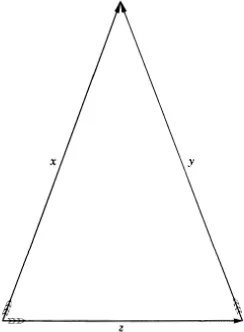
FIGURE 1.1
Think of the sides of the given triangle as if they were arrows laid on the ground and call them x, y, and z (see Fig. 1.1). The letters “x”, “y”, and “z” stand for the arrows themselves, not for their lengths. To denote their lengths we u...
Table of contents
- Cover
- Title Page
- Copyright Page
- Dedication
- Contents
- Preface
- Note to the Reader
- Chapter I Introduction
- Chapter II The PLANE
- Chapter III Linear Dependence, Span, Dimension, Bases, Subspaces
- Chapter IV Linear Transformations
- Chapter V The Dual Space; Multilinear Forms; Determinants
- Chapter VI Determinants: A Traditional Treatment
- Chapter VII Inner Product Spaces
- Appendix A. Equations and Identities
- Index of Symbols
- Index
- List of Definitions, Theorems, Corollaries, and Lemmas