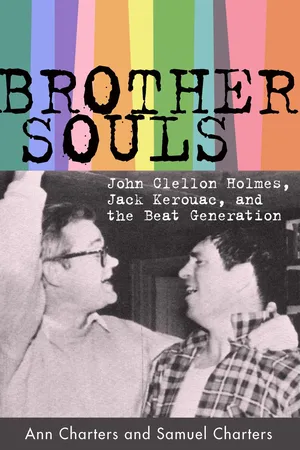
John Clellon Holmes met Jack Kerouac on a hot New York City weekend in 1948, and until the end of Kerouac's life they were—in Holmes's words—"Brother Souls." Both were neophyte novelists, hungry for literary fame but just as hungry to find a new way of responding to their experiences in a postwar American society that for them had lost its direction. Late one night as they sat talking, Kerouac spontaneously created the term "Beat Generation" to describe this new attitude they felt stirring around them. Brother-Souls: John Clellon Holmes, Jack Kerouac, and the Beat Generation is the remarkable chronicle of this cornerstone friendship and the life of John Clellon Holmes. From 1948 to 1951, when Kerouac's wanderings took him back to New York, he and Holmes met almost daily. Struggling to find a form for the novel he intended to write, Kerouac climbed the stairs to the apartment in midtown Manhattan where Holmes lived with his wife to read the pages of Holmes's manuscript for the novel Go as they left the typewriter. With the pages of Holmes's final chapter still in his mind, he was at last able to crack his own writing dilemma. In a burst of creation in April 1951, he drew all the materials he had been gathering into the scroll manuscript of On the Road. Biographer Ann Charters was close to John Clellon Holmes for more than a decade. At his death in 1988 she was one of a handful of scholars allowed access to the voluminous archive of letters, journals, and manuscripts Holmes had been keeping for twenty-five years. In that mass of material waited an untold story. These two ambitious writers, Holmes and Kerouac, shared days and nights arguing over what writing should be, wandering from one explosive party to the next, and hanging on the new sounds of bebop. Through the pages of Holmes's journals, often written the morning after the events they recount, Charters discovered and mined an unparalleled trove describing the seminal figures of the Beat Generation: Holmes, Kerouac, Neal Cassady, Allen Ginsberg, William Burroughs, Gregory Corso, and their friends and lovers.
eBook - ePub
Brother-Souls
John Clellon Holmes, Jack Kerouac, and the Beat Generation
- 464 pages
- English
- ePUB (mobile friendly)
- Available on iOS & Android
eBook - ePub
Brother-Souls
John Clellon Holmes, Jack Kerouac, and the Beat Generation
About this book
Trusted by 375,005 students
Access to over 1.5 million titles for a fair monthly price.
Study more efficiently using our study tools.
Information
Chapter 1
A USABLE PAST
Dear Jack:
I am reading your Doctor Sax and I am impelled to write even before I have finished it. I don’t know what will happen to this book, but it will always be close to me. I truly believe it is a wondrous thing…. While you scurried over the dump that sunny day in 1936 to watch the flood unfold [in Lowell, Mass.], I stood on the banks of the Pemagawassett River, running usually thin, but now swollen and outraged, through Plymouth, N.H. to the north. Yes, it was the same flood. The town was marooned for four days, no electricity or school, and milk swung in over the river on a rope. I walked just outside of town, pondering this great event, and saw the highway slip into vale and disappear in muddy water. How strange! It was the same flood, only I was younger. Across the river there were flats, with jerry-built cheap houses, and beyond them a wooden baseball stadium rarely used, and I stood by the inundated railroad tracks on the town side of the river, carrying a paper bag of hot doughnuts made that morning, in a worn lumber jacket, studying the current that had laved around the porches of those cheap houses and knocked some over and made a lake of the baseball diamond. And continually ate up those doughnuts. Only there was no sun; it had rained steadily for three weeks. The sky was leaden and the boats were out. It was the same flood.
—JOHN CLELLON HOLMES, letter to Jack Kerouac, October 15, 1952
John Clellon Holmes was only ten when the flood of 1936 prodded the rivers in the northeastern United States over their banks and into the surrounding towns and cities in New England. Jack Kerouac had just turned fourteen. Each of them vividly remembered the flood, and for Holmes it became one more point where their lives had crossed, even if miles apart and only on the banks of flooded rivers. In their temperaments they were more different than they were alike, but their boyhood in New England towns was a place from their past they would always share. It wasn’t only the coincidence that Kerouac saw the flooding of the Merrimack River from the town of Lowell, Massachusetts. Lowell is almost eighty miles to the south of Plymouth, New Hampshire, where Holmes went to see the rising water carrying a bag of doughnuts “just tonged out of the grease by our half-Algonquin cook, Dorothy.”1 A dozen miles downstream from Plymouth, the Pemagawassett River, whose relentless, rising crest Holmes stood watching, flowed into the Merrimack River at Bristol, New Hampshire, and became the mingled waters and the same debris that a few days later raged past Kerouac in the flood. As Holmes wrote,
We would discover this eerie correspondence in our lives only years later in New York, up way past midnight, the river of traffic in the clashing street below roaring as loud as the converging rivers of our boyhood, and bringing the memory back to both of us at the same instant.2
In 1948, when Holmes and Kerouac first met, they were still young—Holmes was twenty-two, Kerouac was twenty-six—but despite bursts of anger and disappointment, periods when they saw each other only sporadically, stinging resentments, monumental outbursts and jealousies, they remained friends for the rest of their lives. At the end, it was only Holmes with whom Kerouac still felt close. As he looked back at their relationship, Holmes recognized Kerouac as what he called a “brother-soul.”3 They had been born on the same day, March 12, four years apart, another “eerie correspondence” in their lives. Kerouac was the older of the two, old enough to be Holmes’ big brother, but after the first few months of their friendship it was accepted that John was the steadier brother whom Jack could always turn to for contact and argument, or for a drink, a party, or a place to sleep for the night.
They met as young, would-be writers, solemnly committed to the self-appointed task they had set themselves of becoming the most important novelists of twentieth-century America. In the postwar years the writing of the “great American novel” was still the goal of every aspiring author. They continued to assure themselves, as they assured the women who patiently worked to support them—Kerouac’s mother and his girlfriends, Holmes’ two wives—that they could someday make a living with their writing. But in the beginning, as they talked and argued in New York City in the early years of their friendship, the dream of finishing their books and finding someone willing to publish them was as far as their hopes took them. After they first met they wrote their next novels together—reading each other’s chapters and forcing each other to justify what had made its way on to the page. Their continual arguments clarified the differences between them and helped to define the writers they became.
Though Kerouac published a novel first in 1950, two years later it was Holmes, with his first novel, Go, who received the only large publisher’s advance that either of them was given during their writing careers. Holmes was also the first who tried to describe their group and what they were attempting to achieve, setting down in print what he and Kerouac had argued out over a long night of beer and bebop in the fall of 1948 when Kerouac first proposed the term “Beat Generation.” Kerouac’s later fame came to completely eclipse his friend’s, and in the wake of this fame the issues that Kerouac’s books raised continue to be proclaimed, argued, dismissed, and defended, while the books themselves continue to be read in virtually all of the world’s major languages. The books Holmes spent so much of his life writing never achieved this level of visibility, but they also never entirely were lost, and he continues to be read for his clear-eyed view of what they experienced. Without Holmes’ story an important dimension of Kerouac’s story is missing—a dimension that adds to our knowledge about his life and the writers who influenced him, his struggles to write On the Road, and his last, lost years of alcoholism. Holmes’ story in the same way would have a missing dimension without the presence in it of his life-long friend Jack Kerouac and the leading roles they played as members of what they were the first to call the Beat Generation.
Like most men and women who spend their lives writing, Holmes was the most sensitive and insightful portrayer of his own life, but for anyone looking for his early years, the story of his childhood is scattered through his letters, his journals, and his occasional essay memoirs. Few writers have given more than a glancing aside at their earliest years, though James Joyce in the opening line of his Portrait of the Artist as a Young Man—“When you wet the bed first it is warm and then it gets cold”—took us about as far back into those beginnings as anyone could be expected to go. Throughout his life Holmes often looked back at his past, repeating some of the same memories but casting them in different scenarios, leaving a shifting picture that sometimes is difficult to interpret.
What Holmes shared with Kerouac was both a New England background and a family living in a kind of social vacuum through the anxious years of the Depression. Each of them was estranged from his father—in Holmes’ case, a father who was away from his wife and children for long periods and finally left them in a strained divorce. Kerouac’s father died of cancer only two years before Jack and John met, but Leo Kerouac was a father with whom Jack had fought for many years, and they never managed to untangle their differences. Both Kerouac and Holmes remained close to their mothers, Kerouac to the virtual exclusion of anyone else who attempted to come close to him, even his only child. Kerouac’s confusions and optimistic ambitions became a theme in the story of their chaotic lives Holmes described in Go in 1952. As novelists they were forced to compromise with their insistence to write only the “truth” by the lawyers working with their publishers. To protect the publishers from potential lawsuits over libel, everyone they wrote about in their autobiographical fiction was concealed behind a pseudonym.
In Go Kerouac’s name became “Gene Pasternak.” In On the Road, the book published five years later about this same period of their lives, Holmes became “Ian MacArthur.”4 There is an eerie stereopticon effect in the overlaid descriptions of the same figures at the same moment in two books written within months of each other by the two friends, both neophyte writers, competitors, and often inseparable drinkers, who met almost daily during the time they wrote these early novels. Entire scenes appear in both books, and obviously whatever was the “reality” of that moment, it lies somewhere in the blurred double portrait. Despite the success of On the Road, of all the books written later about their lifestyle, Go is still the most honest. It is also the darkest portrayal of the Beat scene.
Kerouac finally worked through his discomfort at the depiction of himself in Go, as well as his resentment at Holmes’ munificent publisher’s advance for the paperback sale of the novel, but he never forgave his friend for the somber, despairing picture he painted of the lives they were leading. What neither of them could have anticipated was that nearly everyone who crowds the pages of Go and On the Road was to become a familiar figure to the intensely curious audience who later discovered the books. Each “fictional” character, based on a real person in their lives, would emerge as a real name and individual—some like Allen Ginsberg for what they would write, others like Neal Cassady for their vivid presence in the story.
For many of the people drifting through their books’ pages, their story was an unhappy one. Beneath the cultural ferment and political sympathies they shared in the late 1940s was the same postwar social anomie that had left Holmes and Kerouac, along with many other gifted New England writers who were their contemporaries, such as Elizabeth Bishop, Robert Creeley, Robert Lowell, Charles Olson, Sylvia Plath, and Anne Sexton, drifting in an emotional sea. The sea charts that should have guided them into a calmer harbor had been redrawn so many times during the catastrophic events of the Depression, the Second World War, and the early years of the Cold War that any useful directions had been jettisoned a long time ago.
Like many young writers, Holmes kept a journal where he attempted to create some pattern in the drift and chaos of his life. Also like most young writers of his and Kerouac’s generation, he spent many of his daily hours at his typewriter writing letters that were voluminous, immediate, unblinkingly candid, and often startling in their incessant questioning and their just as decided answering. To fill out the record of his daily writing stints, Holmes usually made carbon copies of the letters he wrote, and the copies found their way into the voluminous archive of journals, letters, and manuscripts he would leave behind him.
Kerouac wrote almost as many letters, most of them preserved by his friends, and after he discovered his style of “sketching” in the fall of 1951, he never left his mother’s apartment without a small cheap notebook jammed into a pocket. Unlike Holmes, however, he printed the jottings in his notebooks, usually with a pencil, filling the narrow lined pages with short wordsketches and comments. Holmes’ typed journal entries, in contrast, often continued from one single-spaced page to the next, some as closely reasoned as an exposition of a theme for debate, others loosely humorous and raunchily uninhibited. For Kerouac, the immediacy of the glimpsed events jotted down in his notebooks became the seed of the emotional affects and vivid descriptions he later created in his picaresque memoirs. For Holmes, the reasoned discourse of his journals became the web of ideas that were at the core of all his writing.
In an essay published a few months before his death in 1988, Holmes described his childhood in an impressionistic sketch that provides the setting for much that happened later in his life, though like any other personal memoir, it is most revealing in what was chosen to be included and what has been left out. He began it with an epigraph that in itself was enigmatic and confusing. He is probably the only writer who ever introduced an autobiographical sketch with a quote that he confessed he didn’t know the meaning of himself.
“To salvage from life something on which one can build more life.” I know this is a truth, and I don’t know what it means.
Why?
I was born in Holyoke, Massachusetts (to a revered New England name that has never brought me any ease) and had a female relative who wore a choker, and a distant male relation who could remember the date of William the Conqueror’s invasion of England but not always his own name. My grandfather, the doctor, saved a genteel New Jersey town from the great flu epidemic, then died of the effort; while my other grandfather, the engineer, wore puttees and celluloid collars all his life in mining camps from San Luis Potosi to Butte to support a colonial household outside of Boston, only to lose it when he was flown out of Canada, dying of exposure and still far from Home. My father was “high strung,” impetuous, a failure after the Crash, a sentimentalist who always sang while in the movies; and my mother, “long suffering,” a Christian martyr, took me to séances where the dead gossiped from the other world. I dutifully learned to sail catboats and dance the rumba, all that was left of our “gentility” as the thirties passed, and no reasons. These weren’t the reasons.
In the winters we lived in houses too big, too drafty, and too rundown for other people to live in, and I was invited to dances in the houses where these other people lived, wearing a borrowed suit, there being a shortage of “acceptable” boys, and my manners good. But every summer there were Peconic’s empty beaches beyond the potato fields, far out on Long Island’s unfashionable North Fork, where the sandy bluffs were perfect for cave-building, and you measured nerve and skill and recklessness by swimming underwater through the space between the diving-rocks, and the family’s house on its headland up the beach, a huge, shingled “cottage,” silvered to a soft patina by nor’-easters, was all of certainty and civility to me—my uncles in close harmony around the upright piano, Great-Aunt Marge’s pseudo-impressionistic dunescapes drying on window sills everywhere, Great-Uncle Canby presiding like a Quaker FDR over the summer’s bounteous tables, while the Germany of his graduate school days darkened to a mad rant of Teutonic voices over the shortwave. Those summers were the last seamless times I was to know—white duck trousers board-stiff with starch, commodious rooms of wicker furniture, BLT’s with too much mayonnaise, the mudguards of yellow roadsters, the last long twilights of peace laddering the tranquil surface of the Sound in bars of burnished gold all the way to—But those weren’t the reasons either.5
If the picture Holmes drew of his early years could have been framed it would have been suffused with the lustrous sunlight of these idyllic summers at the beach with his father’s family before the outbreak of the Second World War. The realities, though—as is so often true with memories—cast darker shadows which he was no more able to leave behind than he could forget his impressions of the golden waves and the starched white duck trousers of his boyhood summers on Long Island Sound. He was born in Holyoke, Massachusetts, on March 12, 1926, and named after his father, John McClellan Holmes Sr., whose full name echoed that of his illustrious Civil War ancestor, the Union Army general and later presidential candidate John McClellan. John was the middle child in his family, with two sisters, Lila born two years earlier on March 1, 1924, and Elizabeth six years later on December 10, 1932. The “revered New England name” he mentioned in his poetic evocation of his childhood was the nineteenth-century American poet and essayist Oliver Wendell Holmes, with whom as a modern twentieth century novelist he felt he shared nothing at all except an obdurate New England-ness.
Both sides of Holmes’ family contained highly educated and accomplished men and women. He could trace his paternal ancestry back ten generations to the time of Shakespeare, beginning with George Holmes, born in 1594 in England, who died in Roxbury, Massachusetts, in 1645. After he came to America he and his wife, Deborah (d. 1662), had a son Nathaniel Holmes (1639–1711), whose son Jehoshaphat (1690–1745) married Sarah Waldorf from the family that produced Ralph Waldo Emerson. Jehosaphat and Sarah sired Jehosaphat Junior (1721–1789), whose son Jehosaphat III (1758–1825) sired Edwin Holmes (1797–1873), educated as a minister in Union College, who married Sarah Marian McClellan, related to the general. Their son John McClellan Holmes graduated Williams College in 1853 and earned his Doctorate in Divinity at the theological seminary in New Brunswick, New Jersey, in 1857. His son, Edwin Holmes, born in Hudson, New York, in 1869, became John’s grandfather Doctor Edwin Holmes.6
Educated at Williams College and trained in medicine at Johns Hopkins University followed by a year of postgraduate study in Berlin, Doctor Holmes married Frieda Shreck Boise in 1899. Their son—John’s father—was born on December 16, 1899, in New York City. Doctor Holmes became the pediatrician for the family of the famous aviator Charles Lindberg and worked so tirelessly in Englewood, New Jersey, during the flu epidemic of 1918–1919 that he developed angina and died shortly after Holmes’ birth. After her husband’s death, Holmes’ paternal grandmother, Frieda Boise Holmes, moved to New York City. Her father had been a professor of music at the Peabody Institute in Baltimore and a composer whose work included the first piano concerto written in the United States. Frieda Holmes was John’s favorite grandmother. She later settled in Greenport, Long Island, not far from Peconic’s beaches, where Holmes visited her every year until her death.7
Holmes’ mother, Elizabeth Franklin Emmons Holmes, called “Betty,” and her four sisters were the daughters of a direct descendant of Benjamin Franklin, so on both sides of the family John and his sisters inherited an innate sense of belonging to what his parents called “gentility,” a privileged class in the American social tradition. This couldn’t have been more unlike Kerouac’s background as the son of French-Canadian immigrants. For most of his life Kerouac’s language at home was a dialect of North American French known as joual, and friends from his youth remembered that he had difficulties with English until he was eighteen.
Betty Holmes and her sisters were the daughters of the eminent American mining engineer S. F. Emmons (1841–1911), who was working in Mexico when she was born in 1900, employed as a consultant in the construction of the Mexican National Railway. Later Betty told her own children stories about riding as a little girl out to the end of the line of newly laid track on a flatcar, seated on top of the heavy bags of gold coins used to pay the workers. Her father spent the next several years managing mines in Arizona, Montana, and other distant places. After his death, she was sent away to boarding school with her sisters. Betty studied music and a...
Table of contents
- Cover Page
- Title Page
- Copyright Page
- Dedication
- Contents
- Acknowledgments
- A Prologue
- 1. A Usable Past
- 2. The Magic of Words
- 3. Whatever World There Would Be
- 4. The Stale Bread of Dedication
- 5. A Weekend in July
- 6. A Kind of Beatness
- 7. Neal & Co.
- 8. This Particular Kind of Madness
- 9. Angelic Visions
- 10. In the Temple of the Gods
- 11. A Torrent of Words
- 12. The Liveitup Kid
- 13. Perfect Fools
- 14. The Rising Tide of Fame
- 15. What Am I Doing Here?
- 16. The Horn
- 17. Too-Late Words
- 18. A Sweet Attention
- 19. To the Edge of Eros
- 20. Gypsying
- 21. A Turn of the Circle
- 22. Gone in October
- 23. On a Porch in Boulder
- 24. Final Chorus
- Notes
- Bibliography
- Index
- Photo Credits
Frequently asked questions
Yes, you can cancel anytime from the Subscription tab in your account settings on the Perlego website. Your subscription will stay active until the end of your current billing period. Learn how to cancel your subscription
No, books cannot be downloaded as external files, such as PDFs, for use outside of Perlego. However, you can download books within the Perlego app for offline reading on mobile or tablet. Learn how to download books offline
Perlego offers two plans: Essential and Complete
- Essential is ideal for learners and professionals who enjoy exploring a wide range of subjects. Access the Essential Library with 800,000+ trusted titles and best-sellers across business, personal growth, and the humanities. Includes unlimited reading time and Standard Read Aloud voice.
- Complete: Perfect for advanced learners and researchers needing full, unrestricted access. Unlock 1.5M+ books across hundreds of subjects, including academic and specialized titles. The Complete Plan also includes advanced features like Premium Read Aloud and Research Assistant.
We are an online textbook subscription service, where you can get access to an entire online library for less than the price of a single book per month. With over 1.5 million books across 990+ topics, we’ve got you covered! Learn about our mission
Look out for the read-aloud symbol on your next book to see if you can listen to it. The read-aloud tool reads text aloud for you, highlighting the text as it is being read. You can pause it, speed it up and slow it down. Learn more about Read Aloud
Yes! You can use the Perlego app on both iOS and Android devices to read anytime, anywhere — even offline. Perfect for commutes or when you’re on the go.
Please note we cannot support devices running on iOS 13 and Android 7 or earlier. Learn more about using the app
Please note we cannot support devices running on iOS 13 and Android 7 or earlier. Learn more about using the app
Yes, you can access Brother-Souls by Ann Charters,Samuel Charters in PDF and/or ePUB format, as well as other popular books in Literature & Literary Biographies. We have over 1.5 million books available in our catalogue for you to explore.