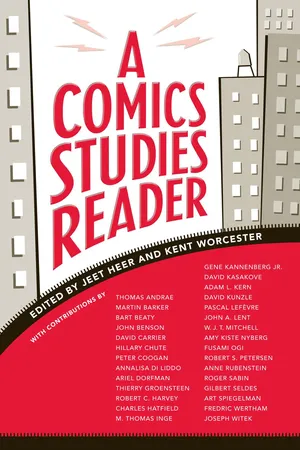
Contributions by Thomas Andrae, Martin Barker, Bart Beaty, John Benson, David Carrier, Hillary Chute, Peter Coogan, Annalisa Di Liddo, Ariel Dorfman, Thierry Groensteen, Robert C. Harvey, Charles Hatfield, M. Thomas Inge, Gene Kannenberg Jr., David Kasakove, Adam L. Kern, David Kunzle, Pascal Lefèvre, John A. Lent, W. J. T. Mitchell, Amy Kiste Nyberg, Fusami Ogi, Robert S. Petersen, Anne Rubenstein, Roger Sabin, Gilbert Seldes, Art Spiegelman, Fredric Wertham, and Joseph Witek
A Comics Studies Reader offers the best of the new comics scholarship in nearly thirty essays on a wide variety of such comics forms as gag cartoons, editorial cartoons, comic strips, comic books, manga, and graphic novels.
The anthology covers the pioneering work of Rodolphe Töpffer, the Disney comics of Carl Barks, and the graphic novels of Art Spiegelman and Chris Ware, as well as Peanuts, romance comics, and superheroes. It explores the stylistic achievements of manga, the international anti-comics campaign, and power and class in Mexican comic books and English illustrated stories.
A Comics Studies Reader introduces readers to the major debates and points of reference that continue to shape the field. It will interest anyone who wants to delve deeper into the world of comics and is ideal for classroom use.
- 380 pages
- English
- ePUB (mobile friendly)
- Available on iOS & Android
eBook - ePub
A Comics Studies Reader
About this book
Information
SCRUTINY AND EVALUATION
While previous sections treated comics in terms of their historical evolution, their formalist properties, or their social role, this section is devoted to analysts who give more detailed attention to particular cartoonists and stories. If comics are a language, as formalist critics suggest, it remains true that different artists deploy this language with varying degrees of skill and aesthetic agendas. The essays in this section use many of the analytical tools we have seen in earlier parts of the book: Ariel Dorfman certainly places Chilean comics in their social and historical context and Gene Kannenberg is attentive to the formalist innovations in Chris Ware’s book; what distinguishes this section, however, is the closer attention paid to the oeuvre of particular artists, rather than broader categories like genres or styles.
Ariel Dorfman’s essay examines the serialized stories of the characters Mampato and Ogú, written and drawn by cartoonist Themos Lobos, setting them against the background of the counter-revolution that overthrew the democratically elected government of Chilean president Salvador Allende in 1973. Using his own memories of Chile during this crisis when he was actively involved in governmental affairs, Dorfman links the plots of these stories to stirred up fears against pro-socialist policies that led to the coup. “The comic strip does not portray the truth of what happened in Chile in those months but rather the version that the Chilean ruling class would have given, and gave, of those events,” Dorfman argues. “Mampato is the dream, the self-justifying, idealized way, the best possible account they could have presented to their children, and to themselves, of the destruction of democracy in their land.” The strength of Dorfman’s reading is the close connection he draws between the seemingly disparate realm of the children’s comics and high politics.
Dorfman’s essay can profitably be read in conjunction with Thomas Andrae’s “The Garden in the Machine,” which offers an alternative interpretation of the same type of children’s comics. In the years after World War II, Carl Barks (1901–2000) won an enormous audience for his comic book stories about Donald Duck and his extended clan (including three nephews and his miserly Uncle Scrooge). Among the most beloved of all American comic books, they have also had their share of critics. In their famous book How to Read Donald Duck: Imperialist Ideology in the Disney Comic (1975), Dorfman and co-author Armand Mattelart argued that Barks’s stories inculcated neocolonial messages, showing the civilized and successful ducks as explorers profiting from the wealth gained through jaunts into third world countries.
Rereading the Barks oeuvre with care, Thomas Andrae argues these animal fables carried a gentler message, one of tolerance for other cultures and environmental awareness. For Andrae, Barks was a pastoralist critical of modern society, and the lands the ducks visited were meant to be utopian alternatives to the depredations of modern life. “Barks was an anti-historicist who critiqued the First World’s illusions of economic and technological progress as a model of development for underdeveloped nations,” Andrae contends. “His story lays bare the dysfunctionality of the commodification of indigenous culture by American imperialism and satirizes the neocolonialist myths that legitimated it.”
Cartoonist Bernie Krigstein (1919–1990) had a relatively brief career in comic books, running from 1943 to 1957. But during those years he brought a rare level of formalist concern to the stories he was asked to illustrate, particular when working for EC comics. John Benson, David Kasakove, and Art Spiegelman provide a panel-by-panel analysis of “Master Race” (1955), one of the most famous stories Krigstein illustrated. This essay highlights the dense layer of visual allusions in the story as well as Krigstein’s care in fusing the breakdown of the page with the unfolding of the story.
This essay shows the strengths of what can be called a “close reading” approach, that is to say one that scrutinizes a relatively brief work with attention to minute details. Part of the authors’ argument is that Krigstein’s value as an artist is reflected in the fact that his work can withstand and reward such microscopic attention. In praising Krigstein they are seeking to clearly delineate his particular stylistic achievement: “In fact, much of the power that Krigstein brings to the story is due to his choice of a style which is the antithesis of standard comics storytelling. Instead of employing the exaggerated visual comic book phrases usually used to clearly denote action and emotion (speed lines, large beads of sweat, etc.), Krigstein uses a much more objective standard of delineation. Instead of frequent close-ups, an often used technique to get ‘close’ to a character’s feelings, Krigstein keeps a physical distance from the characters. Instead of using ‘dramatic’ motion picture type lighting effects, Krigstein uses patterns of dark and light in much more abstract ways. Instead of a humanizing use of free shapes, Krigstein concentrates on using sharp angles and straight lines wherever possible.”
Words and pictures work together in comics to tell a story: often true but not always. In Chris Ware’s “Thrilling Adventure Stories” (1991) the pictures present a superhero tale while the words unfold a painful coming of age story. The story presents a formalist challenge that Gene Kannenberg, Jr., takes up with exegetical cleverness. As with the essay on Krigstein, Kannenberg approaches comics through an intensive, focused scrutiny in order to calibrate a cartoonist’s particular aesthetic strength. “Through deliberate manipulation of the appearance and placement of text within—and surrounding—his comics pages, Ware exploits the graphic nature of printed comics text in ways few other cartoonists have attempted,” Kannenberg argues. “In so doing, he takes full advantage of comics’ innate ability to create complexity through the multivalent interpretive possibilities engendered by the form’s presentation of structured text/image combinations.”
Comics normally exist on the page but there has long been a parallel tradition of paracomics, whereby cartoon images are used as part of a stage performance. Among the classic cartoonists, Winsor McCay gave “chalk talks” to make comics come alive. The writer Alan Moore is a more recent example of an artist interested in making performative comics. In her essay on Moore and his occasional collaborator Eddie Campbell, Annalisa Di Liddo not only explores these performance works (and their adaptations into print comics), she demonstrates that they cast light into the very nature of comics as a medium. In Di Liddo’s essay we see that a close reading of comics is shown to be an activity that can move beyond rigid formalist boundaries. To appreciate Campbell’s adaptation, Di Liddo argues, it “must not be read as an attempt to substitute the performance, but as an alternative and just as effective way to convey the multi-sensory experience of the live act.”
Art Spiegelman’s Maus (1991) is one of the most lavishly praised of all comics. Yet most of the attention that this groundbreaking work receives has focused on the contents (a story of surviving the Holocaust). Spiegelman’s skills as a storyteller make this literary approach feasible, which has the unfortunate effect of leading commentators to avoid dealing with Spiegelman’s art. In her essay “History and Graphic Representation in Maus,” Hillary Chute works to counteract this tendency by focusing on “the specificities of reading graphically, of taking individual pages as crucial units of comics grammar.” Reading graphically means teasing out the layers of meaning in Spiegelman’s drawings and relating them to the thematic concerns of the work.
What distinguishes these essays is the way they use the array of analytical tools developed by comics scholars, applying in various measures historical context, social analysis, and formalist readings to the examination of particular comics. As such, they point towards the increasing success of comics scholars in synthesizing a range of approaches to gain a more integrated view of comics.
The Innocents March into History
ARIEL DORFMAN
In Santiago de Chile, every Wednesday on my way home, I used to buy a children’s magazine called Mampato, and each evening, before putting my six-year-old son Rodrigo to bed, I would read it to him. It was 1973. The Allende government was fighting for its life. We were fighting for ours. There wasn’t an instant to spare. Nonetheless, I always managed to keep that Wednesday appointment.
In the repetition of this act there was undoubtedly a sense of despair. To cling to a pattern or a schedule, some landscape untouched by violence, when things are falling apart, is to make believe that a semblance of normalcy remains somewhere, awaits us someplace. It is possible, however, that I was doing more than indulging in a family ritual on the brink of disaster. There may also have been a pinch of intellectual curiosity in my reading activities.
On the surface, there was nothing special about the magazine. It contained all the usual material of a semi-educational sort: nature studies, little vignettes on Chilean history, cutouts, puzzles, mazes, jokes, some comic strips from abroad, do-it-yourself sections. But Mampato was not only the name of the magazine. It was also the name of a boy, a character whose feats—to be eternally continued in the next issue—occupied four central full-color pages, as he and his friend Ogú, a primitive, overgrown caveman, ventured into the far future to battle the tyrant Ferjus. It was this story, drawn exclusively in Chile itself, which began to interest or should I say to obsess me.
As we read, each Wednesday, it began to dawn on me that what I was reading in the comic mirrored what was happening in the streets of Santiago. While Mampato and his friends went about the business of overthrowing a tyrant in the year 4000, Salvador Allende, the democratically chosen president of the real Chile, was being similarly branded “tyrant” by rather less fictitious forces seeking to oust him.
For a person who had already written books and essays on mass subliterature for children, and on the childish aspects of the adult media, this was a unique opportunity: to watch a comic strip intervening directly, albeit covertly, in history. I had assumed, and still do, that such fictional forms influenced people, especially youngsters, through a code of half-hidden values, which helped them adapt to reality by blurring out, or perhaps by falsely acting out, its dilemmas. I had therefore focused my attention primarily on the covert structure of the work itself—how it functioned, its meaning, and how it established certain formulas for success which could be popularized and incorporated into other versions and variations. I felt it was important to denounce the dominant model behind mass culture, the techniques, precepts, implicit educational views that shaped the consumer’s imagination and dissolved his critical faculties. Although such a model was useful, displaying the invisible ideas that inform our everyday mythology, it was itself no more than a construction. Once this model has been inferred from the texts and frozen into a common denominator applicable to so many other media representations, it was easy to forget how it operated in reality: reacting to threats, defending the status quo, absorbing and reinterpreting the latest problems in neutral terms, trying to offer explanations for a seething, conflicting stream of troubles. By concentrating on the finished product, and trying to discover the ideological foundations behind it, I had separated it from the historical movement and matrix where it was produced and received by living human beings.
Reprinted from Ariel Dorfman, The Empire’s Old Clothes: What the Lone Ranger, Babar, and Other Innocent Heroes Do to Our Minds (Pantheon, 1983), 177–96. Copyright © Ariel Dorfman, reprinted with permission of The Wylie Agency, Inc.
It was clear that behind each individual work there lurked, if we are allowed such melodramatic verbs, a consciousness industry. The owners of the economy and the State were also, of course, the owners of the means of definition, transmission, and reception of culture. They were a class. But I had not asked myself specifically how emotion and intellect came together, and under what circumstances, to spawn such works; what people, under what particular strains, with what degree of clarity or blind intuition produced mass subliterature. Nor had I explored how the chain of command and persuasion, economic and political interests, could obtain such results.
I told myself—and it was right to do so—that what I cared about were the effects on the readers. Mass media fiction, as opposed to art, leaves hardly any space for interpretation by the audience. With less leeway for participation, the passive consumer was restricted to certain foregone avenues and conclusions. So the reader I had in mind was not a real person who, with all his or her contradictions, must deal with that vision, accommodate it, modify it, fight it, succumb to it. My reader was, in a way, an idealization, an objective possibility that could be deduced or was implicit in the text itself.
A sociology of art, an examination of culture as an interplay between real readers and real producers, was not then, and is not now, my main intention. But the Mampato case gives us an opportunity, if not to answer questions about how such processes work in reality, at least to ask them. By observing a mass media production for children unfolding in particularly vivid historical circumstances, we can not only enrich the conclusions we have already reached but clarify some of the issues which have been, so far, left out of our perspective.
Mampato, accompanied by Ogú, has journeyed into the far future in order to visit his girlfriend Rena, who typifies everything a young lady should be according to upper-class Chilean standards: white-skinned, blond, green eyes, slim, wearing the latest fashions. She and the other inhabitants of her land are peaceful, beautiful telepaths who are technically very advanced (because here “all minds think in a united way”) without having lost their naturalness and charm. Unfortunately, they are unable to defend themselves against their neighbors, “malign beings” out to “dominate the earth.” Ferjus, the tyrant of that other country, can read minds, just like Rena. She, however, does not abuse this power (“It’s not nice to invade private thoughts without asking permission”), while he uses it to subject and destroy his victims.
Each of these countries seems to be, in different ways, a recognizable metaphor for Chile. If Rena’s land has the same topography (high mountains, cultivated valleys, the same sort of trees and birds), the despot’s has the right shape. He reigns over a mammoth tree, as elongated and slender as Chile, its different floors or regions interconnected by elevators. If Rena’s country is the utopia Chile might someday become (or, with its bucolic tranquility, what it supposedly once was), the realm of Ferjus projects the more contemporary and infernal image of a house ferociously divided against itself. Those responsible for such a sorry state of affairs are clearly “foreigners.” Disciples of Ferjus, they are yellow-skinned usurpers of power who have many of the physical characteristics normally associated with villains: Dracula teeth, advanced prognathism, small heads on overmuscular bodies. To these features, which—as usual—seem to caricature the working class, may ...
Table of contents
- Cover Page
- Title Page
- Copyright Page
- Contents
- Acknowledgments
- Introduction
- Why Are Comics Still in Search of Cultural Legitimization?
- HISTORICAL CONSIDERATIONS
- CRAFT, ART, FORM
- CULTURE, NARRATIVE, IDENTITY
- SCRUTINY AND EVALUATION
- Contributors
- Index
Trusted by 375,005 students
Access to over 1.5 million titles for a fair monthly price.
Study more efficiently using our study tools.
Frequently asked questions
Yes, you can cancel anytime from the Subscription tab in your account settings on the Perlego website. Your subscription will stay active until the end of your current billing period. Learn how to cancel your subscription
No, books cannot be downloaded as external files, such as PDFs, for use outside of Perlego. However, you can download books within the Perlego app for offline reading on mobile or tablet. Learn how to download books offline
We are an online textbook subscription service, where you can get access to an entire online library for less than the price of a single book per month. With over 1.5 million books across 990+ topics, we’ve got you covered! Learn about our mission
Look out for the read-aloud symbol on your next book to see if you can listen to it. The read-aloud tool reads text aloud for you, highlighting the text as it is being read. You can pause it, speed it up and slow it down. Learn more about Read Aloud
Yes! You can use the Perlego app on both iOS and Android devices to read anytime, anywhere — even offline. Perfect for commutes or when you’re on the go.
Please note we cannot support devices running on iOS 13 and Android 7 or earlier. Learn more about using the app
Please note we cannot support devices running on iOS 13 and Android 7 or earlier. Learn more about using the app
Yes, you can access A Comics Studies Reader by Jeet Heer,Kent Worcester in PDF and/or ePUB format, as well as other popular books in Literature & Literary Essays. We have over 1.5 million books available in our catalogue for you to explore.