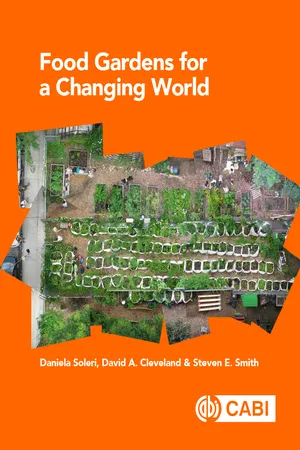
Food gardening is becoming increasingly popular, as people look for new ways to live more sustainably and minimize harm to the environment. This book addresses the most pressing challenges facing food gardening in the 21st century - worldwide changes in climate, the environment, natural resources, and communities - and the basic biological, ecological and social concepts which influence our understanding. Examples throughout the text demonstrate how gardeners can use these theories to their advantage.
- English
- ePUB (mobile friendly)
- Available on iOS & Android
eBook - ePub
Food Gardens for a Changing World
About this book
Trusted by 375,005 students
Access to over 1.5 million titles for a fair monthly price.
Study more efficiently using our study tools.
Information
1 What can Food Gardens Contribute? Gardens and Wellbeing
Chapter 1 in a nutshell.
• Eating fruits and vegetables from the garden can improve nutrition and health by providing compounds often lacking in the diet, replacing unhealthy, empty-calorie foods, and making foods more flavorful and meaningful.
• Community gardeners eat more fruits and vegetables than their neighbors who do not garden.
• Gardening can provide regular, enjoyable physical activity that can improve health.
• Feeling productive and interacting with plants, nature, and other gardeners supports a positive attitude about yourself and others.
• Growing food in a garden can be more environmentally beneficial than growing the same food in conventional agriculture.
• Food gardens can contribute to ecologically healthy and beautiful environments—for example, by increasing water infiltration, soil quality, carbon sequestration, and shade, and by providing homes for pollinators, and culturally and personally meaningful plants.
• Many of the individual and environmental benefits of gardens also have a positive impact on communities and society.
• Economic benefits from gardens can include fewer food purchases, and income from the sale or trade of garden produce.
• Still, gardens are not always or automatically beneficial—they can be used to exploit people and communities.
• Transparent and participatory garden organizations and projects help to avoid situations that aren’t in the best interest of gardeners, their communities, or society.
A freshly picked ear of corn, a bowl of sautéed greens and herbs, a ripe peach, a handful of sweet jujube fruits, a bunch of bright flowers—what food gardens can contribute seems obvious when we enjoy the harvest. But in addition to these pleasures, there is more and more evidence of other benefits that food gardens and gardening can provide. In fact, in most cases, gardens provide multiple benefits, and in so doing they contribute to our personal wellbeing—that is, our physical, material, social, and emotional health and happiness. Gardens can contribute to better diets, increased physical activity, and healthy weight, that along with not smoking and moderate alcohol consumption, are estimated to have the potential to increase lifespans by about 20 years compared with people whose lifestyles do not include those practices (Li et al., 2018). Gardens can also contribute to environmental health that benefits individuals, communities, and the Earth. Food gardens can do this because, like many small-scale farms, especially in the global south, they can produce not only food, but herbs, flowers and medicines, protect biodiversity, support positive ecological processes, and beautify the environment (IAASTD, 2009).
Sometimes changing our habits is the most effective, but most challenging way to obtain the benefits gardens can offer. We are often adrift in our thoughts, which distract us from the present, and are frequently unhelpful (Killingsworth and Gilbert, 2010) (Fig. 1.1), so practicing focusing our attention on what we’re doing and where we are, and understanding the possible benefits of doing this, can be very effective for changing some behaviors (Box 1.1). Attention and understanding can support positive behavior changes in diets, amount of physical activity, and social interactions that decrease non-communicable diseases (NCDs—non-infectious diseases that are often chronic, and progress over time). And gardening can contribute to increasing those positive behaviors. For example, it can be motivating to know that spending 15 minutes to walk to your plot in the community garden and working there for 30 minutes burns over 150 calories and can provide physical, psychological, and emotional benefits, whereas perusing the internet for the same amount of time burns only half the calories and has no health benefit. However, changing habits is not a simple matter of awareness and willpower. Many factors including poverty, racism, historical trauma, and environmental contamination undermine efforts to change, and are why gardens alone may not be adequate or even appropriate, when structural, social and policy changes are required (Section 1.6).

Figure 1.1. Adrift in our thoughts
Box 1.1. Mindfulness and behavior change
Mindfulness is one of several approaches that people can use to help make positives changes in their behavior by changing the way they think (Hayes et al., 2011). The idea is to bring your mind to focus attention on the present and be able to observe your experiences without judging them. Judgment tends to shift the mind away from the present, tangling it up in explanatory stories that are not helpful, and are disconnected from reality. Careful observation of what is happening right now makes it easier to decide how we want to behave, rather than just following habitual patterns. Mindfulness has been shown to help people change behaviors such as unhealthy eating (Mason et al., 2016). It can also be calming, and interrupt negative thought patterns, helping people manage pain, anxiety, and depression, improving overall wellbeing (Hayes et al., 2011), and the way we interact with each other.
There are many practices for learning mindfulness. Here are two common ones. Focus on the breath: for five minutes sit quietly and attentively and focus on your breath coming in and out through your nose, notice the feeling and sound, count five complete breaths before starting the counting again—it can be very challenging to stay focused even for five breaths but this improves quickly with practice. Eat a raisin: sitting quietly and attentively, slowly eat one raisin, taking as long as possible, exploring it in your mouth, focusing on the taste, texture, smell, and any other sensations.
Working in the garden can also be an excellent way to practice focused attention, as documented in Wendy Johnson’s memoir about the garden at Green Gulch Zen Center (Johnson, 2008): “Working in the garden is also meditation, though not in the conventional sense of calming down, moving slowly and deliberately, and dwelling in stillness. On the contrary, I am often most alert and settled in the garden when I am working hard, hip-deep in a succulent snarl of spring weeds.”
Every benefit is accompanied by costs, so we can think in terms of the benefit:cost ratio and the net benefit that occurs when that ratio is greater than one. There are many kinds of benefits and costs including financial, psychological, environmental, nutritional, and social. Whether something is a benefit or cost depends on how it is defined, based on subjective values and objective measurements, including how you define the boundaries of benefits and costs in time and space. Benefits can be multifaceted, and can also be intertwined with costs, and completely separating them may not be possible, or worthwhile. For example, as we discuss below in Section 1.5, time spent gardening can be assessed as a cost of gardening, or as a beneficial physical activity, which is very difficult to separate from your personal psychological benefits, and even the social benefits for you and your community. This does not mean benefit:cost assessments should not be made, but the multifunctional nature of gardens and gardening needs to be taken into account, including the importance to different people of different benefits and costs. In this chapter we outline some of the potential benefits of food gardens, particularly those that have been documented by scientific studies. However, lack of research evidence of benefits does not necessarily mean they don’t exist. Because gardens have often been thought of as relatively unimportant, they have been overlooked for a long time and so there are not many systematic studies of gardens and their impacts, although this is changing.
Identifying and documenting benefits and costs is especially important in making the case for funding and public support of community and home gardens when they are competing with alternative uses for land, water, and time, as has been true, for example, since at least the late nineteenth century in the US (Lawson, 2005). Every situation is different, and we can’t assume that benefits will or will not occur. Despite their many potential benefits, food gardens are not magical and should never be thought of or promoted as a cure-all. Sometimes benefits found in formal, controlled studies may not occur on the ground in real gardens, or vice versa, and sometimes food gardens are not the best response to a need or problem. As we emphasize throughout this book, keeping the framework described in the Introduction in mind, and being a good observer, will help when trying to figure out what contributions gardens can, and cannot, make in your situation. This chapter covers concepts important for assessing the value of existing or planned gardens, and for increasing their benefits.
1.1. Diet and Nutrition
The full effect of individual foods on nutrition and health is hard to detect, because it’s difficult to separate the effects of foods from the meals and diets they are part of, from the variation in nutrients they contain, and from other factors that affect nutrition and health. For example, in the US, many vegetables are eaten in combination with foods containing lots of calories and sodium, and in forms with dietary fiber removed (Guthrie and Lin, 2014). But at the same time, an increasing number of studies are showing that eating diets high in fruits, vegetables, and whole grains, and low in meat, refined grains, added sugars, and salt—especially when all of these are done together—is associated with a lower risk of acquiring NCDs and a greater likelihood of living longer (Scarborough et al., 2012; Aune et al., 2013, 2017; Esselstyn et al., 2014; Hu et al., 2014; Tilman and Clark, 2014). “Fruit” and “vegetable” can be confusing terms because botanically, “fruit” is a seed-bearing structure and “vegetable” is not used, while in culinary usage, “vegetable” often refers to all edible plant parts, and in popular use the two terms frequently reflect what is thought of as sweet vs. savory, which often don’t align with botanical definitions (IARC, 2003, 1–21). In FGCW we use these terms in the popular sense, for example when discussing diets, but use the more precise botanical definitions in Chapters 5, 6 and 10.
NCDs include many types of cancers, heart disease, type 2 diabetes (previously referred to as adult onset diabetes mellitus), and hypertension (high blood pressure). The metabolic syndrome is the name given to the combination of risk factors for heart disease, stroke, and type 2 diabetes, including a large waistline due to fat storage in the abdomen, high fasting blood sugar levels, and abnormal levels of fat in the blood (Bremer et al., 2012). The metabolic syndrome and NCDs are increasingly common among people living in societies that have experienced a nutrition transition to more unhealthy diets (Box 1.4).
While the details are often controversial, there now appears to be overwhelming evidence that a diet containing lots of minimally processed plant foods is important for good health at all ages: “The case that we should, indeed, eat true food, mostly plants, is all but incontrovertible” (Katz and Meller, 2014, 94). Yet, while plant rich, vegetarian, or completely plant-based (vegan) diets can be nutritionally adequate and protect against NCDs, they can also contain excess salt, sugar, and fat, and need some planning to avoid deficiencies, especially of vitamins B12, D and K2, omega-3 fatty acids, calcium, iron, and zinc (Craig, 2010; Li, 2014).
In this section we focus on what food gardens can contribute to nutritious and delicious diets that support healthy, active, long lives through: a) the nutrient and other content of garden foo...
Table of contents
- Cover
- Half Title
- Title
- Copyright
- Contents
- Acknowledgments
- Introduction
- PART I Starting at the beginning: gardens and the big picture
- 1. What can Food Gardens Contribute? Gardens and Wellbeing
- Appendix 1A Nutrients and Energy in Garden Foods
- 2. Changes Coming to your Garden
- 3. Responding to Change as a Food Gardening Strategy
- Appendix 3A Worked Formal Garden Experiments
- PART II Starting the garden
- 4. Garden Placement
- 5. How Plants Live and Grow
- 6. Starting and Caring for Garden Plants
- PART III Garden management
- 7. Soil, Nutrients, and Organic Matter
- 8. Water, Soils, and Plants
- 9. Managing Pests, Pathogens, and Beneficial Organisms
- 10. Saving Seeds for Planting and Sharing
- Index
- Back Cover
Frequently asked questions
Yes, you can cancel anytime from the Subscription tab in your account settings on the Perlego website. Your subscription will stay active until the end of your current billing period. Learn how to cancel your subscription
No, books cannot be downloaded as external files, such as PDFs, for use outside of Perlego. However, you can download books within the Perlego app for offline reading on mobile or tablet. Learn how to download books offline
Perlego offers two plans: Essential and Complete
- Essential is ideal for learners and professionals who enjoy exploring a wide range of subjects. Access the Essential Library with 800,000+ trusted titles and best-sellers across business, personal growth, and the humanities. Includes unlimited reading time and Standard Read Aloud voice.
- Complete: Perfect for advanced learners and researchers needing full, unrestricted access. Unlock 1.5M+ books across hundreds of subjects, including academic and specialized titles. The Complete Plan also includes advanced features like Premium Read Aloud and Research Assistant.
We are an online textbook subscription service, where you can get access to an entire online library for less than the price of a single book per month. With over 1.5 million books across 990+ topics, we’ve got you covered! Learn about our mission
Look out for the read-aloud symbol on your next book to see if you can listen to it. The read-aloud tool reads text aloud for you, highlighting the text as it is being read. You can pause it, speed it up and slow it down. Learn more about Read Aloud
Yes! You can use the Perlego app on both iOS and Android devices to read anytime, anywhere — even offline. Perfect for commutes or when you’re on the go.
Please note we cannot support devices running on iOS 13 and Android 7 or earlier. Learn more about using the app
Please note we cannot support devices running on iOS 13 and Android 7 or earlier. Learn more about using the app
Yes, you can access Food Gardens for a Changing World by Daniela Soleri,David A. Cleveland,Steven E. Smith in PDF and/or ePUB format, as well as other popular books in Biological Sciences & Horticulture. We have over 1.5 million books available in our catalogue for you to explore.