Revised and updated: the award-winning historical analysis of the civil rights movement examining the interplay of race and class in the American South.
In
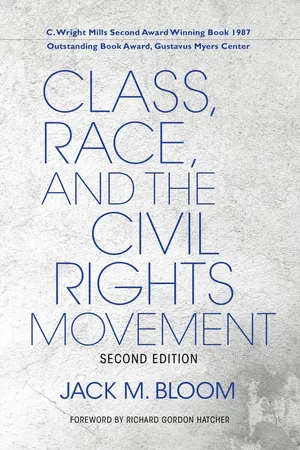
Race, Class, and the Civil Rights Movement, sociologist Jack M. Bloom explains what the civil rights movement was about, why it was successful, and why it fell short of some of its objectives. With a unique sociohistorical analysis, he argues that Southern racist practices were established by the agrarian upper class, and that only when this class system was undermined did the civil rights movement became possible. He also demonstrates how the movement was the culmination of political struggles beginning in the Reconstruction era and influenced by the New Deal policies of the 1930s.
Widely praise when it was first published 1987,
Race, Class, and the Civil Rights Movement was a C. Wright Mills Second Award–winning book and also won the Gustavus Myers Center Outstanding Book Award. In this second edition, Bloom updates his study in light of current scholarship on civil rights history. He also presents an analysis of the New Right within the Republican Party, starting in the 1960s, as a reaction to the civil rights movement.
- 368 pages
- English
- ePUB (mobile friendly)
- Available on iOS & Android
eBook - ePub
Class, Race, and the Civil Rights Movement
About this book
Information
PART ONE
The Changing Political Economy of Racism
I
THE POLITICAL ECONOMY OF SOUTHERN RACISM
Racism did not overwhelm class; racism became an organizing principle for social strata fearful of class-based political action.
Armsted Robinson1
TO UNDERSTAND HOW THE CIVIL RIGHTS MOVEMENT CAME into existence, how blacks successfully challenged racist practices, it is necessary first to grasp the root of this racism. Doing so will make it possible to understand what blacks had to confront in the mid-twentieth century. The civil rights movement encountered bitterness, resistance, even murder. Why? Why did the whites cling so tenaciously to segregation and the racial oppression associated with it? What was at stake in this struggle?
The civil rights movement was centered in the South. If black rights and dignity were to be won, it had to be in that region, because it was the base and source of the racial practices of the nation. “The South,” wrote Martin Luther King, “was the stronghold of racism. . . . There could be no possibility of life-transforming change anywhere so long as the vast and solid influence of Southern segregation remained unchallenged and unhurt. The ten-year assault at the roots was fundamental to undermining the system.”2 Southern racism marked blacks with the badge of inferiority. It deprived them of political rights, economic opportunity, social justice, and human dignity. Why? How did these racist practices come to be embedded within the Southern social system? C. Vann Woodward pointed out that the position blacks came to occupy in the South was not inevitable and did not emerge immediately after the Civil War.
This chapter analyzes the creation of the racial system of the post–Civil War South. It argues that the racist beliefs and practices that the civil rights movement confronted were inextricably intertwined with, and shaped by, the class structure and class struggles of the latter part of the nineteenth century. More specifically, white supremacy became, more than anything else, the means used to maintain the dominance of the Southern upper class. Because of the importance of white supremacy in maintaining the class structure, this elite, based on its ownership of land, had a vested interest in perpetuating racism. Southern racism was thus intertwined with the class structure of the South and was, in fact, its lynchpin.
Post–Civil War racism did not develop under ordinary circumstances; rather, it took form in a period that can only be described as revolutionary. The South’s defeat in the Civil War and the sudden emancipation of the slaves threw the social system into chaos; the destruction of slavery had ended one order, but it did not immediately create another. What the new economic arrangements would be, what social forces would predominate, and what was to be the basis of new racial relations were all unsettled issues. The Civil War and the era of Reconstruction destroyed the class system of the old South, and the result was a prolonged struggle over the social system that would replace it. “Emancipation,” wrote James L. Roark in his study Masters without Slaves, “confronted planters with a problem their deepest convictions told them it was impossible to resolve—the management of staple-producing plantations employing free black labor.”3 The new racial practices were created in the course of carrying out this struggle, and racist oppression was made the glue that held the class system together.
Throughout the remainder of the nineteenth century, virtually all possible political combinations came into being at one point or another. Upper-class whites developed a paternalistic relationship with blacks, which they used to hold back the class aspirations of lower-class whites. Upper- and lower-class whites allied to suppress blacks whenever blacks sought to challenge the economic and social arrangements that were the basis of the oppressive conditions of their lives. Lower-class whites and blacks united against the class prerogatives of the upper class. But the main dynamic in this process was provided by the upper-class whites’ successful effort to retain their economic and political domination of the region.
A new order eventually emerged from this period of social upheaval, an order that established a new class system. Upheavals of this magnitude often take decades to resolve, and so it was in the South. A stable system was not fully attained until after the turn of the century, by which time the Southern landowning class was once again securely in control, after having spent the remainder of the nineteenth century fighting to restore its position.
It was not a foregone conclusion that whites would join in concert against blacks. White small farmers had long borne their own grudges against the wealthy slaveholders, who had regarded and treated them as “white trash” and who had denied them the best agricultural land, and the economic squeeze they experienced after the Civil War (discussed later in this chapter) reinforced their anger against the upper class. The newly freed slaves shared similar interests with the white farmers. Separately, each group constituted a problem for the planters; together, especially with the support of the federal government, both groups were a genuine threat to the existence of the landed aristocracy.
These problems were intensified by the South’s poverty and by the efforts of the planters to retain as much of the old social system as they could. Such circumstances forced the landowning class to change its character and to become bourgeois in order to make possible a settlement with the North. The new merchant-landlord class that emerged out of the ruins of the Civil War and Reconstruction had its roots in the old planter class, and as it groped toward new class relations, it did so with the aim of recapitulating the old.
The form that white supremacy took was not a product of a coherent strategy but involved ad hoc responses to chaotic circumstances. White supremacy was directed primarily toward removing blacks from political power. Without political power, blacks could more easily be forced into economic subservience and become the controlled labor force that the merchant-landlord class felt it needed. White supremacy did not mean that all whites were to be supreme. It became the “code word” and the strategy for the domination of the region by the merchant-landlord class of the Black Belt, the traditional plantation area. In the name of white supremacy, lower-class whites were asked to sacrifice their well-being and eventually even their right to vote. That was ostensibly for the purpose of avoiding the danger of “Negro domination”; but in reality this racial danger was raised any time the merchant-landlord class felt its class position threatened. As a consequence, the merchant-landlords emerged from the turbulence occasioned by the South’s defeat in the Civil War as powerful and secure in their region as the slaveholding class itself had been.
The Southern landed elite did not create the Southern racial system alone, though it was the primary mover. Lower-class white racism is not in doubt here, but it was not primarily responsible for the system of racial domination. Left to themselves, the merchant-landlords might have preferred a more genteel system, based on their own paternalistic relationship with blacks. Such a relationship enabled them to create the unholy alliance between themselves and the blacks in which wealthy whites “protected” blacks and enabled them to retain the right to vote and to use public property, so long as they stayed in their “place.” In return, this white upper class was able to use the blacks as a buffer against the demands of lower-class whites and to play each off against the other. But the possibility of black and white labor joining to challenge the political and economic structure was a constant threat. When the threat turned into a reality, the Southern elite acted to end the danger once and for all. It consolidated the hegemony of its class by removing all political rights from blacks, and, as it turned out, from many whites as well.
The first section of this chapter, “Survival of the Landowning Class,” traces the economic and social evolution that the region underwent in the latter part of the nineteenth century. The conditions that existed in this period established the framework within which the battle for political power took place. This section delineates the major protagonists: the planter class, the merchants, and the evolution of both into the new merchant-landlord class; white farmers; and the newly freed blacks. It demonstrates the problems each of these social groups faced and the evolutionary outcome of their efforts to respond to these problems. It does not, for the most part, show the process whereby a new social and economic system of exploitation was created, for that discussion requires an explication of the political struggles of the period. The subsequent two sections, “The Challenge of Reconstruction” and “The Threat from Below,” trace this political process. The last section, “Shadow of the Plantation,” discusses the class system of the South as it solidified out of this chaotic period and entered the twentieth century.
Survival of the Landowning Class
Poverty was the supreme reality of the post–Civil War South. It deeply affected everything about the South and cast a pall of desperation on everyone’s endeavors. In this period the very survival of the plantation came into question. The former slave-owning class had suffered serious economic losses as a result of the war. Much of its capital had been invested in slaves. Most of the remainder had gone for land and war bonds. The victorious North repudiated the bonds, and the land that escaped damage had only a potential value without a stable labor force to work it. The physical destruction of cities, railroads, bridges, ports, navigable streams, even food and livestock added to the seriousness of the economic damage. Total destruction has been estimated in the billions of dollars. James Goldfield noted: “Abandoned fields . . . heirloom seeds for cotton lost; seedbeds choked with weeds; levees and canals fallen into disrepair; shops shuttered or destroyed. If a family were fortunate enough to salvage a plough, they would have to drag it through the fields themselves.”4 Moreover, the tariffs that the South had long opposed had been substantially raised during the war—up 47 percent and steadily rising thereafter. Probably the most destructive result of the war was the death of one quarter of the white male population of military age—also the age of greatest economic output—in the South.5
All of that was compounded by the lack of liquid capital available in the region for planters to borrow. In 1880 the South had 35 percent of the nation’s population but only 8.5 percent of the banking deposits. By 1895 there was only one bank for every 58,130 inhabitants of the South, while the comparable national figure was one per 16,000. In Georgia alone, 123 of the state’s 137 counties had no banking facilities whatsoever. Neither did most of the parishes in Louisiana, where historian William Hare wrote, “rural banks simply did not exist.” The banks that did exist were short of funds. As late as 1937, savings deposits in the South were only 6 percent of the national total; of the sixty-six largest banks in the country at that time, only two were Southern, and they were on the bottom of the list. The weakness of the banking system was exaggerated by the cyclical demands upon it. Deposits tended to be largest in the fall and winter after the harvest and smallest in the spring and summer, when the need for farm credit was the greatest.6
The Reconstruction regimes heavily taxed the planters. Throughout the South, property taxes were four times higher in 1870 than they had been in 1860. In Mississippi the property tax rate was fourteen times higher in 1874 than in 1869, the last year of Democratic Party control. As taxes went up, so did the assessed value of property. Previously much of the planters’ property had been assessed at less than its value for tax purposes; now that tendency was reversed. In some cases the aim of the taxation was, frankly, confiscatory. These taxes were directed primarily against the planter class, who, in its turn, provided most of t...
Table of contents
- Cover
- Title Page
- Copyright
- Dedication
- Contents
- Foreword
- Acknowledgments
- Introduction to the Second Edition
- Introduction
- Part One: The Changing Political Economy of Racism
- Part Two: The Black Movement
- Afterword: Class, Race, and the Rise of the New Right
- Bibliography
- Index
- About the Author
Trusted by 375,005 students
Access to over 1.5 million titles for a fair monthly price.
Study more efficiently using our study tools.
Frequently asked questions
Yes, you can cancel anytime from the Subscription tab in your account settings on the Perlego website. Your subscription will stay active until the end of your current billing period. Learn how to cancel your subscription
No, books cannot be downloaded as external files, such as PDFs, for use outside of Perlego. However, you can download books within the Perlego app for offline reading on mobile or tablet. Learn how to download books offline
We are an online textbook subscription service, where you can get access to an entire online library for less than the price of a single book per month. With over 1.5 million books across 990+ topics, we’ve got you covered! Learn about our mission
Look out for the read-aloud symbol on your next book to see if you can listen to it. The read-aloud tool reads text aloud for you, highlighting the text as it is being read. You can pause it, speed it up and slow it down. Learn more about Read Aloud
Yes! You can use the Perlego app on both iOS and Android devices to read anytime, anywhere — even offline. Perfect for commutes or when you’re on the go.
Please note we cannot support devices running on iOS 13 and Android 7 or earlier. Learn more about using the app
Please note we cannot support devices running on iOS 13 and Android 7 or earlier. Learn more about using the app
Yes, you can access Class, Race, and the Civil Rights Movement by Jack M. Bloom in PDF and/or ePUB format, as well as other popular books in Social Sciences & Social History. We have over 1.5 million books available in our catalogue for you to explore.