- 306 pages
- English
- ePUB (mobile friendly)
- Available on iOS & Android
eBook - ePub
About this book
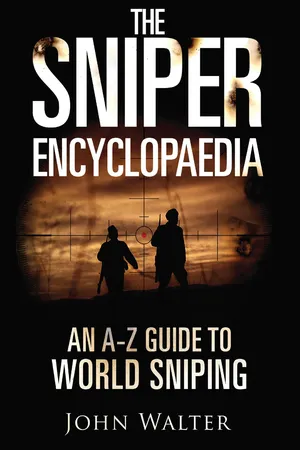
The Sniper Encyclopaedia is an indispensable alphabetical, topic-by-topic guide to a fascinating subject.It is intended as a companion volume to John Walter's Snipers at War (Greenhill Books, 2017) and is another addition to the Greenhill Sniper Library which includes a series of first-person memoirs.This is a comprehensive work that covers virtually every aspect of sniping. The work contains personal details of hundreds of snipers, including world-renowned gurus such as Vasiliy Zaytsev and Chris Kyle as well as many crack shots generally overlooked by history. Among them are some of more than a thousand Red Army snipers, men and a surprising number of women, who amassed sufficient kills to be awarded the Medal for Courage and, later, the Order of Glory. Some of the best-known victims of snipers are identified, and the veracity of some of the most popular myths is explored.The book pays special attention to the history and development of the many specialist sniper rifles - some more successful than others - that have served the world's armies since the American Wars of the nineteenth century to today's technology-based conflicts. Attention, too, is paid to the progress made with ammunition—without which, of course, precision shooting would be impossible and the development of aids and accessories, from camouflage clothing to laser rangefinders.Finally, The Sniper Encyclopaedia examines place and specific campaigns - the way marksman have influenced the course of the individual battles and locations which have played a crucial part in the history of sniping, from individual sites to sniper schools and training grounds.The book contains authors' biographies, a critical assessment of the many books and memoirs from the world of the sniper, and a guide to research techniques.
Trusted by 375,005 students
Access to over 1.5 million titles for a fair monthly price.
Study more efficiently using our study tools.
Information
Subtopic
Military & Maritime HistoryIndex
HistoryThe Sniper Encyclopaedia: INTRODUCTION
From antiquity to today’s conflict in Syria, reducing the effectiveness of fighting forces by eliminating leaders – if necessary by assassinating them – has been an inviolable constant. Consequently, great strides in equipment and techniques have been made from the Trojan Wars, through the rise of formalized shooting competitions (bows, guns) to the concept of the Jäger, the use in war of the Long Rifles of the American backwoods, the introduction of rifled firearms, and the development of the telescope sight.
The American Civil War of 1861–5 marked a step away from the traditional close-range massedranks warfare still practised in the Crimea (1853–6), largely thanks to advances in technology. Breechloading, the self-contained metal-case cartridge and even early optical sights promoted specialist sharpshooting units. Berdan’s group remains the best known, but there were many others and the idea of shooting accurately at long range became established. The influences of the Wild West, such as the rise of long-range buffalo shooting and constant skirmishes with Native Americans, honed many an individual’s performance. But the lessons were forgotten almost as soon as the Civil War had ceased and the wilds had been tamed.
The period from the end of the American Civil War in 1865 until the end of the Second South African or Boer War in 1902 was one in which technology struggled to overcome the prejudice of the military mind-set: senior commanders still remembered the Crimea or even Waterloo, and were rarely keen to depart from the classic line of battle even though effectual repeating rifles and the first rapid-firing guns had appeared.
The first detailed experiments with optically sighted rifles were undertaken in this period, and there was great enthusiasm for ultra-long-range target shooting. Yet these had little effect militarily, as most of the innovations were speedily rejected by the authorities. The expertise of Boer marksmen and the value during the war in South Africa of irregulars such as the Lovat Scouts and Thorneycroft’s Mounted Infantry were habitually rejected by senior commanders, even though the Boy Scouts, formed by an officer who had had first-hand experience fighting the Boers, initially included marksmanship as an essential component of field-craft training. This was only to be reassessed more favourably once the First World War had bogged down in trenchscape.
The early years of the 20th century mixed conventional wars (Russo-Japanese) with colonial skirmishes. However, when the First World War began in 1914, there was a near-universal initial lack of enthusiasm for anything which departed from ‘The Norm’; the generals, often cavalrymen, despised and undervalued the machine gun, and sniping was dismissed as ungentlemanly until the idea of chivalry disappeared and localized improvisation began to override established conventions. Many officers began to see the value of snipers, and attempts were made to recruit hunters, ghillies, trackers and those target-shooters who showed the unique traits required to observe for hours and then make shots count. Hunters and experienced marksmen had provided the Lovat Scouts with their complement in South Africa, and would continue to do so in the trenches.
Attempts were made to provide appropriate marksmanship training in an era when firing practice was limited in virtually all armies to a few rounds per man per year for fear of expending too much of the budget. A vague notion of the psychology of the sniper arose, with a beneficial influence on selection of suitable personnel. New tactics were formulated to employ snipers’ skills.
The absence of specialist equipment was initially answered by pressing sporting guns into service while better solutions were found: optical sights sturdy enough to withstand the rigours of service, and rifles which, if not specially developed, had at least been selected for their accuracy. Improvements had also been made to ammunition. By 1918, sharpshooter’s versions of the Gew. 98, the Lebel, the Lee-Enfield and the Pattern 1914/Model 1917 rifles were enhancing performance even though snipers (especially on the British side) still had stigma attached to their role.
The pacifism that followed on from the horrors of the First World War helped inspire the creation of the League of Nations, which was intended to herald world peace. The great empires had fallen, and new nations clamoured for attention. However, not all of the new states were stable: Yugoslavia, in particular, was an uneasy confederation in which individual regions constantly agitated for independence. The lessons of imperialism had not been learned.
The seeming victors, Britain, France and the USA, peremptorily reduced resources which would otherwise have been spent on the development of weaponry, throwing away many of the lessons the First World War had taught. The sniper was once again a pariah, and the specially adapted rifles were scrapped, stored or reverted to ‘service pattern’. Many of the tactical and strategic lessons that had been learned were lost. Even in Germany, steadily if clandestinely flouting the restrictions on rearmament imposed by the Treaty of Versailles, optically sighted rifles were discarded; indeed, even sporting rifles of this type were withdrawn from many of the population.
Only in the USSR was the idea of marksmanship as a military tool upheld, as the effects of training programmes implemented by Osoaviakhim and Vsevobuch took hold. Indeed, acceptance by the Central School of Sniper Training depended on attending at least 110 hours of Vsevobuch classes. This commitment would prove to be exceptionally beneficial after the Germans had invaded.
When hostilities began in 1939, many observers confidently predicted that the fighting would take the classic form: irresistible force (Blitzkrieg) pitted against an immovable object (the Maginot mentality). And, indeed, the fluidity of the opening campaigns in Poland and North Africa, even the invasion of France, did have a certain similarity to 1914. However, the intercession of the English Channel and the obduracy of the Russian people had brought stalemate by 1942, as two seemingly equal opponents slugged it out.

The Whitworth was undoubtedly the most accurate of all cap-lock military longarms. Though prone to fouling, the weapon was to be feared even at 1,000 yards. Confederate sharpshooters, in particular, made good use of Whitworths during the Civil War, often using Davidson telescope sights of the type just visible here. James D. Julia, Inc., a Division of Morphy’s Auctions

This Soviet marksman is armed with a 91/30 Mosin-Nagant sniper rifle – note the down-turned bolt handle – fitted with a PE sight in a monobloc over-chamber mount. This suggests that the picture was taken prior to the German invasion of the USSR in June 1941, as the PE had largely given way to the simplified PEM after the catastrophic campaigns undertaken in Finland during the Winter War of 1939–40. Author’s collection
Battles such as that for Stalingrad were fought not at arms’ length, but in the pockets: behind walls of shattered buildings, in craters, in bunkers. Opposing forces were often only a grenadethrow apart, distances at which machine guns were implacable slaughterers. In this return to the trenchscape of 1918, the universal value of a small number of trained marksmen as a way of destabilizing command structures or minimizing the effect of strongpoints was clear to all. Thus the value of the sniper was belatedly seen, though the strength of feeling varied from army to army. Most active initially were the Russians (who had been taught the harshest lessons during the Winter War with Finland) and the Germans, owing to the uniqueness of their titanic confrontation, but the US Army embraced precision marksmanship once the war with the Japanese had reached the costly island-by-island clearances. The British made good use of snipers after D-Day, learning lessons from the debacle at Dieppe in 1942. Virtually every army created ‘sniper schools’, where the performance of individuals could be analysed by experienced tutors, but there was no substitute for field service, which put unique pressures on a sniper’s marksmanship, fieldcraft and strength of character.
Though the end of the Second World War brought peace in 1945, there was little stability. The USSR had grabbed large sections of Eastern Europe, and relations between the Soviets and the Western Allies deteriorated. The Cold War had begun. This was largely a game of bluff and counterbluff, as nuclear weaponry had advanced to a point where the consequences of pressing the button would be cataclysmic: ‘Mutually Assured Destruction’. Conventionally fought campaigns, such as the Korean War of 1950–3, gradually gave way to brushfire wars fought against guerrillas and insurgents. These comparatively small-scale conflicts were less clearly defined than the world wars had been, and demanded much more tactical flexibility. The lessons were not always easily learned; the French were bundled out of Indo-China, the US experience in Vietnam was far from happy, and the Russians made no real headway in Afghanistan. Overwhelming force could be beaten by subversion, and still the sniper could make a valid contribution to the outcome by eliminating commanders, neutralizing key strongpoints and clearing territory. The influence of the bolt-action rifles used by most nations during the Second World War waned as self-loaders were introduced universally, but the advent of enhanced detection systems – infra-red locators, image intensifiers, digital technology – brought new dimensions to the sniper’s work.
The Gulf War, and indeed, many other conflicts in the past 30 years, have been fought largely on conventional lines. However, the rise of campaigns directed at arm’s length with the assistance of cruise missiles or 0f drones equipped with laser-guided bombs has shifted the focus of sniping. The expert marksman still has a military role, particularly now that large-calibre anti-matériel rifles have become commonplace, but the war against terror and urban conflicts have rewritten the rules. Long-term surveillance can give way to rapid multiple-target acquisition, and a new series of challenges have had to be faced. These are reflected in the design and development of the sniper rifle, which remains an invaluable tool in the 21st century. But the man or woman behind the rifle is still the difference between success and failure . . .

This US Navy SEAL is seen at practice with his .308/7.62 mm SR-25, fitted with a Knight’s Armament sound suppressor and a 3–9 × optical Bushnell sight. US Department of Defense
The Sniper Encyclopaedia: THE DIRECTORY
Balaoglan Abasov
RED ARMY SNIPER
Born in Azerbaijan in 1919, Abasov recorded 106 kills by the end of July 1941, but was killed the following year during the battle for Stalingrad. [SOSN2009]
Mamed-Ali Abasov
SOVIET NAVY SNIPER
Serving with the 63rd [SOSN2009] or the 69th Marine Infantry Brigade [AASN2016], Abasov has been credited with 104 kills prior to the award of the Order of the Red Banner and 187 kills achieved by December 1943, when he is said to have been wounded seriously enough to end his career. No other details are currently available.
Tuleugali Abdybekov
RED ARMY SNIPER
Said to have served on the Stalingrad Front, obtaining 397 kills [AASN2016], Tuleugali Nasyrkhanovich Abdybekov died of wounds on 23 Fe...
Table of contents
- Cover
- Dedication
- Title
- Copyright
- CONTENTS
- What to Expect . . . and Acknowledgements
- Bibliography and Sources of Information
- The Sniper Encyclopaedia: INTRODUCTION
Frequently asked questions
Yes, you can cancel anytime from the Subscription tab in your account settings on the Perlego website. Your subscription will stay active until the end of your current billing period. Learn how to cancel your subscription
No, books cannot be downloaded as external files, such as PDFs, for use outside of Perlego. However, you can download books within the Perlego app for offline reading on mobile or tablet. Learn how to download books offline
Perlego offers two plans: Essential and Complete
- Essential is ideal for learners and professionals who enjoy exploring a wide range of subjects. Access the Essential Library with 800,000+ trusted titles and best-sellers across business, personal growth, and the humanities. Includes unlimited reading time and Standard Read Aloud voice.
- Complete: Perfect for advanced learners and researchers needing full, unrestricted access. Unlock 1.5M+ books across hundreds of subjects, including academic and specialized titles. The Complete Plan also includes advanced features like Premium Read Aloud and Research Assistant.
We are an online textbook subscription service, where you can get access to an entire online library for less than the price of a single book per month. With over 1.5 million books across 990+ topics, we’ve got you covered! Learn about our mission
Look out for the read-aloud symbol on your next book to see if you can listen to it. The read-aloud tool reads text aloud for you, highlighting the text as it is being read. You can pause it, speed it up and slow it down. Learn more about Read Aloud
Yes! You can use the Perlego app on both iOS and Android devices to read anytime, anywhere — even offline. Perfect for commutes or when you’re on the go.
Please note we cannot support devices running on iOS 13 and Android 7 or earlier. Learn more about using the app
Please note we cannot support devices running on iOS 13 and Android 7 or earlier. Learn more about using the app
Yes, you can access The Sniper Encyclopaedia by John Walter in PDF and/or ePUB format, as well as other popular books in History & Military & Maritime History. We have over 1.5 million books available in our catalogue for you to explore.