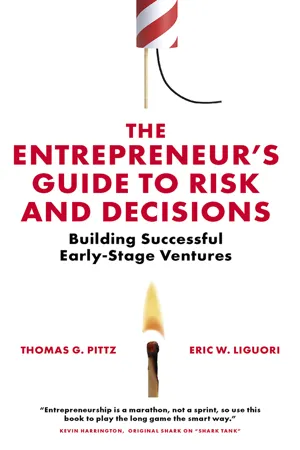
Following lean startup logic, The Entrepreneur's Guide to Risk and Decisions: Building Successful Early-Stage Ventures cuts through to the strategically important – and emotionally charged – decisions that separate the successful entrepreneurs from the unsuccessful. It is designed to help entrepreneurs move quickly, rapidly iterate their business models based on customer feedback, and provide guideposts for managing the risks inherent in all startup ventures.
eBook - ePub
The Entrepreneur’s Guide to Risk and Decisions
Building Successful Early-Stage Ventures
- 183 pages
- English
- ePUB (mobile friendly)
- Available on iOS & Android
eBook - ePub
The Entrepreneur’s Guide to Risk and Decisions
Building Successful Early-Stage Ventures
About this book
Becoming a successful entrepreneur is impossible without accepting risk – the question is which risk to take and at what time. Expert authors Thomas G. Pittz and Eric W. Liguori draw on years of working with and in early-stage ventures to provide guidance for managing the risk associated with these decisions. Throughout this book, they offer practical, no-nonsense advice for marketing and financing your business, bringing on partners and employees, networking with key connectors, and launching your business as inexpensively and aggressively as possible.
Information
1
PROCESS
1. IDEAS VERSUS EXECUTION
The power of ideas is a bit paradoxical when it comes to launching a business. On the one hand, it makes no sense to start a business without a good idea. Initiating a business startup without an idea rarely, if ever, generates successful companies. Beginning with an idea that you are passionate about is often what motivates entrepreneurs through the difficult times and keeps you from giving up too early. Furthermore, starting a business before arriving at a good idea tends to motivate a rush toward a business model which, unfortunately, usually results in plausible-sounding but derivative business concepts. However, the paradox of ideas is that without execution, ideas are worthless, but without ideas execution is futile.
And, in instances where the founder believes so much in the idea that he or she is unwilling to learn from customers or colleagues and is unable to pivot, then ideas are worth less than nothing. This sentiment about the power of ideas in launching a business is echoed by nearly everyone who has experienced entrepreneurship first-hand. Let us continue to speak plainly, your business ideas are not original. Perhaps you have never previously encountered anything like the brilliant concept rolling around in your head, but rest assured that someone else has thought of it and perhaps even tried to make a business out of it. The idea matters very little. What matters is execution.
To be brutally honest, ideas themselves are worth nothing. Great ideas can also cause entrepreneurs to become too secretive about their business models. If entrepreneurs guard their ideas too closely, they often miss out on opportunities to share them with someone who can help bring them to fruition. Even if your business idea sound like a cannot-miss concept to others (and, here’s a news flash, it likely won’t) those wouldbe idea thieves still must out-execute you and your team. Launching a startup company is perhaps one of the most difficult and all-consuming jobs a person could choose; most people will simply not have the guts and stamina for it. So, rather than steal your idea, most advisors will tell you that it has no future as a business (friends and family will, of course, likely tell you that it will be a smashing success). So, as opposed to jealously guarding ideas, it is far more important to develop a strong sense of self-belief and to share ideas to stimulate learning, growth, and create the space for organic and serendipitous opportunities.
There are many ways to generate business ideas and entire volumes have been written on the subject. You can look at the macro-environment for trends and technologies that are on the horizon and determine how to move into these areas or apply these concepts in other industries. You can focus on something that bothers you to find a solution that can become a business. You can find a way to make a product or service cheaper. You can look for gaps in customer demand in industries that are dominated by large players or an industry that has fallen behind the innovation curve. Whichever path you choose for generating your business idea, your success will be greater if you start with something that you know and, most importantly, that you concentrate on talking to potential customers to determine what their needs and interests are.
Whatever idea you choose, how well you execute on your business model is far and away the most important predictor of success in your new venture. Execution can be conceived of as comprising two parts: growth and optimization. Growth is the most important aspect of execution because it creates momentum: When your company is growing, people are happy and it feels like you are succeeding. When your company is growing, new roles and responsibilities are created and people feel like their careers are advancing and their investments are paying off. The opposite is true as well; when your company is not growing, it is demoralizing and causes rapid burnout.
As a result, the most critical aspect of successful execution is to maintain growth by making it your top priority. Identifying a growth metric that can be easily tracked and gamified will bring focus to the company’s momentum. After all, what the founder measures, the company does. Do not, however, fool yourself with vanity metrics. Vanity metrics are common mistakes that can derail momentum. For example, do not focus on press, conference presentations, and trade shows unless you plan to sell (and track sales) from your company there or focus on new customers without also looking at retention of existing customers. Set aggressive growth goals that are achievable and celebrate successes. Decipher what is blocking your growth and talk regularly about what could make your company grow faster. These conversations will create employee buy-in and stimulate new ideas for attracting customers.
It is quite common for a company that is growing like crazy to struggle to maintain efficient internal processes and create concern among the founders and employees about things coming unraveled. This concern is amplified when people start to question how the company can maintain its operations at a large scale out when you get there. However, there are many resources available to help optimize your business and investors seek out opportunities where growth is rapid and optimization is minimal. They see these companies as undervalued. So, while growth should always be the priority, best practice would dictate that some attention is focused on optimization of the business model. This is particularly true when considering customer service – do not focus too much on growth that it hinders your ability to provide consistently excellent customer service to existing consumers.
Focus on building products or services that consumers love – this is the way that all great companies have achieved growth. Do not fall prey to the splashy partnership or massive press launch as these rarely work in the long-run. Rather, attract consumers organically and continually ask where you can find more of them. Test numerous growth strategies including advertisements, guerilla marketing, traditional sales, social media, etc. Perhaps most importantly, do not be afraid to engage in sales yourself. At least one founder must become adept at asking people to use your product or service and asking people to give money.
A quick related word on competitors: most founders believe that if they fail it will be because they could not out-compete their competitors in the early stages of their business. This could not be further from the truth. In reality, most early-stage startups die from self-inflicted wounds as opposed to any retaliatory action by their competitors. When companies fail, it is nearly always because they did not find a solution to the problems of their customers. Frankly, entrepreneurs would be better off by simply ignoring competitors unless and until they are able to out-execute them with actual customer products or services. This is especially true when competitors make a big splash in the press or raise a lot of money as witnessing those events can be demoralizing and can distract from the fact that it is all about execution and meeting customer needs. No amount of press or money can shortcut that process.
Plus, without competition, entrepreneurship does not exist. It is the reason antitrust legislation has developed and why some policy-makers suggest that in industries where intellectual property plays an important role, enforcement should be more stringent. Young companies require a competitive marketplace to compete with established firms and we must remain diligent to ensure that economic and tax incentives do not favor big firms over small or old firms over new. We must also be careful of the scope and duration of non-compete agreements as our goal is to preserve entrepreneurial entry into the marketplace. The message to entrepreneurs is thus: do not play the victim when competitors enter your market or employees leave with trade secrets. Protect your company wherever you can, but, ultimately, your job is to outperform them.
2. BUSINESS PLANS VERSUS BUSINESS MODELS
The business model is intended to replace an elaborate business plan with a single page, easily digested, and easily updated picture of the company and its activities. Frankly speaking, business plans take too long to write, are seldom updated, and are often out of date by the time they are completed. A full business plan can be valuable for convincing friends and family to support your business endeavor and are still required by bankers for debt financing, but they too often distract from the primary foci of the early-stage venture: getting feedback from customers and adapting to new information. Business models, on the other hand, are intended to be simple and dynamic tools that can be adjusted and synchronized with changes to the business. If used correctly, they can also be a powerful tool for cogently and parsimoniously explaining your business to potential partners, employees, customers, and investors. It is useful to think of a business model as a drawing that shows all of the different parts of your company’s strategy and how they are related and interdependent. It demonstrates how the business makes money in a simple and straightforward design that is easy to describe to others.
A business model is a company’s plan for making a profit and mapping out how the business will create ongoing value for customers. That last part, called the value proposition, is the crux of the business model as it addresses what differentiates the product or service from competitors and the status quo solution to customer problems. A quick search on google will yield numerous definitions and articles describing the business model but all (at least the good ones) will focus on the customer value proposition. The profit model is the other critical aspect of the business model as it involves revenue streams and cost structures.
Over the years, business models have become more diversified and more sophisticated. Perhaps the most widely utilized conceptualization of the business model is Osterwalder and Pigneur’s (2010) “Business Model Canvas” that includes nine components that integrate to form the full business model. Each component represents an important building block in the construction of the overall business. It is a dynamic model that is intended to be routinely analyzed and updated to reflect the changes in the competitive landscape and macro-environmental forces. The Business Model Canvas includes:
- Value proposition – The unique value that a company’s product or service provides to customers.
- Customer segments – The customers targeted by the company’s product or service.
- Customer relationships – How the company builds relationships with its customers.
- Channels – The channels that a company uses to acquire, retain, and develop its customers.
- Revenue streams – The different areas of revenue generation and how the company generates continuous cash flow.
- Key partnerships – The strategic partnerships that the company forms to increase efficiencies and scalability of the business.
- Key resources – The assets and knowledge that the company possesses that allow it to provide distinct value to customers that other companies cannot.
- Key activities – The routine activities that the company engages in that enable it to execute its strategy and establish market presence.
- Cost structure – The costs associated with the business model and which components can be leveraged to reduce costs.
In our experience, a derivation of the business model canvas by Ash Maurya (2010), called the “Lean Canvas” is probably even more suitable for use by entrepreneurs of early-stage ventures. The Lean Canvas uses the same nine-component framework of the Business Model Canvas, reframed to be of use to the early-stage business. The new framework consists of:
- Problem – What is the customer’s problem that your business is trying to solve?
- Solution – What is the company’s solution or set of solutions to the customer problem?
- Unique value proposition – How and why the company is different from competitors and other solutions to the customer’s problem?
- Key metrics – The performance indicators that demonstrate how the business is performing.
- Unfair advantage – Something the company has that cannot be easily copied or purchased.
- Channels – The various paths that will be used to reach customers.
- Customer segments – The target market and alpha users.
- Cost structure – The costs associated with the business model and which components can be leveraged to reduce costs.
- Revenue streams – The different areas of revenue generation and how the company generates continuous cash flow.
Existing within the Business Model Canvas and Lean Canvas, there are numerous revenue models for entrepreneurs to consider. The “bait and hook” revenue model involves offering a basic product at a very low cost (the bait) and then charging substantial recurring amounts for refills or services (the hook). Examples of this model include razors and razor blades, printers and ink cartridges, and Adobe’s reader and writer. The “freemium” revenue model involves basic services are offered for free to entice users in premium services, which require an upgrade and a fee. In the “franchise” model, the franchisee uses another firm’s successful business model and leverages the corporate brand while the franchisor generates fee and royalty revenues from the franchisees. The “direct sales” model involves marketing directly to consumers through personal contact arrangements through demonstration or personal presentations. In “collective or shared” revenue models, businesses that come together to share information or resources. The “value-added reseller” is a revenue model in which a business makes something which is resold by other businesses with some modifications that add value to the original product or service. The “disintermediary” model involves sidestepping traditional middle men to reach customers directly, made famous by Dell, WebMD, and Warby Parker. The aforementioned are only some of the most popular business models and we encourage interested entrepreneurs to research additional ideas and information on the subject.
Savvy entrepreneurs will experiment with numerous business model varieties and even consider developing some of their own to test the underlying assumptions of their business and explore other ways of generating customer value. Frequent and successful business model innovation can increase a company’s resilience to changes in the competitive landscape, which can provide a competitive advantage. Also, be sure to match your marketing plan with your business model. For example, if you are offering a free product, it does not make sense to grow by buying users. Or, if you have a product or service with less than a $500 LTV, you should experiment with guerilla marketing techniques, social media, and other less-expensive marketing methods. Conversely, if your product or service brings more than $500 in LTV, then traditional sales methods may be the optimal approach. We will discuss LTV (lifetime customer value) in much more detail later in the book.
3. PROTOTYPING AND MVPS
The overarching goal of any entrepreneur in any industry should always be rapid response to customer feedback. That is why prototyping a business idea is an integral part of a lean startup approach and is widely used in design thinking. It allows an entrepreneur to test ideas with customers quickly and improve upon those ideas based on feedback. It allows ideas that should not see the light of day to be shut down quickly, while allowing ideas that have appeal to customers to continue to improve. Prototyping is as important for small business owners as it is for founders of startup companies as well, for example, should a restaurant add a new m...
Table of contents
- Cover
- Title
- Copyright
- Contents
- Prologue
- Foreword
- 1. Process
- 2. People
- 3. Networks
- 4. Sales & Marketing
- 5. Financing
- 6. Nuts & Bolts
- References
- Index
Trusted by 375,005 students
Access to over 1.5 million titles for a fair monthly price.
Study more efficiently using our study tools.
Frequently asked questions
Yes, you can cancel anytime from the Subscription tab in your account settings on the Perlego website. Your subscription will stay active until the end of your current billing period. Learn how to cancel your subscription
No, books cannot be downloaded as external files, such as PDFs, for use outside of Perlego. However, you can download books within the Perlego app for offline reading on mobile or tablet. Learn how to download books offline
Perlego offers two plans: Essential and Complete
- Essential is ideal for learners and professionals who enjoy exploring a wide range of subjects. Access the Essential Library with 800,000+ trusted titles and best-sellers across business, personal growth, and the humanities. Includes unlimited reading time and Standard Read Aloud voice.
- Complete: Perfect for advanced learners and researchers needing full, unrestricted access. Unlock 1.5M+ books across hundreds of subjects, including academic and specialized titles. The Complete Plan also includes advanced features like Premium Read Aloud and Research Assistant.
We are an online textbook subscription service, where you can get access to an entire online library for less than the price of a single book per month. With over 1.5 million books across 990+ topics, we’ve got you covered! Learn about our mission
Look out for the read-aloud symbol on your next book to see if you can listen to it. The read-aloud tool reads text aloud for you, highlighting the text as it is being read. You can pause it, speed it up and slow it down. Learn more about Read Aloud
Yes! You can use the Perlego app on both iOS and Android devices to read anytime, anywhere — even offline. Perfect for commutes or when you’re on the go.
Please note we cannot support devices running on iOS 13 and Android 7 or earlier. Learn more about using the app
Please note we cannot support devices running on iOS 13 and Android 7 or earlier. Learn more about using the app
Yes, you can access The Entrepreneur’s Guide to Risk and Decisions by Thomas G. Pittz,Eric W. Liguori in PDF and/or ePUB format, as well as other popular books in Business & Business General. We have over 1.5 million books available in our catalogue for you to explore.