![]()
PART ONE
HOW BELIEF, SYSTEMATIC ORGANISATION, LEADERSHIP AND MANAGEMENT ALL FIT TOGETHER
![]()
CHAPTER 1
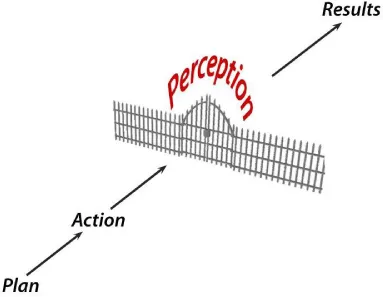
PERCEPTION IS THE GATEKEEPER TO RESULTS
Some people arrive at work each day to robotically spend their day. That may be perfectly acceptable in some types of job. For example, on some factory production lines or in shipping departments the worker repeats a sequence of simple tasks so many times they hardly need to think about their work. This diminishes as computer controlled automation takes over and makes that type of work redundant.
In the future, we can expect many more roles to convert from requiring human effort to being automated and controlled by computer. So, it is almost certain that your people must use their minds at least as much as their brawn. Their freethinking complicates matters for you, the leader.
As they think about you, their work and their teammates, they continuously form perceptions about the work ahead. One of the things they consider, consciously or subconsciously, is the likelihood of forthcoming success or failure. And, of course, you do the same. Let us assess these thoughts and rate your chances for success.
CONSIDER YOUR CURRENT GOALS AT WORK
First, write a list that names each of your current goals2. Do that now…
For each item on your list, now rate your team’s likelihood of success. For each goal, choose the most appropriate answer from the list of nine alternatives below. Write the answer against each item as a number from 1 to 9.
For example, if one goal was to ‘Move office’ and you felt certain you would achieve this perfectly by the required date, you would rate that goal ‘9’ and enter the score ‘9’ on your list next to the goal.
Here are the nine alternative answers.
1. I wish I could answer but I am not even sure what my team should achieve.
2. I am not certain how to answer because there is no way that I can know what the likelihood of success really is. We will just have to do our best and see how things pan out.
3. I am confident in the ability of my team and myself, but I know enough about my job to say that some of our current goals are unrealistic and unattainable.
4. I really would like to feel more confident, but the reality is that I am not sure it is possible to achieve our goals.
5. It is possible but it is going to be a struggle.
6. We should succeed in some areas but may well miss other goals.
7. We have an even-odds likelihood of success.
8. There is a very good chance, but it is not a foregone conclusion.
9. I am certain we will achieve our goals on time, to the desired quality, with the available resources (on time, on quality, on budget).
Rate your goals now…
Now you have a list of goals, each with a 1 to 9 score. The higher the score the better. Next, switch viewpoint and look from the perspective of your team members. Endeavour to see the work ahead as they would.
CONSIDER TEAM MEMBERS’ PERCEPTIONS
Consider each of your key people, one at a time. In your mind, set them free to speak from the heart and tell you straight. Theoretically at this point, which of the nine previous options would each person select to describe your team’s likelihood of forthcoming success?
This exercise is well worth the time and thought. List your key people and note down the answer you would expect from each person…
It matters very much how each of your team members would answer. Their views offer an important guide to whether you and your team are heading towards forthcoming success or failure. That is because your team’s belief in success or failure has a direct and substantial effect upon their effort, their performance and therefore your results.
If your people do not believe they can do something, they will either deliver a sub-standard performance or more likely fail altogether. Likewise, if you do not think you can do something, you will probably fail. This is because perception is the gatekeeper to results.
When you give people a new job to complete, or a deadline to meet, they at once start thinking ahead. They assess how the work will mesh with their existing workload. They ponder their ability to do the work. We all do this, but in varying degrees of detail and with varying levels of ability to accurately assess the situation.
• Do we possess the necessary skills and resources?
• Will we find the work easy or tough?
• What hurdles will be in our way?
• Will we need to rely upon other people?
• Might they let us down?
• Is it possible we shall fail?
We temper any natural enthusiasm (or pessimism) as we consider the reality of the challenge ahead. We ponder any obvious risks and speculate upon the potential for unforeseen problems to arise. Then, having weighed up those factors, we form a judgment about the probability of success or failure.
Many people do not follow the above thought processes as systematically. Many will jump to an immediate decision based upon gut feeling. Whichever way we go about it, we soon form an opinion that falls somewhere between the two extremes of ‘We can easily do this’ and ‘This is impossible.’
Whichever way people think, be it considered, reasoned or intuitive, informed or uninformed, prejudiced or open-minded, off-the-wall or wise, everyone in your team has an opinion. Be assured, their perceptions significantly affect your chances of success as a leader.
THE INFLUENCE OF BELIEF UPON SUCCESS
The arena in which people’s belief in success or failure is most openly displayed is professional sport. For example, listen to the interview of a winning Olympic athlete. He or she often reveals how belief played an essential part in their success.3
For example, after winning Wimbledon for a record eighth time in 2017, the tennis player Roger Federer said that, ‘It’s just belief you know…if you believe you can go really far in your life. I believed, and I did it.’
On the other hand, when the interviewer moves on to speak with the loser, you will often detect language that betrays a lack of belief. They say something like, ‘I did my best but I knew it was going to be difficult,’ or even ‘I’m not yet ready for this level of competition.’
At work, the power of belief is not so openly on display but the impact is just the same. You will have experienced how your own belief has influenced your results for good or ill. Of course, it is the same for everyone in your team.
Federico Fellini, the Italian film producer, was familiar with leading large and expensive projects. He said, ‘Our minds shape the way a thing will be, because we act according to our expectations.’ Henry Ford, the founder of Ford Motor Company in 1901, put it this way, ‘Whether you think you can or cannot, you are probably right.’ Perceptions exert a powerful controlling influence over your people’s quality of effort, levels of energy, degree of creative thinking and more.
Thus, many leaders who understand the importance of a positive attitude will insist the solution is for everyone to talk only of success. Positive affirmations become part of the team’s everyday language: ‘We have a can-do attitude. There is no such thing as problems. We overcome all challenges. We are the best.’ And so on. Expressing these positives does lift the mood. But is this reality? Can belief alone achieve all? Surely, some things must genuinely be impossible, or is positivity all powerful?
The rise of positive thinking in western society owes much to one minister in the Reformed Church of America. He moved to Manhattan, New York, in 1932. Next door to his new church was a psychiatric outpatient clinic. The minister and his psychoanalyst neighbour became friends. They worked together helping people who had mentally hit rock-bottom as they tried to cope with life. The minister, Norman Vincent Peale, observed how adopting a continually positive approach would enable people to turn around their physical and mental health, help them out of the abyss, and often improve their fortunes.
After 20 years of experience he wrote a seminal book: The Power of Positive Thinking.4 That book spawned an entire self-help industry that continues today, with millions of books sold each year and thousands of so-called self-help gurus selling their services. Peale’s book came before sixty years of serious psychological research and recent scientific investigation of the human brain.
Magnetic Resonance Imaging (MRI) scanners enable scientists to picture brain activity as a person responds to repeated positive thought patterns. Over time, these repeated patterns alter the pathways and physical construction of the brain.5 We now understand much more about how our minds respond to positive thoughts and thereby influence our actions and so our outcomes. And, interestingly, the result of all that scientific study confirms what Peale wrote back in 1952. It works like this…
When we repeatedly direct our feelings, words, vision, emotions and actions we create physical changes in our brains. We must act upon several fronts. First, we identify which of our current beliefs align with our goals. Those beliefs form the foundations upon which we construct our desired new beliefs.
Secondly, we proactively direct our thoughts to see in our mind’s eye the achievement of our goals. We involve our self-talk and our emotions. Some people say they experience an internal movie with positive dialogue, live action, vivid colour and emotional power. They see, hear, feel and even smell their imagined forthcoming success. They repeat this visualisation many times until they firmly believe they will achieve their goals.
Inevitably, our beliefs exert a very strong influence over how we act, and how muc...