![]()
PART ONE
INNOVATION FOR TOMORROW
1.1
INNOVATION, INTENTION AND ARTIFICIAL INTELLIGENCE
Karren Whitely-Brooks Whitespace
While many of the chapters in this edition deal with specific details about Intellectual Property and the financial and tax implications of funding and protecting inventors, this opening chapter will deal with the more fundamental questions of the innovative process. The questions discussed will include, why a business should innovate? And how to make wise choices using the latest technological advances in artificial intelligence?
WHY INNOVATE? WHAT DOES IT REALLY MEAN?
If you take as a given that innovation is necessary for any business, and indeed society, to advance and flourish; then you may be reading this book to find an edge in your quest to improve your company. If however, you are an inventor, then you may not have the requisite mindset to be an innovator. Common wisdom would argue that if one can invent something then, surely, one is automatically, an innovator. The confusion begins when one reviews the popular definitions for the noun, innovation. Merriam-Webster Dictionary offers these definitions: 1. The introduction of something new. And goes on to state in its second most common definition: 2. A new method, idea or device.
When one explores other knowledge sources such as Wikipedia, they begin with the same definition for innovation as “something new” but go on to expand the idea by stating, “innovation takes place through the provision of more-effective products, processes... that are made available to markets, governments and society”. If however, the inventor, who builds a better mousetrap, does not require a-brand new-mousetrap and the inventor is able to commercialise and positively affect society with his mousetrap, then that inventor is truly an innovator. Innovations are thus, incremental improvements which satisfy our clients’ needs and demands rather than just something new or different.
The futurist and author, Jacob Morgan gives a more easily understood example, which is important if you and your company want to innovate. He asks, “Is Google Glass an invention or an innovation?”, and offers in contrast, “Is the Apple iPhone an innovation or an invention?”. This is not just a discussion of semantics but goes to the core of the dilemma. If the invention of Google Glass, while novel and definitionally appearing to be an innovation, remains an oddity with little commercial acceptance or demand; then the invention of Google Glass, he argues, is not an innovation. The iPhone, Morgan states, is “both new and has had a profound influence in the way we communicate, store and access data” which makes it truly an innovation. It is as Wikipedia offers, “the more-effective” inventions which result in an innovation and the inventor and his company, to be classified as an innovator.
At a recent social gathering, I was asked, “what are you working on?” and I replied,” we are helping a business foment innovation.” My friend immediately asked, “what have they invented?” My reply was, “they have invented a new intention, and indeed, a new mindset.” I wasn’t being glib or enigmatic but have found that the stated intention to innovate, which includes the goal of delivering something new or at least better and the mindset to commercialise the output of their work, are the two basic requisites for any company to be considered, truly innovative.
‘INTENTIONS HAVE NO INTELLIGENCE’
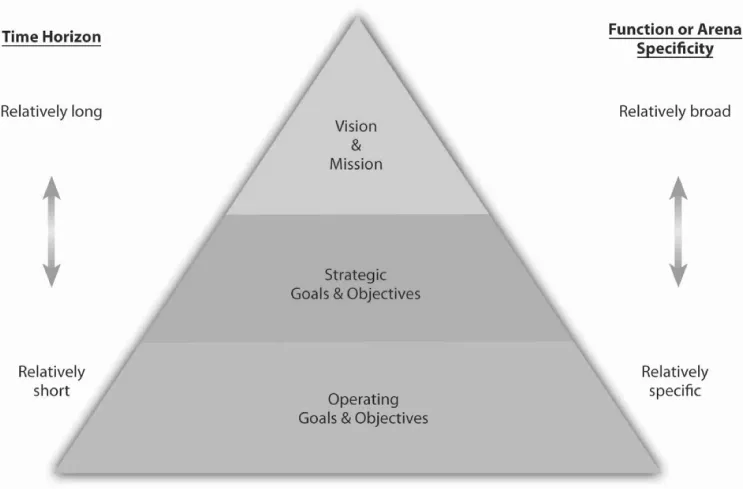
Unfortunately, the word new and the promise of innovation have become ubiquitous in our lives, as any visit to the supermarket will attest. It is obvious in every aisle of our shopping that new and improved can apply to everything from apples to zucchinis. All too often, leaders of business have a mindset which says, ‘innovation is just some business school hype or marketing speak.’ The scepticism surrounding innovation is that it has little relevance to the day-to-day operation of the company. We strongly suggest the company “vision” or “mission statement” which is necessarily a broad generalisation to be delivered over a long period, should include the intelligent intention to innovate. The company’s long view must be accompanied by the short-term deliverable projects, which will become commercially viable and make a difference to our clients and shareholders.
The following diagram demonstrates how the importance of long and short-term goals relate to a company’s ability to innovate. We would argue that in all three areas of Mission, Strategic Goals and Operating Objectives there must be a stated and determined intention to innovate; not lip service, but a firm and communicated intention; not just a hope but an intelligent intention.
The requirement for specific and short-term projects to produce commercial success is the test, which will prove whether the new product or process is truly innovative.
Figure 1.1.1 – Time horizons for short and long term goals
Ever since Peter Drucker argued in the Harvard Business review in 1996 that “Innovation is the specific function of entrepreneurship”, business consultancies have been attempting to assist companies to change their mindset. Drucker’s premise instructs companies to promote “wealth producing resources” as a fundamental goal for their employees. As the twenty-first century continues to make great advances in Artificial Intelligence, it appears that business leaders may now be hoping that technology will provide these much sought after resources and innovations.
WILL ARTIFICIAL INTELLIGENCE ASSIST INNOVATION?
Arvind Krishna, Director of IBM Research says, “Faced with a constant onslaught of data, we needed a new type of system that learns and adapts and we now have that with AI”. Krishna further states, regarding the use of AI in business innovation, “What was deemed impossible a few years ago is not only becoming possible, it’s very quickly becoming necessary and expected”.
In just the last decade AI has exploded because of the combination of big data with powerful graphics processing units (GPUs), which has benefited from employing the well-known model of Deep Learning. We all remember the stories of Deep Blue which was programmed by the forefathers of IBM Research back in the 20th century and which culminated in a competition with the Russian Chess Master, Gary Kasparov in 1996. It was IBM’s Deep Learning which allowed the computer to analyse the millions of chess moves and which revealed Artificial Intelligence as one of the most important technologies to be developed in the 21st century.
It is this Deep Learning popularised by Deep Blue, which will be educated by Deep Reasoning in order to create a new technology, enabling machines to conduct unsupervised learning. It is the human brain function of unsupervised learning, which continues to baffle the technologists. IBM Research is attempting to make machines curious and to seek answers. These machines will indeed produce new questions, as they learn from each other, but this is proving far more difficult than the much discussed language and image recognition applications.
The emotional side of facial recognition, for example, and the reasoning which humans develop from a young age, is much more difficult for Deep Learning to grasp. Computer scientists are working with neuroscientists and psychiatrists to help the advanced computer facial recognition of emotional indications. Dr. Fei Fei, Professor of Computer Science at Stanford University, says AI image recognition, struggles to identify and interpret emotions; the computer’s cognition is similar to the human condition classified as Alexithymia. This is a condition which inhibits some humans from both expressing and recognising emotions, often accompanying Autism and other psychological disorders. IBM research, however, has made great strides in image recognition which is helping identify and diagnose a variety of illness and pathologies.
One example of AI image recognition is the computer application which assists the clinician in recognising melanoma lesions on human skin. While a clinician may be confident in recognising a certain type of lesion within a predominant racial skin colour, they dramatically increase their diagnostic ability with the AI database. The computer is able to compare, select and identify from a much greater range of images and skin tones and alert the doctor to possible areas of concern from patients they are not accustomed to treating. The use of AI in pathological recognition and diagnosis meets the societal impact criteria for innovation.
ARTIFICIAL INTELLIGENCE AND DECISIONS
Hollywood and science fiction authors may sensationalise the possibilities for unethical or humanity-threatening decisions from Artificial Intelligence; however, most computer scientists find this dystopic vision to be less than probable. The fascination with the human brain and the sensory inputs which we take for granted, underlines the complexity and difficulty in using Artificial Intelligence to actually reason. The intersection of Deep Learning with Deep Reasoning will produce innovative products and help business leaders make better and more informed decisions.
Aya Soffer, IBM Director of AI and Cognitive Analytics Research, says “computers don’t have common sense”. Humans grow up “understanding gravity” and inertia and the physical properties which allow us to function. A simple example of “objects staying where they are put”, or moving, if influenced by wind or vibration or gravity is extremely complex for AI to comprehend on the mathematical level. It is the human, common sense, which is a mysterious combination of learned and inherent genetic wisdom, which is difficult for the computer models to simulate and understand.
Our life experience may however, make common sense decisions difficult. One popular test of common sense, which is easily passed by 4 and 5 year olds, is almost always failed by adult participants. It starts with the simple question of, “How do you put a Giraffe in a refrigerator?”. Most adults struggle, consider size and cutting up pieces etc. while the child answers “You open the door and put in the Giraffe and close the door”. The test continues with, “How do you put an Elephant in the refrigerator?” adults again, consider size and possibilities, animal cruelty and many permutations, while children, who learn and remember with greater focus on short term memory, answer correctly: “You open the refrigerator and take out the Giraffe and put in the Elephant”. While humorous, the quiz does illustrate how complicated and layered our decision-making process can become after years of apparently logical conclusions.
If the confluence of Deep Reasoning with Deep Learning can assist the innovator with decision making, then it stands to reason that more useful inv...