![]()
Chapter 1: Miss Frances Dove and the High Wycombe Suffragists
‘I see myself as a girl, skating with my father and brothers on the Serpentine, riding on the tops of omnibuses, rowing on the water in the Regents Park... I was merely doing what my younger brothers did... I was looked upon as a very extraordinary and exceptional specimen of girlhood... Again, I see myself as one of the earliest students at Girton College..., but at home I was virtually boycotted by all the young people of the neighbourhood... This prejudice has now entirely melted away.’
- Free Press, 20th March, 1908.
MISS Dove recounted these memories at one of the most significant public meetings in her long career. The nature of the evening itself marked an important development in the campaign for votes for women in Buckinghamshire. Instead of holding ‘drawing rooms’ in people’s houses as in previous years, this was the first meeting in the Town Hall and marked the launch of a new local suffrage society, affiliated initially to the Central Society for Women’s Suffrage. Having established Wycombe Abbey School in the preceding decade, Miss Dove was on the threshold of a wider, political role, having been elected to Wycombe Council just a few months previously. At this historic meeting, Miss Dove was responding to the speeches of Lady Knightley and Mrs Fawcett, leaders of the NUWSS, who were visiting Wycombe on that day to support the local campaign. To have received the public endorsement of the electors of Wycombe, followed a few months afterwards by the visit of these national figureheads of the constitutional campaign for votes for women, must have made Miss Dove feel that real progress was being made, and that some of the fruits of the women’s emancipation movement were being realised in her own life.
The remarkable 1907 survey which Miss Dove conducted into the lives of the ex-pupils of Wycombe Abbey School, must have reinforced the feeling of progress in the advancement and achievements of women. From among the 800 replies she received from her postal survey, Miss Dove identified the following professions: ‘several Doctors, a Head and many Assistant Headmistresses, Members of Education Committees, Authoresses, Hospital Nurses, Missionaries, the Principal of a Church Missionary Society Training Home, Housekeepers, Photographers, Gardeners, Charity Organisation Society Secretaries, Actresses, Journalists, Sculptors, Public Singers, Artists in Stained Glass, Librarians, HM Inspectors of Schools, Inspectors of Boarded-out Children, Technical Teachers, Sisters, Superintendents of Inquiries of Investigation, A Solicitor’s Clerk, a Portrait Painter and a teacher of Jiu-Jitsu’.1 Miss Dove was later to declare, when she chaired another exciting meeting at the Town Hall in 1909, that, ‘she did not think a hard and fast line could be drawn between men’s and women’s work’.2
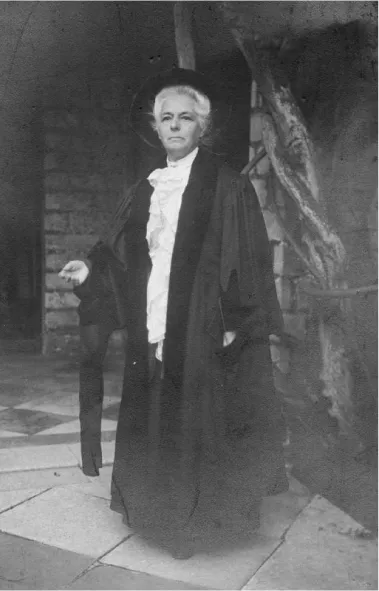
Miss Dove in her formal councillor’s garb, c. 1909. Courtesy of Wycombe Abbey School
However, Miss Dove’s earlier triumphant declaration of the ‘melting away’ of prejudice was shortly to be proved to be premature, as were any confident predictions of the imminent success of the women’s suffrage movement. One of the lowest moments in Miss Dove’s experience occurred in this same period, not long before her retirement as Headteacher of Abbey School in 1910. In November 1908 Miss Dove had been prevented, by the margin of just two votes, from being hailed as one of two of Britain’s first female town mayors. Less than five years after this personal snub, Miss Dove was being chased through the streets of High Wycombe by an angry mob. A few months after this debacle, this indomitable woman failed to be re-elected as a local councillor by a wide margin
Nevertheless, by Miss Dove’s own admission, she was often pleasantly surprised at the progress that was being made, in both the suffrage campaign and also more widely. The number and diversity of this list of occupations of the ex-pupils of Wycombe Abbey School serves as a vivid reminder of changing attitudes to women during Miss Dove’s own lifetime. To begin with, there was no established system of schools for girls when Miss Dove was born. Nor were women allowed to work in a whole range of professions. Miss Dove’s early life was lived in a very different era to the one she found herself in when she was elected to the Town Council of High Wycombe, just sixty years later.
Born in 1847, while her parents were on a tour of Europe, Frances Dove was the first of ten children in a relatively progressive family.3 Her father was the Rev. John Thomas Dove. As curate of Rev. Llewelyn Davies of Christ Church, Marylebone, John was exposed early to the debate on women’s education, being introduced to the vicar’s sister, Emily Davies. Miss Davies was one of the most prominent figures in the growing campaign to widen educational opportunities for girls and went on to found Girton College, Cambridge in 1869.4
The history of her own education and training was outlined by Miss Dove in November 1904, at the presentation of a painting of her for display in the school library. Speaking in the third person about her experience, she said,
She was born before the end of the first half of the century, when women’s education was at its very lowest ebb. At that time there was a home for governesses in Harley Street and Frederick Denison Maurice was a Professor at Kings College. Professor Maurice became interested in the struggles of governesses to obtain teaching for themselves, and as a result Queen’s College was founded in 1848... She became a student at Queen’s College in 1860... In 1871 she entered as a student at Girton College, lately founded by Miss Emily Davies... In 1877 she became a member of Miss Lumsden’s staff at St Leonard’s School, St Andrews and in 1882 was honoured by the Council by being asked to become its Headmistress.’5
Miss Dove was one of the first two women to sit for the Natural Sciences Tripos at Cambridge, which she passed in 1875. It was not until 30 years later that she was able to receive the degree, granted by Trinity College, Dublin, which had also been upgraded to an MA, in recognition of her subsequent achievements. In the summer of 1905, Miss Dove was one of over 700 ‘Steamboat Ladies’ who crossed the Irish Sea between 1904 and 1907, in order to be awarded quasi ad eundum degrees at Trinity, because Oxford and Cambridge were still refusing to award degrees to women.6
Throughout her life, Miss Dove was passionately determined to see girls enjoying the same opportunities for education as boys. It was this which led Miss Dove to tender her resignation as Headmistress of St Leonards School, in 1895. She had identified a new challenge of establishing a new school in England, which she perceived as ‘a great venture of faith’.7 Miss Dove’s uncompromising aim was enshrined in the Abbey School’s original prospectus. This ambitiously stated, for example, that, ‘The School is intended to provide for girls an education which, while moderate in cost and especially adapted to their requirements, shall be as complete on all its sides as that given to boys at the great Public Schools’.8
Miss Dove’s desire to see equality between the sexes extended to her advocating a whole range of sporting activities, even those usually seen as a male preserve, like cricket. This unusually advanced attitude to female sporting prowess, found its ultimate expression in the chapter Miss Dove wrote for a book on the subject of ‘The Cultivation of the Body’.9
Miss Dove arrived in High Wycombe in 1896, the year before the formation of the biggest suffrage society, the NUWSS. The year prior to her coming to the town, two pioneering women’s football teams then touring the country, played at Loakes Park, High Wycombe.10 And the year following Miss Dove’s arrival marked the first public vote in support of women’s suffrage, by the Liberal Association within the county.
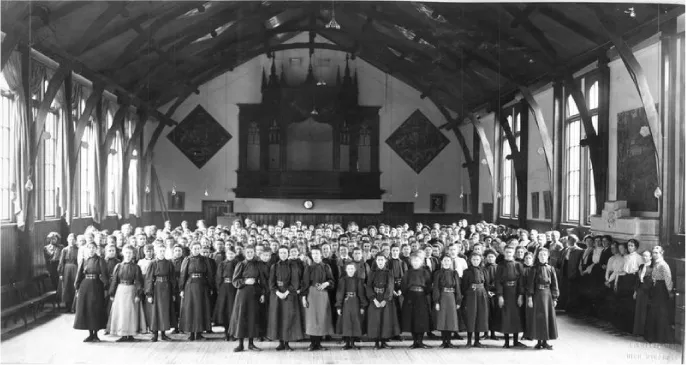
Wycombe Abbey School pupils and staff, Christmas 1902. Courtesy of Wycombe Abbey School
However, at this stage, Miss Dove clearly had other things on her mind. Losing no time in securing the funding and identifying the site for her future school for girls...