Pocket Guide to Physical Assessment
eBook - ePub

Pocket Guide to Physical Assessment

  1. English
  2. ePUB (mobile friendly)
  3. Available on iOS & Android
eBook - ePub

Pocket Guide to Physical Assessment

About this book

A concise, quick-reference handbook on history taking and physical examination

Pocket Guide to Physical AssessmentĀ is a compact yet comprehensive reference for students and practitioners alike, employing a step-by-step framework for effective patient assessment, diagnosis and planning of care.

This valuable guide covers topics including cardiovascular, respiratory, neurological and musculoskeletal system examinations, patient interviews, history taking and general health assessments. Clear diagrams and checklists illustrate key points, while easy-to-follow instructions and concise descriptions of clinical situations and diseases aid in clinical decision-making.

  • Compact, pocket-sized guide that contains only the essential information for physical assessment
  • Instructs readers on best clinical practice and how to present and communicate cases
  • Develops and improves necessary skills for physical clinical examinations
  • Ideal for use on the ward or as a companion to the accompanying textbook,Ā Physical Assessment for Nurses and Healthcare Professionals

Pocket Guide to Physical AssessmentĀ is an invaluable reference for healthcare students, newly qualified and advanced nurse practitioners, and allied health practitioners.
Frequently asked questions

Yes, you can cancel anytime from the Subscription tab in your account settings on the Perlego website. Your subscription will stay active until the end of your current billing period. Learn how to cancel your subscription.
No, books cannot be downloaded as external files, such as PDFs, for use outside of Perlego. However, you can download books within the Perlego app for offline reading on mobile or tablet. Learn more here.
Perlego offers two plans: Essential and Complete
  • Essential is ideal for learners and professionals who enjoy exploring a wide range of subjects. Access the Essential Library with 800,000+ trusted titles and best-sellers across business, personal growth, and the humanities. Includes unlimited reading time and Standard Read Aloud voice.
  • Complete: Perfect for advanced learners and researchers needing full, unrestricted access. Unlock 1.4M+ books across hundreds of subjects, including academic and specialized titles. The Complete Plan also includes advanced features like Premium Read Aloud and Research Assistant.
Both plans are available with monthly, semester, or annual billing cycles.
We are an online textbook subscription service, where you can get access to an entire online library for less than the price of a single book per month. With over 1 million books across 1000+ topics, we’ve got you covered! Learn more here.
Look out for the read-aloud symbol on your next book to see if you can listen to it. The read-aloud tool reads text aloud for you, highlighting the text as it is being read. You can pause it, speed it up and slow it down. Learn more here.
Yes! You can use the Perlego app on both iOS or Android devices to read anytime, anywhere — even offline. Perfect for commutes or when you’re on the go.
Please note we cannot support devices running on iOS 13 and Android 7 or earlier. Learn more about using the app.
Yes, you can access Pocket Guide to Physical Assessment by Carol Lynn Cox in PDF and/or ePUB format, as well as other popular books in Medicine & Nursing. We have over one million books available in our catalogue for you to explore.

Information

Year
2019
Print ISBN
9781119108924
eBook ISBN
9781119108948
Edition
1
Subtopic
Nursing

1
Interviewing and History Taking

Carol Lynn Cox1,2
1 School of Health Sciences, City, University of London, London, UK
2 Health and Hope Clinics, Pensacola, FL, USA

1.1 General Procedures

1.1.1 Introduction

The patient's history is the major subjective source of data about their health status. It will give you insight into actual and potential problems as well as providing a guide for the physical examination. History taking involves obtaining the patient's chief complaint (quoted in the patient's words), a full review of systems from the patient's perspective, exploration of patient problems associated with the chief complaint, and other (frequently associated) problems that require addressing from the patient's perspective (Ball et al. 2014a, b; Barkauskas et al. 2002; Bickley and Szilagyi 2007, 2013; Cox 2010; Dains et al. 2012, 2015; Epstein et al. 2008; Japp and Robertson 2013; Jarvis 2008, 2015; Seidel et al. 2006, 2010; Swartz 2006; Talley and O'Connor 2006, 2014).
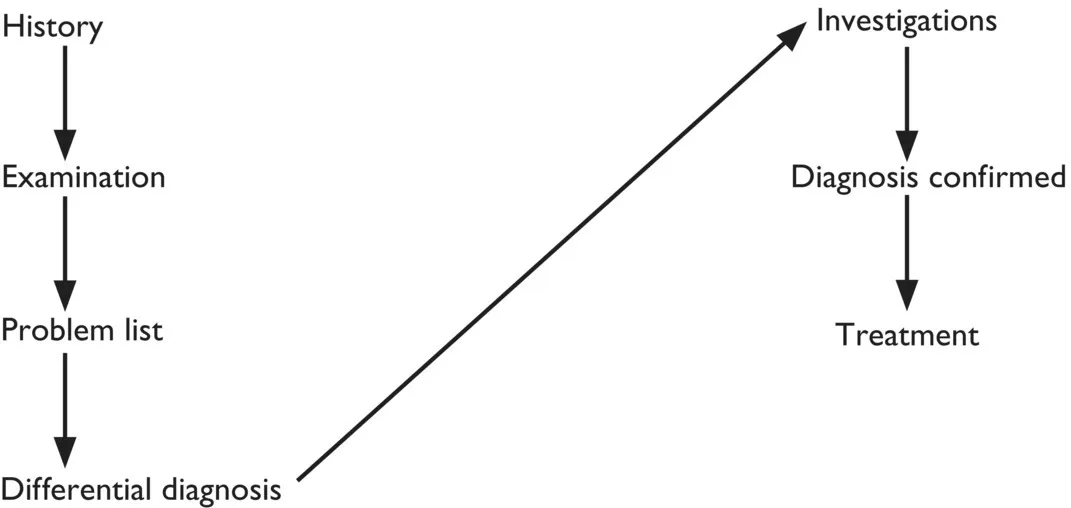
Schematic with arrows from history to examination, to problem list, to differential diagnosis, to investigations, to diagnosis confirmed, and to treatment.
Figure 1.1 Usual sequence of events.
Source: Cox 2010. Reproduced with permission from John Wiley and Sons.

1.1.2 Approaching the Patient

  • Put the patient at ease by being confident and quietly friendly (Hatton and Blackwood 2003; Jackson and Vessey 2010; Rudolf and Levene 2011; Sawyer 2012).
  • Greet the patient: ā€˜Good morning, Mr/Mrs Smith’. (Address the patient formally and use the full name until the patient has given you permission for less formal address.)
  • Shake the patient's hand or place your hand on theirs if the patient is ill. (This action begins your physical assessment. It will give you a baseline indication of the patient's physical condition. For example, cold, clammy, diaphoretic, or pyrexial.)
  • State your name and title/role.
  • Make sure the patient is comfortable.
  • Explain that you wish to ask the patient questions to find out what the patient perceives is the problem or has happened.
    Start the history taking by stating something like ā€˜I want to start by asking you some questions about your health’. (Always begin with general questions and then move to more specific questions (Cox 2010) Inform the patient how long you are likely to take and what to expect. For example, after discussing what has happened to the patient, explain that you would like to examine them.

1.1.3 Usual Sequence of Events (Figure 1.1)

1.1.3.1 Importance of the History

  • It identifies:
    • what the problem is or has happened
    • the personality of the patient
    • how the illness has affected the patient and family
    • any specific anxieties
    • the physical and social environment.
  • It establishes the practitioner–patient relationship.
  • It provides the foundation for your differential diagnoses.
  • It often gives the diagnosis.
  • Find the principal symptoms or symptom. Ask one of the following questions:
    • ā€˜How may I help you?’
    • ā€˜What has the problem been?’
    • ā€˜Tell me, why have you come to the surgery/clinic/hospital today?’ or ā€˜Tell me why you came to see me today?’
      Effective history taking involves allowing the patient to talk in an unstructured way whilst you maintain control of the interview. Use language that the patient can understand and avoid the use of medical jargon (Collins‐Bride and Saxe 2013; Cox 2010; Sawyer 2012; Tally and O'Connor 2014). Avoid asking questions that can be answered by a simple ā€˜yes’ or ā€˜no’. Ask questions that require a graded response. For example, ā€˜Describe how your headache feels’. Avoid using multiple‐choice questions that may confuse the patient (Cox 2010; Jackson and Vessey 2010). Ask one question at a time. Avoid asking questions like: ā€˜What's wrong?’ or ā€˜What brought you here?’ Use clarification to confirm your understanding of the patient's problem. Avoid forming premature conclusions about the patient's problem and above all remain nonjudgemental in your demeanour. Avoid making judgemental statements.
  • Let the patient tell their story in their own word...

Table of contents

  1. Cover
  2. Table of Contents
  3. List of Contributors
  4. Foreword
  5. Preface
  6. Acknowledgements
  7. 1 Interviewing and History Taking
  8. 2 General Health Assessment
  9. 3 Basic Examination, Notes, and Diagnostic Principles
  10. 4 Examination of the CardiovascularSystem
  11. 5 Examination of the Respiratory System
  12. 6 Examination of the Abdomen
  13. 7 Examination of the Male Genitalia
  14. 8 Examination of the Female Genitalia
  15. 9 Examination of the Nervous System
  16. 10 Examination of the Eye
  17. 11 Examination of the Musculoskeletal System
  18. 12 Presenting Cases and Communication
  19. Appendix A: Jaeger Reading Chart
  20. Appendix B: Visual Acuity 3 Meter/21 Foot Chart
  21. Appendix C: Hodkinson Ten‐Point Mental Test Score
  22. Appendix D: Barthel Index of Activities of Daily Living
  23. Appendix E: Mini‐Mental State Examination (MMSE)
  24. Appendix F: Glasgow Coma Scale
  25. Appendix G: Warning Signs of Alzheimer’s Disease
  26. Appendix H: Trigger Symptoms Indicative of Dementia
  27. Appendix I: The 12‐Lead Electrocardiogram
  28. Index
  29. End User License Agreement