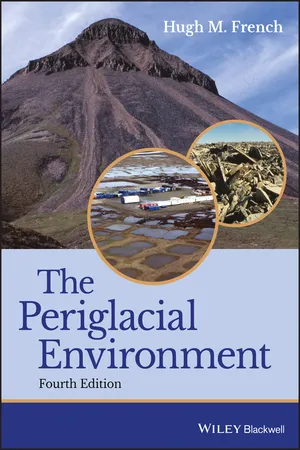
The Periglacial Environment, Fourth Edition, is an authoritative overview of the world's cold, non-glacial environments. First published in 1976 and subsequently revised in 1996 and 2007, the text has been the international standard for nearly 40 years.
The Fourth Edition continues to be a personal interpretation of the frost-induced conditions, geomorphic processes and landforms that characterize periglacial environments. Part One discusses the periglacial concept and describes the typical climates and ecosystems that are involved. Part Two describes the geocryology (permafrost science) associated with frozen ground. Part Three outlines the weathering and geomorphic processes associated with cold-climate conditions. Part Four provides insight into the periglacial environments of the Quaternary, especially the Late Pleistocene. Part Five describes some of the problems associated with human occupancy in regions that experience frozen ground and cold-climate conditions.
Extensively revised and updated
Written by an expert with over 50 years of field research
Draws upon the author's personal experience from Northern Canada, Alaska, Siberia, Tibet, Antarctica, Svalbard, Scandinavia, southern South America, Western Europe and eastern North America
This book is an invaluable reference for advanced undergraduates in geography, geology, earth sciences and environmental sciences programs, and to resource managers and geotechnical engineers interested in cold regions.
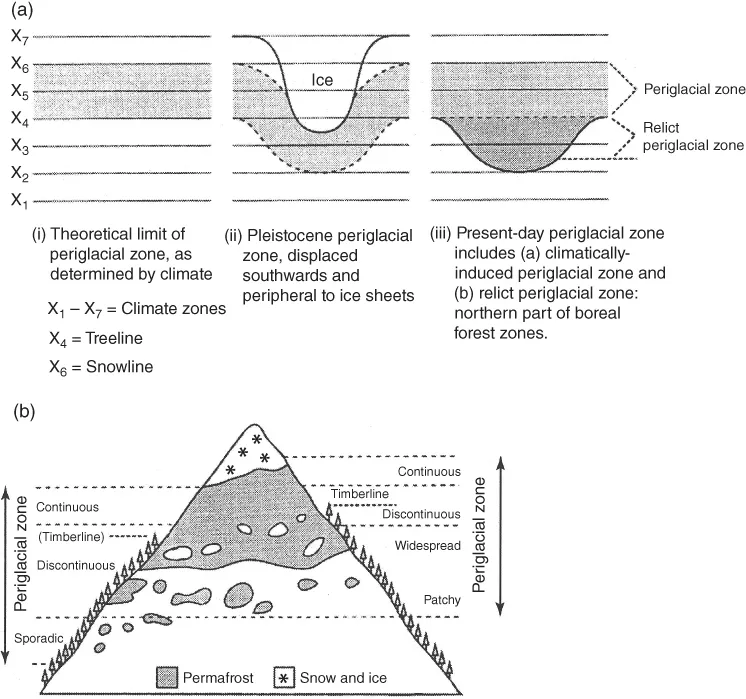
The term ‘periglacial’ was first used by a Polish geologist, Walery von Łozinski, when referring to the mechanical disintegration of sandstones in the Gorgany Range of the southern Carpathian Mountains, a region now part of central Roumania. Łozinski described the angular rock rubble surfaces that characterize the mountain summits as ‘periglacial facies’ formed by the previous action of intense frost (von Łozinski, 1909). Following the Xl Geological Congress in Stockholm in 1910 and the subsequent field excursion to Svalbard in 1911 (von Łozinski, 1912), the concept of a ‘periglacial zone’ was introduced to refer to the climatic and geomorphic conditions peripheral to Pleistocene ice sheets and glaciers. Theoretically, this was a tundra zone that extended as far south as the tree line. In the mountains, it was a zone between the timberline and the snow line (Figure 1.1).
Figure 1.1 Schematic diagram illustrating limits of the periglacial zone: (a) high latitudes; (b) alpine areas.
Almost certainly, Łozinski was influenced by a Swedish geologist, J.G. Andersson, who had summarized, a few years earlier, his observations on mass-wasting on Bear Island (latitude 74°N), a cold, wet and windy island in the northern North Atlantic (Andersson, 1906, pp. 94–97; 104–110). It was Andersson who introduced the term ‘solifluction’ to the scientific literature. He also described the ‘stone runs’, or quartzite blockfields, that characterize the gentle slopes of the equally cold and damp Falkland Islands, located in the South Atlantic. On hearsay alone, the latter phenomena had already been compared to the ‘rubble-drift’ and ‘head’ deposits of southern England by the English geologist James Geikie (1874, pp. 722–723) who attributed them to a ‘cold climate more severe than the present’.
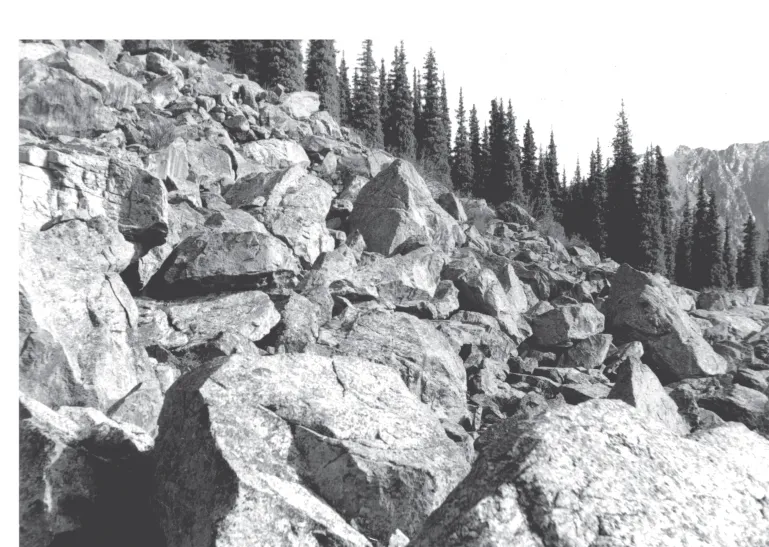
Łozinski referred to his rock-rubble accumulations as periglacial facies (Figure 1.2). In subsequent years, angular rock-rubble accumulations on upland slopes and summits were widely reported in the scientific literature. Today, they are usually referred to as ‘blockfields’ or ‘mountain-top detritus’ (see Table 15.1).
Figure 1.2 Typical ‘periglacial facies’ developed on granite in the Carpathian Mountains, southern Poland. Note that the periglacial facies described by Łozinski were in sandstone and further to the east in the Gorgany Range, now in Roumania. The photograph was supplied courtesy of Dr R. Zurawek. See also ‘mountain-top detritus’; Chapter 15.
Over a hundred years later, Łozinski's definition is regarded as unnecessarily restricting. Few, if any, modern analogs exist (French, 2000). There are two main reasons. First, frost-action phenomena are known to occur at great distances from both present-day and Pleistocene ice margins. In fact, frost-action phenomena can be completely unrelated to ice-marginal conditions. Second, although Łozinski used the term to refer primarily to areas rather than processes, the term has increasingly been understood to refer to a complex of cold-dominated geomorphic processes. These include not only frost-action and permafrost-related processes but also the range of azonal processes associated with snow, running water and wind. These demand neither a peripheral ice-marginal location nor excessive cold. Instead, they assume distinctive or extreme characteristics under cold, non-glacial conditions.
1.2 Diagnostic Criteria
Periglacial environments are relatively simple to define. They are characterized by intense frost and restricted to areas that experience cold, but essentially non-glacial, climates (French, 2007).
Two criteria are regarded as diagnostic. First, there is ground freezing and thawing. According to J. Tricart (1968, p. 830), '…the periglacial morphogenetic milieu is that where the influence of freeze-thaw oscillations is dominant'. Second, all periglacial environments experience either seasonally-frozen or perennially-frozen ground. The latter, if it persists for more than two years, is termed permafrost (Muller, 1943). According to T. L. Péwé (1969, p. 4), ‘…permafrost is the common denominator of the periglacial environment, and is practically ubiquitous in the active periglacial zone’.
Periglacial environments should not be confused with either proglacial or paraglacial environments, although both may be regarded as being periglacial in nature. Whereas ‘periglacial’ is essentially a function of process, ‘proglacial’ is a function of location and ‘paraglacial’ is a function of the degree and mode of recovery from a previous geomorphic system (Ballantyne, 2002; Slaymaker, 2009). It follows that periglacial and proglacial environments are largely adjusted to contemporary processes while paraglacial environments are explicitly transitional and transient in nature. Thus, periglacial landscapes that existed during the cold periods of the Quaternary in areas that no longer experience periglacial conditions are largely paraglacial in n...
Table of contents
Cover
Title Page
Copyright
Table of Contents
Preface to Fourth Edition
Preface to Third Edition
Preface to Second Edition
Preface to First Edition
Acknowledgments
Part I: The Periglacial Domain
Part II: Frozen Ground and Permafrost
Part III: Periglacial Geomorphology
Part IV: Pleistocene Periglacial Environments
Part V: Human Occupance and The Periglacial Environment
References
Index
End User License Agreement
Trusted by 375,005 students
Access to over 1.5 million titles for a fair monthly price.
Study more efficiently using our study tools.
Frequently asked questions
Yes, you can cancel anytime from the Subscription tab in your account settings on the Perlego website. Your subscription will stay active until the end of your current billing period. Learn how to cancel your subscription
No, books cannot be downloaded as external files, such as PDFs, for use outside of Perlego. However, you can download books within the Perlego app for offline reading on mobile or tablet. Learn how to download books offline
Perlego offers two plans: Essential and Complete
Essential is ideal for learners and professionals who enjoy exploring a wide range of subjects. Access the Essential Library with 800,000+ trusted titles and best-sellers across business, personal growth, and the humanities. Includes unlimited reading time and Standard Read Aloud voice.
Complete: Perfect for advanced learners and researchers needing full, unrestricted access. Unlock 1.5M+ books across hundreds of subjects, including academic and specialized titles. The Complete Plan also includes advanced features like Premium Read Aloud and Research Assistant.
Both plans are available with monthly, semester, or annual billing cycles.
We are an online textbook subscription service, where you can get access to an entire online library for less than the price of a single book per month. With over 1.5 million books across 990+ topics, we’ve got you covered! Learn about our mission
Look out for the read-aloud symbol on your next book to see if you can listen to it. The read-aloud tool reads text aloud for you, highlighting the text as it is being read. You can pause it, speed it up and slow it down. Learn more about Read Aloud
Yes! You can use the Perlego app on both iOS and Android devices to read anytime, anywhere — even offline. Perfect for commutes or when you’re on the go. Please note we cannot support devices running on iOS 13 and Android 7 or earlier. Learn more about using the app
Yes, you can access The Periglacial Environment by Hugh M. French in PDF and/or ePUB format, as well as other popular books in Physical Sciences & Geology & Earth Sciences. We have over 1.5 million books available in our catalogue for you to explore.