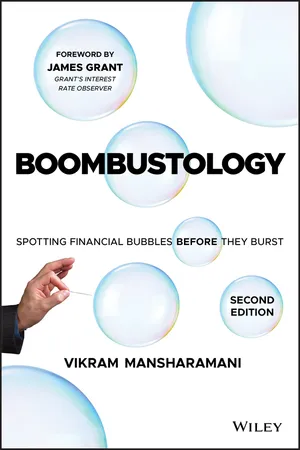
Boombustology
eBook - ePub

Boombustology

Spotting Financial Bubbles Before They Burst

  1. English
  2. ePUB (mobile friendly)
  3. Available on iOS & Android
eBook - ePub

Boombustology

Spotting Financial Bubbles Before They Burst

About this book

The new, fully-updated edition of the respected guide to understanding financial extremes, evaluating investment opportunities, and identifying future bubbles

Now in its second edition, Boombustology is an authoritative, up-to-date guide on the history of booms, busts, and financial cycles. Engaging and accessible, this popular book helps investors, policymakers, and analysts navigate the radical uncertainty that plagues today's uncertain investing and economic environment. Author Vikram Mansharamani, an experienced global equity investor and prominent Harvard University lecturer, presents his multi-disciplinary framework for identifying financial bubbles before they burst. Moving beyond the typical view of booms and busts as primarily economic occurrences, this innovative book offers a multidisciplinary approach that utilizes microeconomic, macroeconomic, psychological, political, and biological lenses to spot unsustainable dynamics. It gives the reader insights into the dynamics that cause soaring financial markets to crash. Cases studies range from the 17 th Century Dutch tulip mania to the more recent US housing collapse.

The numerous cross-currents driving today's markets—trade wars, inverted yield curves, currency wars, economic slowdowns, dangerous debt dynamics, populism, nationalism, as well as the general uncertainties in the global economy—demand that investors, policymakers, and analysts be on the lookout for a forthcoming recession, market correction, or worse.

An essential resource for anyone interested in financial markets, the second edition of Boombustology:

  • Adopts multiple lenses to understand the dynamics of booms, busts, bubbles, manias, crashes
  • Utilizes the common characteristics of past bubbles to assist in identifying future financial extremes
  • Presents a set of practical indicators that point to a financial bubble, enabling readers to gauge the likelihood of an unsustainable boom
  • Offers two new chapters that analyze the long-term prospects for Indian markets and the distortions being caused by the passive investing boom
  • Includes a new foreword by James Grant, legendary editor of Grant's Interest Rate Observer

A comprehensive exploration of how bubbles form and why they burst, Boombustology, 2 nd Edition is packed with a wealth of new and updated information for individual and institutional investors, academics, students, policymakers, risk-managers, and corporate managers alike.

Frequently asked questions

Yes, you can cancel anytime from the Subscription tab in your account settings on the Perlego website. Your subscription will stay active until the end of your current billing period. Learn how to cancel your subscription.
At the moment all of our mobile-responsive ePub books are available to download via the app. Most of our PDFs are also available to download and we're working on making the final remaining ones downloadable now. Learn more here.
Perlego offers two plans: Essential and Complete
  • Essential is ideal for learners and professionals who enjoy exploring a wide range of subjects. Access the Essential Library with 800,000+ trusted titles and best-sellers across business, personal growth, and the humanities. Includes unlimited reading time and Standard Read Aloud voice.
  • Complete: Perfect for advanced learners and researchers needing full, unrestricted access. Unlock 1.4M+ books across hundreds of subjects, including academic and specialized titles. The Complete Plan also includes advanced features like Premium Read Aloud and Research Assistant.
Both plans are available with monthly, semester, or annual billing cycles.
We are an online textbook subscription service, where you can get access to an entire online library for less than the price of a single book per month. With over 1 million books across 1000+ topics, we’ve got you covered! Learn more here.
Look out for the read-aloud symbol on your next book to see if you can listen to it. The read-aloud tool reads text aloud for you, highlighting the text as it is being read. You can pause it, speed it up and slow it down. Learn more here.
Yes! You can use the Perlego app on both iOS or Android devices to read anytime, anywhere — even offline. Perfect for commutes or when you’re on the go.
Please note we cannot support devices running on iOS 13 and Android 7 or earlier. Learn more about using the app.
Yes, you can access Boombustology by Vikram Mansharamani in PDF and/or ePUB format, as well as other popular books in Business & Finance. We have over one million books available in our catalogue for you to explore.

Information

Publisher
Wiley
Year
2019
Print ISBN
9781119575603
eBook ISBN
9781119575597
Edition
2
Subtopic
Finance

PART I
Five Lenses

Part I surveys five disciplines: microeconomics, macroeconomics, psychology, politics, and biology. Each discipline, or lens, is presented as a useful tool in deciphering the mysteries of bubbles before they burst. Specific topics emerging from these five lenses include equilibrium tendencies, reflexivity, credit dynamics, overconfidence, anchoring and adjustment, price mechanisms, property rights, epidemics, and emergence.

CHAPTER 1
Microeconomic Perspectives: TO EQUILIBRIUM OR NOT?

The most interesting, and profitable, times to be involved in investment management are when Mr. Smith's invisible hand is visibly broken.
—Paul A. McCulley
In this opening chapter, we begin our discussion of the various lenses that prove useful in the study of booms and busts by focusing upon a critically important and far-reaching element of traditional microeconomic theory: supply and demand–driven equilibrium. Two competing and seemingly contradictory theories are presented and discussed: the efficient market hypothesis and the theory of reflexivity.
There are many ways in which to illustrate the concept of equilibrium, but it is perhaps best analogized with a ball on a curved shape (see Figure 1.1). A situation in which equilibrium is possible is one in which over time, if left to its own devices, the ball will find one unique location. Overshooting or undershooting this spot is self-correcting. A situation of disequilibrium, however, is one in which the ball is unable to find a unique location. A ball in such a state does not generate self-correcting moves that dampen its moves toward a theoretical “equilibrium” or resting spot; rather, disequilibrium generates motion that is self-reinforcing and accelerates the ball's move away from any stable state.
A ball on a curved shape illustrating the concept of equilibrium.
Figure 1.1 Equilibrium in Pictures
The application of these concepts to the financial arena is very straightforward. The concept of a stable point is best analogized with a price or valuation level in the financial arena. The general idea behind price equilibrium stems from the powerful forces of supply and demand. Inherent in most equilibrium-oriented approaches is a belief that higher prices generate new supply that tends to push prices down. Likewise, it is believed that lower prices generate new demand that tends to push prices up. In this way, deviations from an appropriate price level are self-correcting.
We begin with the traditional economic lens that adopts an equilibrium-oriented view of the financial world. In addition to being based on intuitive supply (the higher the price, the more will be produced) and demand (the higher the price, the lower the demand) logic, the argument in favor of equilibrium is seductively simple. Following a discussion of the efficient market hypothesis and its implications for financial equilibrium, the chapter then turns to the theory of reflexivity. Developed by billionaire George Soros, the theory states that misperceptions about reality may become self-fulfilling, driving prices to ever-greater distances from any supposed stability point.
The careful reader will complete this chapter with the tools to consider financial developments as being equilibrium-oriented or not—which in and of itself should prove valuable in the study of and participation in financial markets. The chapter concludes with a plausible framework for combining the usefulness of both equilibrium and reflexivity lenses.

“Random Walks” and Accurate Prices: The Efficient Market Hypothesis

Adam Smith observed in 1776 that individual, selfish pursuits are able to achieve optimal group outcomes better than if individuals selflessly pursued what they each deemed best for the group. It was as if the self-interested individual is “led by an invisible hand to promote an end which was no part of his intention … [B]y pursuing his own interest, he frequently promotes that of society more effectually than when he really intends to promote it.”1
Economic thinking has been profoundly influenced by this early idea that selfish pursuits allocate scarce resources more efficiently than any individual might, despite the noblest of intentions. The laws of supply and demand drive the most efficient allocation of resources, and prices provide accurate signals for the increasing (or decreasing) of supply, with demand rising as prices fall or falling as prices rise.2 An analogous construct in finance is the efficient market hypothesis, a theory that posits prices of financial securities embody all known information and therefore only move randomly.
The early origins of the efficient market hypothesis can be traced back to George Rutledge Gibson, who in 1889 asserted that the prices of shares that were well known in an open market embodied “the judgment of the best intelligence concerning them.”3 The statement captures one of the two key building blocks upon which the efficient market hypothesis was built: that prices “contain” or “embody” all available public information. This assertion, which was later developed with greater rigor and precision in the twentieth century, was combined with early econometric work asserting that security prices move in a random manner. This latter claim, developed primarily by MIT economist Paul Samuelson and University of Chicago economist Eugene Fama, essentially stated that stock prices were not predictable based on their prior movements. The idea is often explained at its most basic by discussing the flipping of a coin. Each flip is independent, meaning it isn't influenced by the flips that came before it. No matter how many heads or tails have come up before, that result has no influence over whether heads or tails comes up on the next flip—even if you just had 100 flips that were all heads or all tails.
Fama and Samuelson—who were both building upon an unpublished dissertation by Louis Bachelier written in 1900, titled “The Theory of Speculation”—provided a compelling framework for understanding the behavior of stock prices through further conceptual development of the efficient market hypothesis.4 In particular, Fama extended, refined, and further developed the theory by articulating three forms of efficiency that exist in the financial markets: weak, semi-strong, and strong.
Before describing each of these three forms of efficiency in greater detail, it is useful to consider the market conditions (i.e. assumptions) on which the theories of efficiency are b...

Table of contents

  1. Cover
  2. Table of Contents
  3. Foreword
  4. PREFACE: Is There A Bubble In Boom-Bust Books?
  5. Acknowledgments
  6. INTRODUCTION: The Study of Financial Extremes
  7. PART I: Five Lenses
  8. PART II: Historical Case Studies
  9. PART III: Looking Ahead
  10. CONCLUSION: Hedgehogs, Foxes, and the Dangers of Making Predictions
  11. ADDENDUMA: Passive Investing Bubble?
  12. About the Author
  13. Index
  14. End User License Agreement