Neuroprotective Effects of Phytochemicals in Neurological Disorders
eBook - ePub

Neuroprotective Effects of Phytochemicals in Neurological Disorders

  1. English
  2. ePUB (mobile friendly)
  3. Available on iOS & Android
eBook - ePub

Neuroprotective Effects of Phytochemicals in Neurological Disorders

About this book

Phytochemicals are naturally occurring bioactive compounds found in edible fruits, plants, vegetables, and herbs. Unlike vitamins and minerals, phytochemicals are not needed for the maintenance of cell viability, but they play a vital role in protecting neural cells from inflammation and oxidative stress associated with normal aging and acute and chronic age-related brain diseases. Neuroprotective Effects of Phytochemicals in Neurological Disorders explores the advances in our understanding of the potential neuroprotective benefits that these naturally occurring chemicals contain.

Neuroprotective Effects of Phytochemicals in Neurological Disorders explores the role that a number of plant-based chemical compounds play in a wide variety of neurological disorders. Chapters explore the impact of phytochemicals on neurotraumatic disorders, such as stroke and spinal cord injury, alongside neurodegenerative diseases such as Alzheimer's and Parkinson's Disease, as well as neuropsychiatric disorders such as depression and schizophrenia. The chapters and sections of this book provide the reader with a big picture view of this field of research.

Neuroprotective Effects of Phytochemicals in Neurological Disorders aims to present readers with a comprehensive and cutting edge look at the effects of phytochemicals on the brain and neurological disorders in a manner useful to researchers, neuroscientists, clinical nutritionists, and physicians.

Frequently asked questions

Yes, you can cancel anytime from the Subscription tab in your account settings on the Perlego website. Your subscription will stay active until the end of your current billing period. Learn how to cancel your subscription.
No, books cannot be downloaded as external files, such as PDFs, for use outside of Perlego. However, you can download books within the Perlego app for offline reading on mobile or tablet. Learn more here.
Perlego offers two plans: Essential and Complete
  • Essential is ideal for learners and professionals who enjoy exploring a wide range of subjects. Access the Essential Library with 800,000+ trusted titles and best-sellers across business, personal growth, and the humanities. Includes unlimited reading time and Standard Read Aloud voice.
  • Complete: Perfect for advanced learners and researchers needing full, unrestricted access. Unlock 1.4M+ books across hundreds of subjects, including academic and specialized titles. The Complete Plan also includes advanced features like Premium Read Aloud and Research Assistant.
Both plans are available with monthly, semester, or annual billing cycles.
We are an online textbook subscription service, where you can get access to an entire online library for less than the price of a single book per month. With over 1 million books across 1000+ topics, we’ve got you covered! Learn more here.
Look out for the read-aloud symbol on your next book to see if you can listen to it. The read-aloud tool reads text aloud for you, highlighting the text as it is being read. You can pause it, speed it up and slow it down. Learn more here.
Yes! You can use the Perlego app on both iOS or Android devices to read anytime, anywhere — even offline. Perfect for commutes or when you’re on the go.
Please note we cannot support devices running on iOS 13 and Android 7 or earlier. Learn more about using the app.
Yes, you can access Neuroprotective Effects of Phytochemicals in Neurological Disorders by Tahira Farooqui, Akhlaq A. Farooqui, Tahira Farooqui,Akhlaq A. Farooqui in PDF and/or ePUB format, as well as other popular books in Biological Sciences & Neuroscience. We have over one million books available in our catalogue for you to explore.

Information

1
Use of Phytochemicals against Neuroinflammation

Wei‐Yi Ong,1,2 Tahira Farooqui,3 Christabel Fung‐Yih Ho,1 Yee‐Kong Ng,1 and Akhlaq A. Farooqui 4
1 Department of Anatomy, National University of Singapore, Singapore
2 Neurobiology and Ageing Research Programme, National University of Singapore, Singapore
3 Department of Entomology, Ohio State University, Columbus, OH, USA
4 Department of Molecular and Cellular Biochemistry, Ohio State University, Columbus, OH, USA

1.1 Introduction

Neuroinflammation and oxidative stress are closely associated with the pathogenesis of neurotraumatic and neurodegenerative diseases, such as stroke and Alzheimer’s disease (AD). During the inflammatory reaction, secretion of proinflammatory cytokines and chemokines amplifies and maintains inflammatory responses. It involves the enzymatic activity of cytosolic phospholipase A2 (cPLA2) and secretory phospholipase A2 (sPLA2), which release arachidonic acid from glycerophospholipids, and of cyclooxygenase (COX) and 5‐lipoxygenase (5‐LOX), which oxidize arachidonic acid to proinflammatory eicosanoids. This is followed by the formation of the prostaglandin D2 (PGD2) and of docosahexaenoic acid (DHA)‐derived resolvins and protectins, which facilitate the resolution of inflammation. Acute neuroinflammation is a protective process that isolates the injured brain tissue from uninjured areas, destroys injured cells, and rebuilds the extracellular matrix. Without it, brain tissue would rapidly be damaged by the effects of injury and infections, including those of microbial, viral, and prion origin. Acute neuroinflammation involves the recruitment of lymphocytes, monocytes, and macrophages of the hematopoietic system and glial cells of the central nervous system (CNS). Microglia are recruited to the site of injury to protect and repair the injured tissue via the secretion of cytokines, chemokines, and lipid mediators such as resolvins and neuroprotectins, while astrocytes react by forming a glial scar. Chronic neuroinflammation, on the other hand, lingers for years, and causes damage to brain tissues. It is closely associated with the activity of microglia and astrocytes and with the assembly and activation of the inflammasome: a multiprotein oligomer consisting of caspase 1, PYCARD, NALP, and sometimes caspase 5 (also known as caspase 11 or ICH‐3). Once activated, the inflammasome binds to and appositions together many p45 pro‐caspase‐1 molecules to induce their autocatalytic cleavage to p20 and p10 subunits. Caspase‐1 then assembles into its active form (consisting of two heterodimers with a p20 and p10 subunit each), in order to carry out a variety of processes, including cleavage of pro‐interleukin (IL)‐1β into IL‐1β, cleavage of pro‐IL‐18 into IL‐18 to induce interferon gamma (IFN‐γ) secretion, and activation of lipid biosynthesis [1]. Inflammasomes orchestrate the activation of precursors of proinflammatory caspases, which, in turn, cleave precursor forms of IL‐1β, IL‐18, and IL‐33 into their active forms. These lead to further stimulation of PLA2, COX‐2, and LOX; generation of eicosanoids, lysophosphatidylcholine (lyso‐PtdCho), and platelet‐activating factor (PAF); production of reactive oxygen species (ROS), proteinases, and complement proteins; and a potent inflammatory response. Alterations in the expression of inflammasome mediators may lead to neurodegeneration in neurotraumatic, neurodegenerative, and neuropsychiatric diseases. Based on this, it has been suggested that regulation of the inflammasome machinery may be better than suppression of all inflammation for the treatment of inflammatory conditions [1,2].
An emerging approach to the alleviation of neuroinflammation involves the use of medicinal plants and herbs. Epidemiological studies have indicated that the incidence of neurological disorders among people living in Asia is lower than that in the Western world. This may be due to the regular consumption of phytochemicals in the form of spices. Extensive research over the last 10 years has indicated that phytochemicals derived from various spices e.g., turmeric, red pepper, black pepper, licorice, clove, ginger, garlic, coriander, cinnamon, target inflammatory and oxidative stress pathways and retard or delay the onset of neurological diseases. More than 7000 phytochemicals, which possess antiproliferative, anti‐inflammatory, antiviral, and hypocholesterolemic properties, have been identified (Figure 1.1). Unlike vitamins and minerals, phytochemicals are not required for the maintenance of cell viability, but play a vital role in protecting neural cells from neuroinflammation and oxidative stress associated with aging and brain disea...
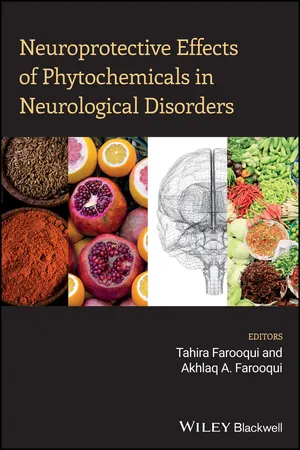
Table of contents

  1. Cover
  2. Title Page
  3. Table of Contents
  4. Contributors
  5. Preface
  6. Acknowledgments
  7. 1 Use of Phytochemicals against Neuroinflammation
  8. 2 Flavonoids in Transgenic Alzheimer’s Disease Mouse Models
  9. 3 Neuroprotective Effects of Polyphenols in Aging and Age‐Related Neurological Disorders
  10. 4 Indian Herbs and their Therapeutic Potential against Alzheimer’s Disease and Other Neurological Disorders
  11. 5 Garlic and its Effects in Neurological Disorders
  12. 6 Effects of Extra‐Virgin Olive Oil in Neurological Disorders
  13. 7 Ginger Components as Anti‐Alzheimer Drugs: Focus on Drug Design
  14. 8 Phytomedicine
  15. 9 Effects of Phytochemicals on Diabetic Retino‐neuropathy
  16. 10 Herbal Drugs
  17. 11 Neuroprotective Properties of Dietary Polyphenols in Parkinson’s Disease
  18. 12 Potential of Polyphenols in the Treatment of Major Depression
  19. 13 Effect of Phytochemicals on Diabetes‐Related Neurological Disorders
  20. 14 Neuroprotective Effects of Extra‐Virgin Olive Oil and its Components in Alzheimer’s Disease
  21. 15 Protective Role of Black‐Tea Extract in a Transgenic Drosophila Model of Parkinson’s Disease
  22. 16 Apitherapy
  23. 17 Molecular Mechanisms behind the Beneficial Activity of Polyunsaturated Fatty Acids in Alzheimer’s Disease and Related Conditions
  24. 18 Prevention of Neuroinflammation by Resveratrol
  25. 19 Modulation of the Estradiol and Neprilysin Pathways by Resveratrol in a Lipopolysaccharide Model of Cognitive Impairment
  26. 20 Neuroprotective Effect of Resveratrol in Cerebral Ischemia
  27. 21 Effects of Nobiletin in Animal Models of Cognitive Impairment
  28. 22 Potential Neuroprotective Effects of Curcumin against Dementia
  29. 23 Neuroprotective Activity of Curcumin and Emblica officinalis Extract against Carbofuran‐Induced Neurotoxicity in Wistar Rats
  30. 24 Potential Use of Curcuminoids for the Treatment of Alzheimer’s Disease
  31. 25 Prevention by Curcumin of Neuroinflammation in Intracerebral Hemorrhage
  32. 26 Effect of Polyphenols on Protein Misfolding
  33. 27 Molecular Mechanisms Involved in the Neuroprotective Action of Phytochemicals
  34. 28 Nutraceuticals and Cognitive Dysfunction
  35. 29 Summary and Perspective
  36. Index
  37. End User License Agreement