In today's business environment, more and more people are requesting cloud-based solutions to help solve their business challenges. So how can you not only anticipate your clients' needs but also keep ahead of the curve to ensure their goals stay on track?
With the help of this accessible book, you'll get a clear sense of cloud computing and understand how to communicate the benefits, drawbacks, and options to your clients so they can make the best choices for their unique needs. Plus, case studies give you the opportunity to relate real-life examples of how the latest technologies are giving organizations worldwide the opportunity to thrive as supply chain solutions in the cloud.
Demonstrates how improvements in forecasting, collaboration, and inventory optimization can lead to cost savings
Explores why cloud computing is becoming increasingly important
Takes a close look at the types of cloud computing
Makes sense of demand-driven forecasting using Amazon's cloud
Whether you work in management, business, or IT, this is the dog-eared reference you'll want to keep close by as you continue making sense of the cloud.
CHAPTER 1 Demand-Driven Forecasting in the Supply Chain
The world is changing at an increasing pace. Consumers are becoming more demanding, and they expect products and services of high quality, value for their money, and timely availability. Organizations and industries across the globe are under pressure to produce products or provide services at the right time, quantity, price, and location. As global competition has increased, those organizations that fail to be proactive with information and business insights gained risk loss of sales and lower market share. Supply chain optimization—from forecasting and planning to execution point of view—is critical to success for organizations across industries and the world. The focus of this book is on demand‐driven forecasting (using data as evidence to forecast demand for sales units) and how cloud computing can assist with computing and Big Data challenges faced by organizations today. From a demand‐driven forecasting perspective, the context will be a business focus rather than a statistical point of view. For the purpose of this book, the emphasis will be on forecasting sales units, highlighting possible benefits of improved forecasts, and supply chain optimization.
Advancements in information technology (IT) and decreasing costs (e.g., data storage, computational resources) can provide opportunities for organizations needing to analyze lots of data. It is becoming easier and more cost‐effective to capture, store, and gain insights from data. Organizations can then respond better and at a quicker pace, producing those products that are in high demand or providing the best value to the organization. Business insights can help organizations understand the sales demand for their products, the sentiment (e.g., like or dislike products) that customers have about their products, and which locations have the highest consumption. The business intelligence gained can help organizations understand what price sensitivity exists, whether there is effectiveness of events and promotions (e.g., influencing demand), what product attributes make the most consumer impact, and much more. IT can help organizations increase digitalization of their supply chains, and cloud computing can provide a scalable and cost‐effective platform for organizations to capture, store, analyze, and consume (view and consequently act upon) large amounts of data.
This chapter aims to provide a brief context of demand‐driven forecasting from a business perspective and sets the scene for subsequent chapters that focus on cloud computing and how the cloud as a platform can assist with demand‐driven forecasting and related challenges. Personal experiences (drawing upon consultative supply chain projects at SAS) are interspersed throughout the chapters, though they have been anonymized to protect organizations worldwide. Viewpoints from several vendors are included to provide a broad and diverse vision of demand‐driven forecasting and supply chain optimization, as well as cloud computing.
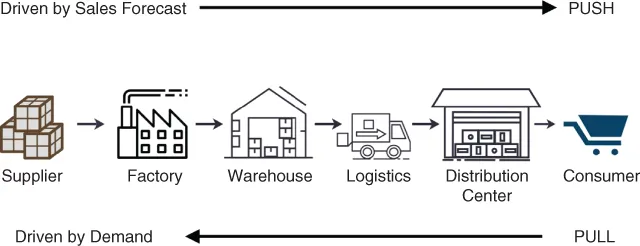
Forecasting of sales is generally used to help organizations predict the number of products to produce, ship, store, distribute, and ultimately sell to end consumers. There has been a shift away from a push philosophy (also known as inside‐out approach) where organizations are sales driven and push products to end consumers. This philosophy has often resulted in overproduction, overstocks in all locations in the supply chain network, and incorrect understanding of consumer demand. Stores often have had to reduce prices to help lower inventory, and this has had a further impact on the profitability of organizations. Sales can be defined as shipments or sales orders. Demand can include point of sales (POS) data, syndicated scanner data, online or mobile sales, or demand data from a connected device (e.g., vending machine, retail stock shelves). A new demand‐pull (also known as an outside‐in approach) philosophy has gained momentum where organizations are learning to sense demand (also known as demand‐sensing) of end consumers and to shift their supply chains to operate more effectively. Organizations that are changing their sales and operations planning (S&OP) process and moving to a demand‐pull philosophy are said to be creating a demand‐driven supply network (DDSN). (See Figure 1.)
Figure 1 Push and Pull—Sales and Operations Process
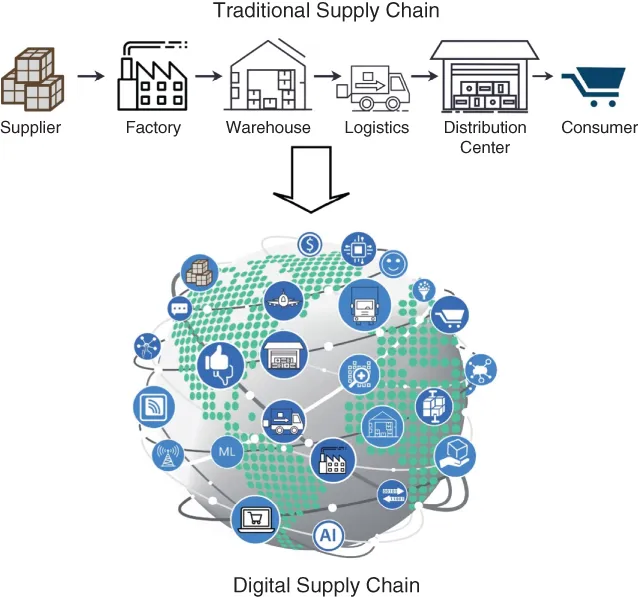
The Boston Consulting Group (BCG) defines a demand‐driven supply chain (DDSC) as a system of coordinated technologies and processes that senses and reacts to real‐time demand signals across a network of customers, suppliers, and employees (Budd, Knizek, and Tevelson 2012, 3). For an organization to be genuinely demand‐driven, it should aim for an advanced supply chain (i.e., supply chain 2.0) that seamlessly integrates customer expectations into its fulfillment model (Joss et al. 2016, 19). Demand‐driven supply chain management focuses on the stability of individual value chain activities, as well as the agility to autonomously respond to changing demands immediately without prior thought or preparation (Eagle 2017, 22). Organizations that transition to a demand‐driven supply chain are adopting the demand‐pull philosophy mentioned earlier. In today's fast‐moving world, the supply chain is moving away from an analog and linear model to a digital and multidimensional model—an interconnected neural model (many connected nodes in a mesh, as shown in Figure 2). Information between nodes is of various types, and flows at different times, volumes, and velocities. Organizations must be able to ingest, sense (analyze), and proactively act upon insights promptly to be successful. According to an MHI survey that was published (Batty et al. 2017, 3), 80 percent of respondents believe a digital supply chain will prevail by the year 2022. The amount of adoption of a digital supply chain transformation varies across organizations, industries, and countries.
Figure 2 Digital Supply Chain—Interconnected
It has become generally accepted that those organizations that use business intelligence and data‐driven insights outperform those organizations that do not. Top‐performing organizations realize the value of leveraging data (Curran et al. 2015, 2–21). Using business intelligence (BI) with analytics built upon quality data (relevant and complete data) allows organizations to sense demand, spot trends, and be more proactive. The spectrum of data is also changing with the digitalization of the supply chain. Recent enhancements in technologies and economies of scale have made it possible to capture data from countless sources and at faster rates (e.g., near real time or regular ingress intervals) than previously possible. Data no longer must be limited to sales demand only, and can include other sources such as weather, economic events and trends, social media data (e.g., useful for product sentiment analysis), traffic data, and more.
Capturing data faster (e.g., near real time via connected devices) and capturing larger volumes of data (e.g., several years of historical data of many variables) have now become more accessible and more affordable than ever before. One of the main philosophies of Big Data is to capture and store all types of data now and worry about figuring out the questions to ask of the data later. There are opportunities for organizations to leverage technologies in computing, analytics, data capture and storage, and the Internet of Things (IoT) to transform their business to a digital supply chain (a well‐connected supply chain). Such data and analytics can lead to improved insights and visibility of an entire supply chain network. The end‐to‐end supply chain visibility of information and material flow enables organizations to make holistic data‐driven decisions optimal for their businesses (Muthukrishnan and Sullivan 2012, 2). Organizations wishing to optimize their supply chain management are moving toward an intelligent and integrated supply management model that has high supply network visibility and high integration of systems, processes, and people of the entire supply chain network internal and external to the organization (Muthukrishnan and Sullivan 2012, 2–5).
The holistic and real‐time data coupled with advanced analytics can help organizations make optimal decisions, streamline operations, and minimize risk through a comprehensive risk management program (Muthukrishnan and Sullivan 2012, 5). The value of data is maximized when it is acted upon at the right time (Barlow 2015, 22). The benefits of the increased visibility and transparency include improved supplier performance, reduced operational costs, improved sales and operations planning (S&OP) outcomes, and increased supply chain responsiveness (Muthukrishnan and Sullivan 2012, 6). Implementing a supply chain with high visibility and integration provides benefits such as increased sales through faster responses and decision making, reduced inventory across the supply chain, reduced logistic and procurement costs, and improved service levels (Muthukrishnan and Sullivan 2012, 11).
The increasing needs for supply chain visibility are leading to the ado...
Table of contents
Cover
Table of Contents
List of Figures
List of Tables
Preface
Acknowledgments
CHAPTER 1: Demand-Driven Forecasting in the Supply Chain
CHAPTER 2: Introduction to Cloud Computing
CHAPTER 3: Migrating to the Cloud
CHAPTER 4: Amazon Web Services and Microsoft Azure
CHAPTER 5: Case Studies of Demand-Driven Forecasting in AWS
CHAPTER 6: Summary
Glossary
References
About the Author
Index
End User License Agreement
Trusted by 375,005 students
Access to over 1.5 million titles for a fair monthly price.
Study more efficiently using our study tools.
Frequently asked questions
Yes, you can cancel anytime from the Subscription tab in your account settings on the Perlego website. Your subscription will stay active until the end of your current billing period. Learn how to cancel your subscription
No, books cannot be downloaded as external files, such as PDFs, for use outside of Perlego. However, you can download books within the Perlego app for offline reading on mobile or tablet. Learn how to download books offline
Perlego offers two plans: Essential and Complete
Essential is ideal for learners and professionals who enjoy exploring a wide range of subjects. Access the Essential Library with 800,000+ trusted titles and best-sellers across business, personal growth, and the humanities. Includes unlimited reading time and Standard Read Aloud voice.
Complete: Perfect for advanced learners and researchers needing full, unrestricted access. Unlock 1.5M+ books across hundreds of subjects, including academic and specialized titles. The Complete Plan also includes advanced features like Premium Read Aloud and Research Assistant.
Both plans are available with monthly, semester, or annual billing cycles.
We are an online textbook subscription service, where you can get access to an entire online library for less than the price of a single book per month. With over 1.5 million books across 990+ topics, we’ve got you covered! Learn about our mission
Look out for the read-aloud symbol on your next book to see if you can listen to it. The read-aloud tool reads text aloud for you, highlighting the text as it is being read. You can pause it, speed it up and slow it down. Learn more about Read Aloud
Yes! You can use the Perlego app on both iOS and Android devices to read anytime, anywhere — even offline. Perfect for commutes or when you’re on the go. Please note we cannot support devices running on iOS 13 and Android 7 or earlier. Learn more about using the app
Yes, you can access The Cloud-Based Demand-Driven Supply Chain by Vinit Sharma in PDF and/or ePUB format, as well as other popular books in Business & Decision Making. We have over 1.5 million books available in our catalogue for you to explore.