Environmental Pest Management
Challenges for Agronomists, Ecologists, Economists and Policymakers
- English
- ePUB (mobile friendly)
- Available on iOS & Android
Environmental Pest Management
Challenges for Agronomists, Ecologists, Economists and Policymakers
About this book
A wide-ranging, interdisciplinary exploration of key topics that interrelate pest management, public health and the environment
This book takes a unique, multidimensional approach to addressing the complex issues surrounding pest management activities and their impacts on the environment and human health, and environmental effects on plant protection practices.
It features contributions by a distinguished group of authors from ten countries, representing an array of disciplines. They include plant protection scientists and officers, economists, agronomists, ecologists, environmental and public health scientists and government policymakers. Over the course of eighteen chapters, those experts share their insights into and analyses of an array of issues of vital concern to everyone with a professional interest in this important subject.
The adverse effects of pest control have become a subject of great concern worldwide, and researchers and enlightened policymakers have at last begun to appreciate the impact of environmental factors on our ability to manage pest populations. Moreover, while issues such as pesticide toxicity have dominated the global conversation about pest management, economic and societal considerations have been largely neglected. Environmental Pest Management: Challenges for Agronomists, Ecologists, Economists and Policymakers is the first work to provide in-depth coverage of all of these pressing issues between the covers of one book.
- Offers a unique multi-dimensional perspective on the complex issues surrounding pest management activities and their effect on the environment and human health
- Addresses growing concerns about specific pest management strategies, including the use of transgenic crops and biological controls
- Analyses the influence of global processes, such as climate change, biological invasions and shifts in consumer demand, and ecosystem services and disservices on pest suppression efforts
- Explores public health concerns regarding biodiversity, pesticide use and food safety
- Identifies key economic drivers of pest suppression research, strategies and technologies
- Proposes new regulatory approaches to create sustainable and viable crop protection systems in the framework of agro-environmental schemes
Offering a timely and comprehensively-unique treatment of pest management and its environmental impacts in a single, inter-disciplinary volume, this book is a valuable resource for scientists in an array of disciplines, as well as government officials and policymakers. Also, teachers of undergraduate and graduate level courses in a variety of fields are sure to find it a highly useful teaching resource.
Frequently asked questions
- Essential is ideal for learners and professionals who enjoy exploring a wide range of subjects. Access the Essential Library with 800,000+ trusted titles and best-sellers across business, personal growth, and the humanities. Includes unlimited reading time and Standard Read Aloud voice.
- Complete: Perfect for advanced learners and researchers needing full, unrestricted access. Unlock 1.4M+ books across hundreds of subjects, including academic and specialized titles. The Complete Plan also includes advanced features like Premium Read Aloud and Research Assistant.
Please note we cannot support devices running on iOS 13 and Android 7 or earlier. Learn more about using the app.
Information
1
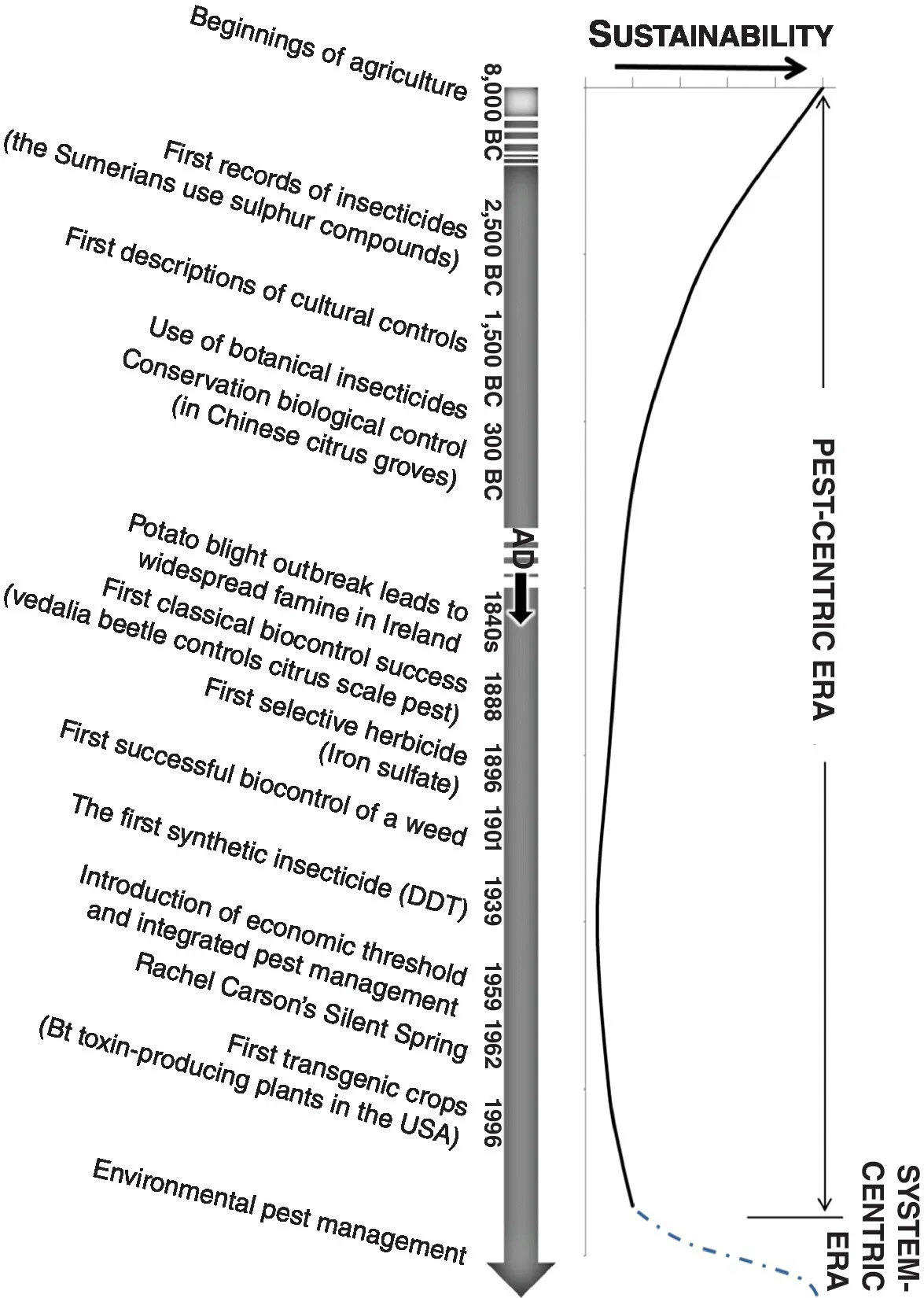
Environmental Pest Management: A Call to Shift from a PestâCentric to a SystemâCentric Approach
1.1 Introduction

1.2 Modern Developments in Pest Control
| Year | Definition | Source |
| 1959 | Applied pest control which combines and integrates biological and chemical control. Chemical control is used as necessary and in a manner which is least disruptive to biological control. Integrated control may make use of naturally occurring biological control as well as biological control affected by manipulated or induced biotic agents. | Stern et al. (1959) |
| 1966 | A pest population management system that utilizes all suitable techniques in a compatible manner to reduce pest populations and maintain them at levels below those causing economic injury. | Smith and Reynolds (1966) |
| 1967 | A pest management system that, in the context of the associated environment and the population dynamics of the pest species, utilizes all suitable techniques and methods in as compatible a manner as possible and maintains the pest populations at levels below those causing economic injury. | FAO (1967) |
| 1969 | Utilization of all suitable techniques to reduce and maintain pest populations at levels below those causing injury of economic importance to agriculture and forestry, or bringing two or more methods of control into a harmonized system designed to maintain pest levels below those at which they cause harm â a system that must rest on firm ecological principles and approaches. | National Academy of Science (1969) |
| 1972 | An approach that employs a combination of techniques to control the wide variety of potential pests that may threaten crops. It involves maximum reliance on natural pest population controls, along with a combination of techniques that may contribute to suppression â cultural methods, pestâspecific diseases, resistant crop varieties, sterile insects, attractants, augmentation of parasites or predators, or chemical pesticides as needed. | Council on Environmental Quality (1972) |
| 1978 | A multidisciplinary, ecological approach to the management of pest populations, which utilizes a variety of control tactics compatibly in a single coâordinated pest management system. | Smith (1978) |
| 1979 | The selection, integration and implementation of pest control based on predicted economic, ecological and sociological consequences. | Bottrell (1979) |
| 1979 | The optimization of pest control in an economically and ecologically sound manner, accomplished by the coâordinated use of multiple tactics to assure stable crop production and to maintain pest damage below the economic injury level while minimizing hazards to humans, animals, plants and the environment. | Office of Technology Assessment (1979) |
| 1980 | An interdisciplinary approach incorporating the judicious application of the most efficient methods of mai... |
Table of contents
- Cover
- Title Page
- Table of Contents
- List of Contributors
- Preface
- 1 Environmental Pest Management
- Part I: General Background
- Part II: Impact of Pest Management Practices on the Environment
- Part III: Influence of Unmanaged Habitats on Pest Management
- Part IV: Effects of Global Changes on Pest Management
- Part V: Pest Control and Public Health
- Part VI: Policies Related to Environmental Pest Management
- Part VII: Concluding Remarks, TakeâHome Messages and a Call for Action
- Index
- End User License Agreement