The Happy, Healthy Nonprofit
eBook - ePub

The Happy, Healthy Nonprofit

Strategies for Impact without Burnout

  1. English
  2. ePUB (mobile friendly)
  3. Available on iOS & Android
eBook - ePub

The Happy, Healthy Nonprofit

Strategies for Impact without Burnout

About this book

Steer your organization away from burnout while boosting all-around performance

The Happy, Healthy Nonprofit presents realistic strategies for leaders looking to optimize organizational achievement while avoiding the common nonprofit burnout. With a uniquely holistic approach to nonprofit leadership strategy, this book functions as a handbook to help leaders examine their existing organization, identify trouble spots, and resolve issues with attention to all aspects of operations and culture. The expert author team walks you through the process of building a happier, healthier organization from the ground up, with a balanced approach that considers more than just quantitative results. Employee wellbeing takes a front seat next to organizational performance, with clear guidance on establishing optimal systems and processes that bring about better results while allowing a healthier work-life balance. By improving attitudes and personal habits at all levels, you'll implement a positive cultural change with sustainable impact.

Nonprofits are driven to do more, more, more, often with fewer and fewer resources; there comes a breaking point where passion dwindles under the weight of pressure, and the mission suffers as a result. This book shows you how to revamp your organization to do more and do it better, by putting cultural considerations at the heart of strategy.

  • Find and relieve cultural and behavioral pain points
  • Achieve better results with attention to well-being
  • Redefine your organizational culture to avoid burnout
  • Establish systems and processes that enable sustainable change

At its core, a nonprofit is driven by passion. What begins as a personal investment in the organization's mission can quickly become the driver of stress and overwork that leads to overall lackluster performance. Executing a cultural about-face can be the lifeline your organization needs to thrive. The Happy, Healthy Nonprofit provides a blueprint for sustainable change, with a holistic approach to improving organizational outlook.

Frequently asked questions

Yes, you can cancel anytime from the Subscription tab in your account settings on the Perlego website. Your subscription will stay active until the end of your current billing period. Learn how to cancel your subscription.
No, books cannot be downloaded as external files, such as PDFs, for use outside of Perlego. However, you can download books within the Perlego app for offline reading on mobile or tablet. Learn more here.
Perlego offers two plans: Essential and Complete
  • Essential is ideal for learners and professionals who enjoy exploring a wide range of subjects. Access the Essential Library with 800,000+ trusted titles and best-sellers across business, personal growth, and the humanities. Includes unlimited reading time and Standard Read Aloud voice.
  • Complete: Perfect for advanced learners and researchers needing full, unrestricted access. Unlock 1.4M+ books across hundreds of subjects, including academic and specialized titles. The Complete Plan also includes advanced features like Premium Read Aloud and Research Assistant.
Both plans are available with monthly, semester, or annual billing cycles.
We are an online textbook subscription service, where you can get access to an entire online library for less than the price of a single book per month. With over 1 million books across 1000+ topics, we’ve got you covered! Learn more here.
Look out for the read-aloud symbol on your next book to see if you can listen to it. The read-aloud tool reads text aloud for you, highlighting the text as it is being read. You can pause it, speed it up and slow it down. Learn more here.
Yes! You can use the Perlego app on both iOS or Android devices to read anytime, anywhere — even offline. Perfect for commutes or when you’re on the go.
Please note we cannot support devices running on iOS 13 and Android 7 or earlier. Learn more about using the app.
Yes, you can access The Happy, Healthy Nonprofit by Beth Kanter,Aliza Sherman in PDF and/or ePUB format, as well as other popular books in Personal Development & Nonprofit Organizations & Charities. We have over one million books available in our catalogue for you to explore.

Information

Part I
Revitalize Yourself

Chapter 1
The Problem: Why Nonprofit Professionals Burn Out

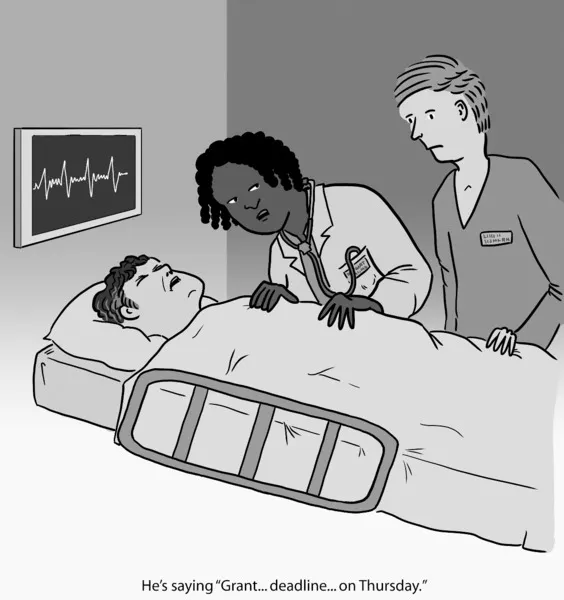
Cartoon shows patient lying on bed and saying  ā€œGrant …deadline…on Thursday.ā€ unconsciously. Doctor is repeating his words to a man standing beside the patient.

When Work and Life Collide

Why does something extreme have to happen before nonprofit leaders change and start to take self-care seriously?
That was the question one nonprofit executive asked after a discussion about nonprofits, self-care practices, and well-being in the workplace during the Alliance for Nonprofit Management Conference in 2015. Someone shared the story of one nonprofit leader he knew who ignored the early warning signs of burnout, kept on going, and suffered an almost-fatal heart attack. That nonprofit leader was lucky. He left the hospital in a wheelchair not a hearse. He subsequently changed his attitude and behavior, prioritizing his well-being so he could continue to lead his organization’s important work.
Sacrificing one’s health in service of a cause is a common narrative in the nonprofit sector. Nonprofit consultant and blogger Joan Garry1 spent eight years as a nonprofit executive director and worked herself and her staff hard. Like most nonprofit leaders, she was so driven by her organization’s mission that every task took on urgency, and there was never any downtime.
While preparing for a board meeting, Garry’s development director revealed that she was wearing a heart monitor due to stress. As the organization’s leader, Garry admits that she should have told her development director to go home and rest, but instead she and everyone else kept prepping for the meeting. Looking back, Garry recognizes how toxic the combination of passion for one’s work and Type A behavior can be.
Garry recently told this story to an executive director who quietly confessed that one of her staff members was currently on a heart monitor. Garry asked, ā€œWhat are we doing to each other? How can we take care of others when we can’t take care of ourselves?ā€
An organization’s work may be mission-based, but its people are mission critical. The passion that social change activists feel for their work is a double-edged sword. On the one hand, that fervor helps them keep going in the face of difficult challenges, especially in the early stages of their careers. On the other hand, they can be so driven they don’t stop to refuel or smell the proverbial roses or even notice they are experiencing symptoms of burnout.
Aisha Moore has worked for 15 years in social justice and health care fields. One day, when leaving the office for lunch, she began to feel dizzy and light-headed. The next thing she knew, she was being wheeled out of the office on a stretcher and taken to the hospital in an ambulance. After a battery of medical tests, Moore learned from her doctor that her symptoms were the result of chronic stress.
ā€œStress? But I love my work,ā€ she told her doctor. Moore was so anxious at work that she did not even notice that stress was making her sick until she passed out. She recovered through a systematic program of self-care she created for herself. She then launched a wellness coaching practice to help other social changemakers avoid her mistakes.2
Cindy Leonard, who manages the consulting and technology programs at the Bayer Center for Nonprofit Management at Robert Morris University, was driving home from work when her heart started to race. She thought she was having a heart attack, pulled over, and dialed 911 for help. The EMTs arrived on the scene and took her vitals. They determined she was having a panic attack, not a heart attack. Leonard learned that she was experiencing an early stage of burnout due to stress. She sought help and began practicing self-care techniques to improve her well-being.3
Laura Maloney, currently chief operating officer at Panthera, a global conservation organization, headed up animal rescue efforts at the Louisiana Society for the Prevention of Cruelty to Animals during Hurricane Katrina. She remembers how the traumatic events affected her and her staff. Later, as the chief operating officer of The Humane Society of the United States, she oversaw the Animal Rescue Team. She noted that while staff at SPCA and The Humane Society are dedicated to their mission of saving animals from inhumane conditions, working long hours and witnessing horrible situations without any relief can be draining, even dangerous.
Maloney became a compassion fatigue educator to teach self-care practices to those in the field of animal protection who were showing early signs of burning out. Maloney recalls an exercise she facilitated at an organization where she invited staff to add ideas and suggestions to a bulletin board on self-care.
ā€œSomeone suggested that once a month, staff leave the office an hour early and do something fun as a group,ā€ she says, adding that next to the suggestion, someone else wrote, ā€œBut the animals don’t leave their cages at 4 P.M. How can we take a break?ā€
These stories, and many more like them, illustrate how good people working in the nonprofit sector view self-care: as something that gets in the way of their work serving an important cause. Self-care is seen as a guilty pleasure, a one-time or once-in-a-while feel-good luxury instead of an individual and organizational necessity. It’s time to change the status quo.
Scarcity of Self-Care

In the face of the challenging work that nonprofits tackle every day, leaders and staff need to be unapologetic about self-care. Nonprofit staff and leaders are often driven to do more with less and to keep going no matter what. But what they need to remember is by practicing self-care, they are not only taking care of themselves but also taking care of the organization’s mission and all of its stakeholders.
Michelle Gislason, MA, is a senior project director at CompassPoint Nonprofit Services and well known for her leadership development and coaching work with nonprofit leaders. She often deals with leaders and organizations working to end domestic violence, work that puts nonprofit staff at risk of burnout because of potential secondary trauma. Gislason talks about radical self-care, channeling one of the leaders in the movement, Norma Wong, when she says, ā€œWe live in complex times. We need clarity of purpose and radical self-care to navigate. If our energy isn’t swelling, how can we do the healing work that is needed? Lack of self-care is a form of repression. Radical self-care is an interruption of viole...

Table of contents

  1. Cover
  2. Endorsements
  3. Title Page
  4. Copyright
  5. Dedication
  6. Our Acknowledgments
  7. Foreword
  8. Introduction
  9. Part I: Revitalize Yourself
  10. Part II: Revitalize Your Organization
  11. Index
  12. EULA