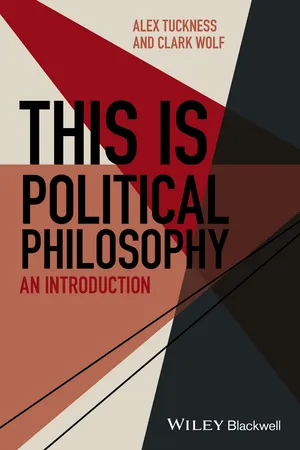
This is Political Philosophy is an accessible and well-balanced introduction to the main issues in political philosophy written by an author team from the fields of both philosophy and politics. This text connects issues at the core of political philosophy with current, live debates in policy, politics, and law and addresses different ideals of political organization, such as democracy, liberty, equality, justice, and happiness. Written with great clarity, This is Political Philosophy is accessible and engaging to those who have little or no prior knowledge of political philosophy.
- English
- ePUB (mobile friendly)
- Available on iOS & Android
eBook - ePub
About this book
Information
Part I
CORE VALUES IN POLITICAL PHILOSOPHY
1
HAPPINESS
SOPHIE
What are you reading about?
JUSTIN
Lying, cruelty, murder, and betrayal.
SOPHIE
About why these are bad things, I assume.
JUSTIN
That’s what is interesting about the book: I think the author is saying that in politics these aren’t necessarily bad.
SOPHIE
That sounds crazy. Give me an example where cruelty and betrayal are good.
JUSTIN
Here’s one from the book. Back during the Italian Renaissance there was a man named Cesare Borgia. He became powerful because he was the illegitimate son of the pope. A territory he controlled was in chaos and turmoil. So first he sent in one of his men to restore order, using as much cruelty as was necessary to get the job done. The man restored order, but was hated by the people because of his cruelty. Then Borgia himself came to town and pretended to have had no idea about the cruelty his officer had used and had that very officer cut into two and his body left in the town square for all to see. Borgia both restored order and avoided a reputation for being cruel.
SOPHIE
What are you reading? That sounds like a show on cable.
JUSTIN
The book is Machiavelli’s The Prince.
SOPHIE
So you think being “Machiavellian” is a good thing?
JUSTIN
I didn’t at first, but the more I have thought about it, the more I agree. In politics you don’t do anyone any good unless you get results. Sometimes getting results means you have to lie or even kill.
SOPHIE
I disagree. People who say they are going to do evil to bring about good are just rationalizing. If you do evil it changes you; you become more evil. You’ll keep going further and further.
JUSTIN
What else should Borgia have done? The region was in lawless chaos, and lawless chaos would have killed far more people in the long run. Politicians who go around trying to be merciful actually end up being cruel. The pain that these measures prevent outweighs the pain that they cause.
SOPHIE
I don’t think one person’s pleasure cancels out another person’s pain. And besides, what about the rights of the people who were brutalized? If you intentionally inflict pain on an innocent person you are violating her rights, end of story.
JUSTIN
Nothing in politics really benefits everyone equally. We don’t have any choice but to make tradeoffs. We have to pass laws asking whether the costs to some outweigh the benefits to others. Everyone’s happiness is relevant.
SOPHIE
There has to be more to the public good than that. Some people find pleasure in humiliating others, but I don’t think that should count as a reason for letting them do it.
JUSTIN
But the pain of the person being humiliated would be greater than the pleasure of the one doing the humiliating.
SOPHIE
Maybe, maybe not. You can’t know that for sure. Anyway, the desire to humiliate others is wrong no matter how happy it makes the person who’s doing the humiliation. We should protect people’s rights no matter what.
Doing Political Philosophy
In this dialogue Justin and Sophie are discussing an issue in political philosophy. One of the most important questions is what values governments should promote. Is the point of government to increase happiness? What if promoting happiness conflicts with promoting freedom? In Aldous Huxley’s book Brave New World people are happy and content, but the contentment comes from a society where people are genetically modified and brainwashed so that they will happily accept a life with very little liberty. Bouts of boredom or anxiety are remedied through easy access to psychedelic drugs. People live lives of comfortable, meaningless amusement. There is more happiness and less pain in a world like that than in ours, but would we really say that such a world is better? In this chapter we will explore debates about whether the purpose of government is to increase happiness.
Happiness, Welfare, and the Aims of Government
Political philosophers look for ways to evaluate political institutions and the behavior of the people who shape those institutions. Are presidents better than kings? Is it better when governments leave people free to organize their own lives, or should governments constrain people’s freedom, so as to prevent them from making mistakes?
Whether it is institutions or actions that we evaluate, it is natural to consider whether they make people happy or unhappy. It is hard to conceive that a government could be good if it caused widespread suffering and misery. In the same spirit, it seems that any nation in which citizens are all happy and content must be doing something right. This chapter will examine the view that the goal of government is to make people happy. We will also consider the closely related view that the goal of politicians should be to promote the happiness of people who are affected by their choices.
To some philosophers, the view that government should promote people’s happiness has appeared to be so obviously true that it hardly seemed necessary to provide reasons for it. But happiness is more complicated than it might initially seem: what is it for people to be happy? Can we be wrong about our own happiness? Is it possible to know in advance which institutions will promote happiness? How should happiness be measured? If we can’t gauge happiness directly, are there other standards we should use to measure well‐being?
If You’re Happy Do You Know It?
If political institutions are better when they make people happy, then we need some way of judging whether people are happy. But we are often bad judges of other people’s happiness. Worse, we may not even be reliable judges of our own happiness. If you think you’re happy, could you be wrong? Those who advocate a subjective view of happiness say that you can’t possibly be wrong about your own state of happiness. If we define happiness in terms of experiences like pleasure or satisfaction, a person who is experiencing these things knows it. Suppose a person’s body were wasting away because of a terrible disease, but the pain medications were so good that she reported feeling happy. (Perhaps the medicines also keep her from realizing what is happening to her.) On the subjective view, she is happy.
Those who advocate an objective view of happiness, by contrast, would claim that people are sometimes wrong about whether they are truly happy. Suppose that a person is content to live a life devoted to video games. When asked, he honestly and sincerely says he is happy. Then he leaves virtual reality for actual reality and decides that having friends he sees with his own eyes is far better than his life before. He then looks back on his previous life and no longer sees it as a time of happiness. In principle, the same judgment could be made by someone else, that he is not happy even though he thinks he is. If a slave claims to be happy, should we believe her?
The Pursuit of Happiness
Philosophers often distinguish between things that are valued intrinsically and things that are valued instrumentally. A thing is valued intrinsically just in case it is something we want for its own sake. If you want something instrumentally, you want it because you can use it in order to get something else you want—perhaps something you want for its own sake. For example, suppose Sophie wants to be rich. If she wants money for its own sake, then she values it intrinsically. If she values money because she can use it to get things she wants, then she values it instrumentally. We might also ask whether money has intrinsic value—that is, whether it should be valued for its own sake—or whether its value is essentially instrumental.
Happiness, one could argue, is something that everyone wants. Even people who like depressing movies may go to them because they enjoy the sadnes...
Table of contents
- COVER
- TITLE PAGE
- TABLE OF CONTENTS
- HOW TO USE THIS BOOK
- PREFACE
- Part I: CORE VALUES IN POLITICAL PHILOSOPHY
- Part II: PROBLEMS OF AUTHORITY AND LEGITIMACY
- Part III: SPECIFIC TOPICS
- INDEX
- END USER LICENSE AGREEMENT
Trusted by 375,005 students
Access to over 1.5 million titles for a fair monthly price.
Study more efficiently using our study tools.
Frequently asked questions
Yes, you can cancel anytime from the Subscription tab in your account settings on the Perlego website. Your subscription will stay active until the end of your current billing period. Learn how to cancel your subscription
No, books cannot be downloaded as external files, such as PDFs, for use outside of Perlego. However, you can download books within the Perlego app for offline reading on mobile or tablet. Learn how to download books offline
Perlego offers two plans: Essential and Complete
- Essential is ideal for learners and professionals who enjoy exploring a wide range of subjects. Access the Essential Library with 800,000+ trusted titles and best-sellers across business, personal growth, and the humanities. Includes unlimited reading time and Standard Read Aloud voice.
- Complete: Perfect for advanced learners and researchers needing full, unrestricted access. Unlock 1.5M+ books across hundreds of subjects, including academic and specialized titles. The Complete Plan also includes advanced features like Premium Read Aloud and Research Assistant.
We are an online textbook subscription service, where you can get access to an entire online library for less than the price of a single book per month. With over 1.5 million books across 990+ topics, we’ve got you covered! Learn about our mission
Look out for the read-aloud symbol on your next book to see if you can listen to it. The read-aloud tool reads text aloud for you, highlighting the text as it is being read. You can pause it, speed it up and slow it down. Learn more about Read Aloud
Yes! You can use the Perlego app on both iOS and Android devices to read anytime, anywhere — even offline. Perfect for commutes or when you’re on the go.
Please note we cannot support devices running on iOS 13 and Android 7 or earlier. Learn more about using the app
Please note we cannot support devices running on iOS 13 and Android 7 or earlier. Learn more about using the app
Yes, you can access This Is Political Philosophy by Alex Tuckness,Clark Wolf in PDF and/or ePUB format, as well as other popular books in Philosophy & Political Philosophy. We have over 1.5 million books available in our catalogue for you to explore.