- The most up-to-date and thorough coverage of Russian, Soviet and post-Soviet cinema, which also effectively fills gaps in the existing scholarship in the field
- This is the first volume on Russian cinema to explore specifically the history of movie theatres, studios, and educational institutions
- The editor is one of the most established and knowledgeable scholars in Russian cinema studies, and contributions come from leading experts in the field of Russian Studies, Film Studies and Visual Culture
- Chapters consider the arts of scriptwriting, sound, production design, costumes and cinematography
- Provides five portraits of key figures in Soviet and Russia film history, whose works have been somewhat neglected
- English
- ePUB (mobile friendly)
- Available on iOS & Android
eBook - ePub
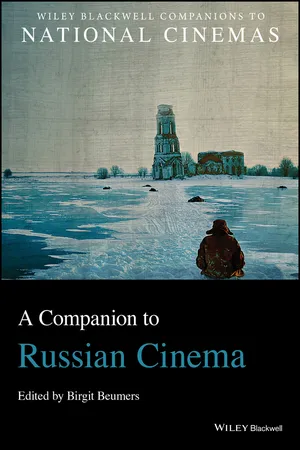
A Companion to Russian Cinema
About this book
A Companion to Russian Cinema provides an exhaustive and carefully organised guide to the cinema of pre-Revolutionary Russia, of the Soviet era, as well as post-Soviet Russian cinema, edited by one of the most established and knowledgeable scholars in Russian cinema studies.
Information
Part I
Structures of Production, Formation, and Exhibition
1
The Film Palaces of Nevsky Prospect: A History of St Petersburg’s Cinemas, 1900–1910
Anna Kovalova
“Fog … and a solid wall of lights from the electro-theatres on Nevsky” (P. 1915) – this is what a Muscovite would remember in the first instance after a visit to St Petersburg in the mid-1910s. Since Moscow was the center of the film press before the Revolution, the cinemas on Nevsky Prospect (Avenue) were first of all seen through Moscow’s eyes, and this picture is quite fantastic: “A continuous strip of cinemas extends from Nikolaev Station to Anichkov Bridge. For all the money in the world, I couldn’t list all of them by name. In almost every house there are two cinemas” (Rex 1915).
This information may nonplus us: where were all these innumerable cinemas? On pre-Revolutionary photographs of Nevsky Prospect, quite a few of which have been preserved, they are rather difficult to spot. This is no surprise: almost all the cinemas were situated either within the buildings, or in courtyards, because it was just impossible to build up the capital’s central street with new cinemas. For the Edison, which was popular in the late 1900s, an entire covered gallery was built, which led visitors into the courtyard; this was distinct from the other “yard” cinemas on Nevsky (Anon. 1909). The smart entrance of the Crystal Palace [Kristall-Palas] cinema was visible from within the courtyard that could be accessed through tall and splendidly decorated gates (Khronika 1910c).
Indeed, a similar picture can be observed today. However, Nevsky Prospect was, and remains, St Petersburg’s main cinema street. During the pre-Revolutionary era, when St Petersburg hugely surpassed Moscow by the number of cinemas, the Nevsky was the largest cinematic center in the whole of Russia: in the evenings, the projectors showed films to thousands of spectators. Thus the history of cinemas on Nevsky goes far beyond the study of local lore and has a direct relation to the hermeneutics of early Russian cinema. Imagining the cinemas on Nevsky means imagining the world of the film viewer in Russia at the beginning of the twentieth century.
According to available data, the first cinema opened on Nevsky in the spring of 1897, the year following the first film screenings in Russia in the Aquarium Park and the Hermitage Gardens. Boris Diushen, a pioneer of Russian cinema, left his memoirs about this cinema, which was located in the Passage [Passazh]:
Occasional events would take place in this venue: an exhibition of wax figures, a visiting magician guest-performer, etc. The venue held no more than 50–60 persons. Curiously, it was called “Edison’s Hall” before it became a cinema, and you could listen there to a tremendous novelty: Edison’s phonograph. In those days people would listen by inserting small rubber tubules into their ears that connected to the phonograph, since a loud-speaking sound record did not yet exist. The cinema, which was referred to as “living photograph,” opened almost unnoticed, and it was mainly children who visited it. They showed three films. The first was shown all around the world: a gardener watering the lawn and a boy stepping on the hose. In perplexity the gardener examines the end of the hose to find out why the water had stopped. The boy takes the foot from the hose, and a strong jet of water hits the gardener’s face. Overall delight! The gardener rushes after the boy and scolds him. The second film showed Nevsky Prospect with a horse-drawn tram and carriages. And the last, third film, showed the arrival of a train. The steam locomotive came directly towards the audience. The spectators were frightened. Then the session was over. There was no musical accompaniment. The session lasted no more than 30 minutes, with two intervals. The first cinema in Russia quickly went bust.(Diushen 2003, 175)
The famous fire in Paris at the annual Charity Bazaar (1897) killed about two hundred people and led to the first big cinema crisis, which continued in Russia until the first Russian revolution of 1905. The demonstration of the “living photograph” created a huge public resonance in 1896, but the cinema soon disappeared onto the periphery of Russian cultural life. Films were shown off and on, more often in the provinces than in the capitals.
The cinema returned to Nevsky Prospect in the middle of the 1900s when house owners, who had earlier reluctantly rented their premises to cinemas, readily handed them over so they would be reconstructed. Between 1904 and 1908, a cinema consisted of one room only, without foyer or lobby. If, as was most often the case, the cinema was a converted apartment with the partitions removed, the spectators entered from the public staircase, obtaining tickets in the hall, at a small table by the door. Thus cinemas located on the premises of stores were set up, as Viktor Shklovskii remembered: “Small cinemas appeared in empty shops in quiet streets, where the doorbell rang all the time, indicating that the screening was about to begin. Actually they let people in at any time […]. The bell rang with a thin, continuous electric jingle” (Shklovskii 1966, 46).
The transformations of the first Russian cinemas are described in detail and analyzed in Iurii Tsiv'ian’s monograph (1991, 14–69), and his concept is applicable to the history of St Petersburg cinemas. In the second half of the 1900s the above-mentioned smaller cinemas began to move from the center to the suburbs, leaving Nevsky Prospect which had become a street for film palaces only.
Boris Diushen remembered: “Somehow, ‘suddenly’ some cinemas opened on Nevsky, some rather ‘magnificently’ furbished” (Diushen 2003, 176). Feozva Vasil'eva, the daughter of the famous gold producer from Omsk, distributed on charitable terms films from Pathé in Russia and opened several cinemas; the actor Nikolai Orlov remembers the details of such an event: “The first cinema which received the name ‘As in Paris’ was in a cozy, private residence in a courtyard of Nevsky Prospect. The exterior was decorated with huge, colorful Parisian posters, and the entrance was garnered with flowers in the summer and fir-trees in the winter. The public entered a splendid foyer along a magnificent carpet. The second cinema was called ‘As in Nice’ and was located opposite, on the corner of Nevsky and Liteiny. It had two halls: on the ground floor they showed serious, scientific films. The setting was rather smart: gilded furniture, huge mirrors in golden frames, wonderful carpets, the walls upholstered with silk, and the doors also” (Orlov 1999, 204). Orlov emphasized that these cinemas served, as Vasil'eva said, for rendezvous: they were a meeting place for rich visitors. After midnight special screenings of the “Parisian kind” were arranged for very important persons – showing openly pornographic films.
At this time the writer Ivan Shcheglov-Leont'ev wrote a malicious feuilleton, in which he likened cinematography to the image of the cheap German cocotte Bertha Kukelvan, and called the St Petersburg Royal Vio cinema a “grandiose pissoir.” Shcheglov, once a protégé of the writer Mikhail Saltykov-Shchedrin and the historian and journalist Mikhail Stasiulevich, had the reputation of being a weird old man, almost a city madman, in St Petersburg at the beginning of the century: he was afraid of steamships, trams, and even carriages. Nobody paid particular attention to his words, yet in more than one way Shcheglov was right: in the 1900s the magnificent cinema was associated with the brothel. The entrepreneur Vasil'eva ran her cinema business together with her husband Vasilii Ipatovich, and they owned some ten impressive cinemas, of which – according to the journal Artist i ststena – only one was “decent”: the Casino de Paris at the corner of Nevsky and Liteiny. The monopolists Vasili'ev occupied a visible place in the film-process of the capital, and their business approach in many respects reflected the shape of St Petersburg’s film distribution of those years.
The first film theater owners in the capital were parvenus and enterprising merchants, and usually did not distinguish themselves by intelligence or a high level of culture. A repulsive scene took place in the Folies Bergère theater on Nevsky at the end of the 1900s: the wife of the owner Nakhman-Geev attacked Vera G-n, whom she suspected of an affair with her husband. The girl was beaten up and suffered bruises and concussions. Vera G-n brought a court case against both Geevs (Anon. 1910b). The feuilleton published in the magazine Artist i stsena also gives some clues about the social origin of the first generation of St Petersburg theatre owners: “Conversation of a doctor without practice and a merchant without credit in a mossy small restaurant,” where the opening of a cinema is described simply: “Let’s stop arguing and get to business. And business is good: we shall open it on Nevsky, we shall arrange it in the Parisian fashion, and it won’t be business but a red mill that will spin money” (Anon. 1910a). A red mill was the emblem of the well-known cinema, the Moulin Rouge, which operated on Nevsky Prospect 51 for over ten years.
The press quite often bantered at the manners of the cinema owners, who...
Table of contents
- Cover
- Title Page
- Table of Contents
- Notes on Contributors
- Acknowledgments
- Notes on Transliteration and References
- Introduction
- Part I: Structures of Production, Formation, and Exhibition
- Part II: For the State or For the Audience? Auteurism, Genre, and Global Markets
- Part III: Sound – Image – Text
- Part IV: Time and Space, History and Place
- Part V: Directors’ Portraits
- Appendix: Chronology of Events in Russian Cinema and History
- Bibliography
- Index
- End User License Agreement
Trusted by 375,005 students
Access to over 1.5 million titles for a fair monthly price.
Study more efficiently using our study tools.
Frequently asked questions
Yes, you can cancel anytime from the Subscription tab in your account settings on the Perlego website. Your subscription will stay active until the end of your current billing period. Learn how to cancel your subscription
No, books cannot be downloaded as external files, such as PDFs, for use outside of Perlego. However, you can download books within the Perlego app for offline reading on mobile or tablet. Learn how to download books offline
Perlego offers two plans: Essential and Complete
- Essential is ideal for learners and professionals who enjoy exploring a wide range of subjects. Access the Essential Library with 800,000+ trusted titles and best-sellers across business, personal growth, and the humanities. Includes unlimited reading time and Standard Read Aloud voice.
- Complete: Perfect for advanced learners and researchers needing full, unrestricted access. Unlock 1.5M+ books across hundreds of subjects, including academic and specialized titles. The Complete Plan also includes advanced features like Premium Read Aloud and Research Assistant.
We are an online textbook subscription service, where you can get access to an entire online library for less than the price of a single book per month. With over 1.5 million books across 990+ topics, we’ve got you covered! Learn about our mission
Look out for the read-aloud symbol on your next book to see if you can listen to it. The read-aloud tool reads text aloud for you, highlighting the text as it is being read. You can pause it, speed it up and slow it down. Learn more about Read Aloud
Yes! You can use the Perlego app on both iOS and Android devices to read anytime, anywhere — even offline. Perfect for commutes or when you’re on the go.
Please note we cannot support devices running on iOS 13 and Android 7 or earlier. Learn more about using the app
Please note we cannot support devices running on iOS 13 and Android 7 or earlier. Learn more about using the app
Yes, you can access A Companion to Russian Cinema by Birgit Beumers in PDF and/or ePUB format, as well as other popular books in Media & Performing Arts & Film History & Criticism. We have over 1.5 million books available in our catalogue for you to explore.