A combination of oxidation methods and C?H bond functionalization, this book emphasizes mechanistic understanding and critical analysis of synthetic reactions to offer a guide or manual for practicing chemists.
• Combines oxidation methods and C?H bond functionalization, two of the most important aspects of organic synthesis
• Deals with C?H bonds, an area of dynamic and continuous research across chemistry and catalysis
• Helps readers understand the fundamental and applied differences among various oxidation methods and reactions
• Covers mechanistic details, conditions, oxidation reagents, and practical aspects of different reactions
- English
- ePUB (mobile friendly)
- Available on iOS & Android
eBook - ePub
Oxidation of C-H Bonds
About this book
Information
1
Introduction
1.1 What Is Oxidation of C─H Bonds?
Oxidation of C─H bonds is to transform the C─H bonds to various C─X bonds, in which X is a nonmetal atom with higher electronegativity than hydrogen, including carbon, nitrogen, oxygen, sulfur, selenium, fluorine, chlorine, bromine, iodine, etc. in this book [1]. In a typical oxidation process, it usually involves a cleavage of the covalent C─H bond and an oxidative functionalization of the carbon by a reagent (Scheme 1.1).
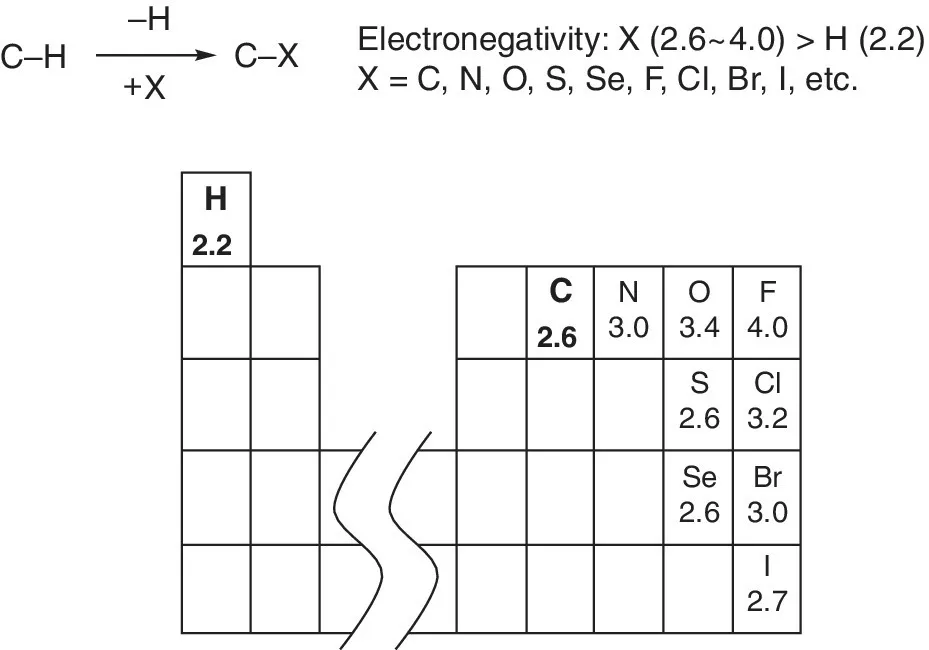
Scheme 1.1 Oxidation of C─H bond.
1.2 Chemical Synthesis and Oxidation of C─H Bonds
1.2.1 Transformation of Organic Compounds
Organic compounds are a kind of carbon molecules containing at least one C─H, C─C, or single C─heteroatom bond, which are very important substances to provide chemical energy, to construct organisms, to act as the functional materials in human life, and so on. Actually, many transformations are happening spontaneously among these organic compounds and other carbon‐containing compounds every day, leading to a big carbon cycle on the Earth. Meanwhile, man‐made organic compounds including agrochemicals, pharmaceuticals, and various organic functional materials are prepared enormously through a series of reactions from the raw materials such as methane, ethylene, and benzene, affecting the human being’s daily life and human beings themselves remarkably. The preparation of target products (complex molecules) from substrates (simple molecules) is called chemical synthesis normally involving multiple‐step reactions in one way (Scheme 1.2).
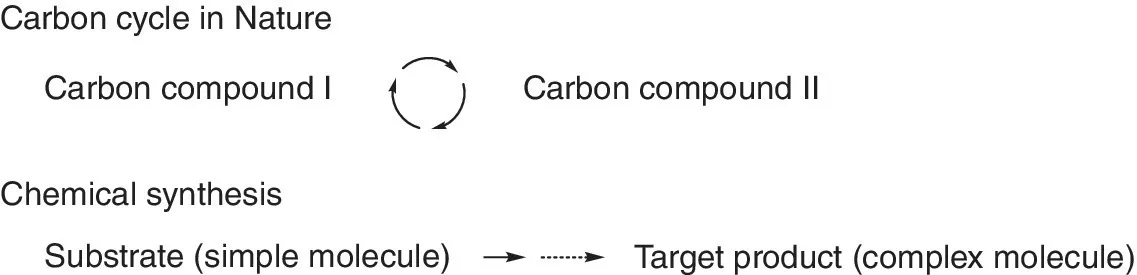
Scheme 1.2 Carbon cycle and chemical synthesis.
1.2.2 Ideal Chemical Synthesis
An ideal chemical synthesis is a process with minimal impact on external environment. There are two simple aspects in the process: mass and energy. In theory, at the end of the most ideal process, there are no other substances transformed except the desired products generated from substrates and no other energy consumed except the reaction heat ΔH for product generation. Although there is a large gap between the current chemical processes and the ideal ones in most cases, it is necessary to give some concise suggestions on the estimation of a practical process. Five rules for a HELLO process are listed as follows:
- High Yield When the product is obtained in high yield, it indicates that the utilization of substrate is highly sufficient and effective during the transformation.
- Efficient Pathway In an efficient pathway of chemical synthesis, a multiple‐step process is usually replaced by a one‐step reaction, a few reactions in one pot, or a cascade reaction to avoid or reduce the consumption of both substance and energy in the reactions and posttreatments. Furthermore, the substrates, intermediates, and products should be tolerant to the reaction systems without protection treatment on functional groups, and no external substances are consumed to initiate, accelerate, or control any reactions in the process.
- Low Loading If it is possible, to save substance, energy, and space, quantitative reactants are employed, and other necessary materials including catalysts, additives, and solvents are used at a minimum during the whole chemical process.
- Low Complexity in Operation It is highly required that a chemical process is carried out easily without special protection and caution, under normal pressure in air, and at an ambient temperature. In such a process, all expenses are reduced on safety, equipment, energy, and so on.
- Only Target Products In some cases, high selectivity such as high stereoselectivity is more important than high yield. Thus, it is the key symbol for an excellent and elegant process to obtain target products only. In other words, a HELLO process could become a HELL one with a poor selectivity because the wastes or by‐products generated could decrease obviously the quantity and/or quality of products and increase largely the cost of substance and energy in the reactions as well as in the product purifications.
To set up such a HELLO process, it mainly depends on the discovery and development of every single perfect reaction, that is, an ideal chemical synthesis is ...
Table of contents
- Cover
- Title Page
- Table of Contents
- Preface
- 1 Introduction
- 2 Oxidation of Methane
- 3 Oxidation of Alkyl sp3C─H Bond
- 4 Oxidation of Alkyl sp3C─H Bond Assisted by Directing Group
- 5 Oxidation of Alkyl sp3C—H Bond Adjacent to Unsaturated Carbon Atom
- 6 Oxidation of Alkyl sp3C─H Bond Adjacent to Heteroatom
- 7 Oxidation of Alkenyl or Carbonyl sp2C─H Bond
- 8 Oxidation of Alkynyl spC─H Bond
- 9 Oxidation of Benzene
- 10 Oxidation of Aryl sp2C─H Bond on Substituted Benzene
- 11 Oxidation of Aryl sp2C─H Bond Assisted by Directing Group
- 12 Oxidation of Aryl sp2C─H Bond on Heteroarene or Perfluoroarene
- 13 Oxidative Cross-Coupling of Aryl sp2C─H Bond with Inert C─H Bond
- Index
- End User License Agreement
Trusted by 375,005 students
Access to over 1.5 million titles for a fair monthly price.
Study more efficiently using our study tools.
Frequently asked questions
Yes, you can cancel anytime from the Subscription tab in your account settings on the Perlego website. Your subscription will stay active until the end of your current billing period. Learn how to cancel your subscription
No, books cannot be downloaded as external files, such as PDFs, for use outside of Perlego. However, you can download books within the Perlego app for offline reading on mobile or tablet. Learn how to download books offline
Perlego offers two plans: Essential and Complete
- Essential is ideal for learners and professionals who enjoy exploring a wide range of subjects. Access the Essential Library with 800,000+ trusted titles and best-sellers across business, personal growth, and the humanities. Includes unlimited reading time and Standard Read Aloud voice.
- Complete: Perfect for advanced learners and researchers needing full, unrestricted access. Unlock 1.5M+ books across hundreds of subjects, including academic and specialized titles. The Complete Plan also includes advanced features like Premium Read Aloud and Research Assistant.
We are an online textbook subscription service, where you can get access to an entire online library for less than the price of a single book per month. With over 1.5 million books across 990+ topics, we’ve got you covered! Learn about our mission
Look out for the read-aloud symbol on your next book to see if you can listen to it. The read-aloud tool reads text aloud for you, highlighting the text as it is being read. You can pause it, speed it up and slow it down. Learn more about Read Aloud
Yes! You can use the Perlego app on both iOS and Android devices to read anytime, anywhere — even offline. Perfect for commutes or when you’re on the go.
Please note we cannot support devices running on iOS 13 and Android 7 or earlier. Learn more about using the app
Please note we cannot support devices running on iOS 13 and Android 7 or earlier. Learn more about using the app
Yes, you can access Oxidation of C-H Bonds by Wenjun Lu,Lihong Zhou in PDF and/or ePUB format, as well as other popular books in Physical Sciences & Industrial & Technical Chemistry. We have over 1.5 million books available in our catalogue for you to explore.