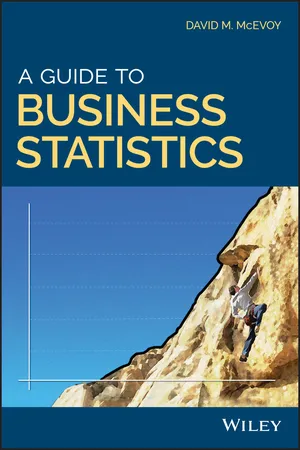
A Guide to Business Statistics
eBook - ePub

A Guide to Business Statistics

  1. English
  2. ePUB (mobile friendly)
  3. Available on iOS & Android
eBook - ePub

A Guide to Business Statistics

About this book

An accessible text that explains fundamental concepts in business statistics that are often obscured by formulae and mathematical notation

A Guide to Business Statistics offers a practical approach to statistics that covers the fundamental concepts in business and economics. The book maintains the level of rigor of a more conventional textbook in business statistics but uses a more streamĀ­lined and intuitive approach. In short, A Guide to Business Statistics provides clarity to the typical statistics textbook cluttered with notation and formulae.

The author—an expert in the field—offers concise and straightforward explanations to the core principles and techniques in business statistics. The concepts are introĀ­duced through examples, and the text is designed to be accessible to readers with a variety of backgrounds. To enhance learning, most of the mathematical formulae and notation appears in technical appendices at the end of each chapter. This important resource:

  • Offers a comprehensive guide to understanding business statistics targeting business and economics students and professionals
  • Introduces the concepts and techniques through concise and intuitive examples
  • Focuses on understanding by moving distracting formulae and mathematical notation to appendices
  • Offers intuition, insights, humor, and practical advice for students of business statistics
  • Features coverage of sampling techniques, descriptive statistics, probability, sampling distributions, confidence intervals, hypothesis tests, and regression

Written for undergraduate business students, business and economics majors, teachers, and practitioners, A Guide to Business Statistics offers an accessible guide to the key concepts and fundamental principles in statistics.

Frequently asked questions

Yes, you can cancel anytime from the Subscription tab in your account settings on the Perlego website. Your subscription will stay active until the end of your current billing period. Learn how to cancel your subscription.
At the moment all of our mobile-responsive ePub books are available to download via the app. Most of our PDFs are also available to download and we're working on making the final remaining ones downloadable now. Learn more here.
Perlego offers two plans: Essential and Complete
  • Essential is ideal for learners and professionals who enjoy exploring a wide range of subjects. Access the Essential Library with 800,000+ trusted titles and best-sellers across business, personal growth, and the humanities. Includes unlimited reading time and Standard Read Aloud voice.
  • Complete: Perfect for advanced learners and researchers needing full, unrestricted access. Unlock 1.4M+ books across hundreds of subjects, including academic and specialized titles. The Complete Plan also includes advanced features like Premium Read Aloud and Research Assistant.
Both plans are available with monthly, semester, or annual billing cycles.
We are an online textbook subscription service, where you can get access to an entire online library for less than the price of a single book per month. With over 1 million books across 1000+ topics, we’ve got you covered! Learn more here.
Look out for the read-aloud symbol on your next book to see if you can listen to it. The read-aloud tool reads text aloud for you, highlighting the text as it is being read. You can pause it, speed it up and slow it down. Learn more here.
Yes! You can use the Perlego app on both iOS or Android devices to read anytime, anywhere — even offline. Perfect for commutes or when you’re on the go.
Please note we cannot support devices running on iOS 13 and Android 7 or earlier. Learn more about using the app.
Yes, you can access A Guide to Business Statistics by David M. McEvoy in PDF and/or ePUB format, as well as other popular books in Economics & Statistics for Business & Economics. We have over one million books available in our catalogue for you to explore.

Information

Chapter 1
Types of Data

Steven Wright once joked that ā€œ42.7% of all statistics are made up on the spot.ā€1 One reason that his quip is effective is because there are good reasons to be suspicious of many of the statistics we encounter every day. Statistics are often reported as hard facts that cannot be argued with. This is not so. Statistics, and the data that the statistics are derived from, are generated by humans. Humans are not infallible and neither are the numbers reported from analyzing the data. As consumers of information, sometimes the statistics we encounter are just simply wrong or even nonsensical. There are examples of peer-reviewed publications reporting 200% reductions in some metric. Even reductions of 12,000% have been reported.2 Without even glancing at the data analyzed in these studies, we know that such statistics are nonsense. You cannot decrease anything by more than 100%. Once you lose 100% of stuff, you are out of stuff. We tend to believe assertions when they are based on data. The problem is that we often do not look carefully at what type of data is being analyzed, how the data were gathered, and whether the results are valid. To be an active and informed citizen, you need to understand a bit about how statistics are generated and what they can tell us. It all starts with understanding the type of data being analyzed, which is the focus of this first chapter.
In the broadest terms, statistics is the science of collecting, analyzing, and interpreting data. One branch of statistics is concerned with how to describe and present data in useful ways (descriptive statistics) and the other branch is concerned with how to use samples of data to draw conclusions about unknown characteristics of a larger population (inferential statistics). In either case, the starting point is understanding a bit about data. Often, when students hear the term data or data analysis, they picture some geek crunching through endless columns of numbers in search for answers. The truth is that data are simply organized information. Data does not have to be numeric, and not all numeric data can be treated the same way. One great thing about the modern state of technology and connectivity is that we have access to incredible amounts of interesting, and often peculiar, datasets. For example, you can read the last words of every executed criminal in the state of Texas since 1982.3 Or, if you think that is too morbid, you may be interested in the location, speed, age, and height of amusement park rollercoasters found all over the world.4 Perhaps, you want to rank every character on the Simpsons by the number of words they spoke between season 1 and season 26.5 The point is that there is so much data available to the public that the possibilities are endless. If you want to get weird, get weird.6 You can let your imagination lead you to data, but let this book guide you on how to analyze it.
The important point is to recognize what type of data you are working with because that will dictate the way you analyze it. In this chapter, we consider the taxonomy of different data types. To begin, all data can be broadly classified as either categorical or numerical.

1.1 Categorical Data

Categorical data (also called qualitative data) have values described by words rather than numbers. Examples include gender, occupation, major, and location. Often, categorical data are represented with codes to make it easier to manage and manipulate. For example, a dataset that includes college majors may convert accounting = 1, economics = 2, and...

Table of contents

  1. Cover
  2. Title Page
  3. Copyright
  4. Dedication
  5. Table of Contents
  6. Preface
  7. Chapter 1: Types of Data
  8. Chapter 2: Populations and Samples
  9. Chapter 3: Descriptive Statistics
  10. Chapter 4: Probability
  11. Chapter 5: The Normal Distribution
  12. Chapter 6: Sampling Distributions
  13. Chapter 7: Confidence Intervals
  14. Chapter 8: Hypothesis Tests of a Population Mean
  15. Chapter 9: Hypothesis Tests of Categorical Data
  16. Chapter 10: Hypothesis Tests Comparing Two Parameters
  17. Chapter 11: Simple Linear Regression
  18. Chapter 12: Multiple Regression
  19. Chapter 13: More Topics in Regression
  20. Index
  21. End User License Agreement