Elementary Financial Derivatives
eBook - ePub

Elementary Financial Derivatives

A Guide to Trading and Valuation with Applications

  1. English
  2. ePUB (mobile friendly)
  3. Available on iOS & Android
eBook - ePub

Elementary Financial Derivatives

A Guide to Trading and Valuation with Applications

About this book

A step-by-step approach to the mathematical financial theory and quantitative methods needed to implement and apply state-of-the-art valuation techniques

Written as an accessible and appealing introduction to financial derivatives, Elementary Financial Derivatives: A Guide to Trading and Valuation with Applications provides the necessary techniques for teaching and learning complex valuation techniques. Filling the current gap in financial engineering literature, the book emphasizes an easy-to-understand approach to the methods and applications of complex concepts without focusing on the underlying statistical and mathematical theories.

Organized into three comprehensive sections, the book discusses the essential topics of the derivatives market with sections on options, swaps, and financial engineering concepts applied primarily, but not exclusively, to the futures market. Providing a better understanding of how to assess risk exposure, the book also includes:

  • A wide range of real-world applications and examples detailing the theoretical concepts discussed throughout
  • Numerous homework problems, highlighted equations, and MicrosoftĀ® Office ExcelĀ® modules for valuation
  • Pedagogical elements such as solved case studies, select answers to problems, and key terms and concepts to aid comprehension of the presented material
  • A companion website that contains an Instructor's Solutions Manual, sample lecture PowerPointĀ® slides, and related Excel files and data sets

Elementary Financial Derivatives: A Guide to Trading and Valuation with Applications is an excellent introductory textbook for upper-undergraduate courses in financial derivatives, quantitative finance, mathematical finance, and financial engineering. The book is also a valuable resource for practitioners in quantitative finance, industry professionals who lack technical knowledge of pricing options, and readers preparing for the CFA exam.

Jana Sacks, PhD, is Associate Professor in the Department of Accounting and Finance at St. John Fisher College in Rochester, New York. A member of The American Finance Association, the National Association of Corporate Directors, and the International Atlantic Economic Society, Dr. Sack's research interests include risk management, credit derivatives, pricing, hedging, and structured finance.
Frequently asked questions

Yes, you can cancel anytime from the Subscription tab in your account settings on the Perlego website. Your subscription will stay active until the end of your current billing period. Learn how to cancel your subscription.
No, books cannot be downloaded as external files, such as PDFs, for use outside of Perlego. However, you can download books within the Perlego app for offline reading on mobile or tablet. Learn more here.
Perlego offers two plans: Essential and Complete
  • Essential is ideal for learners and professionals who enjoy exploring a wide range of subjects. Access the Essential Library with 800,000+ trusted titles and best-sellers across business, personal growth, and the humanities. Includes unlimited reading time and Standard Read Aloud voice.
  • Complete: Perfect for advanced learners and researchers needing full, unrestricted access. Unlock 1.4M+ books across hundreds of subjects, including academic and specialized titles. The Complete Plan also includes advanced features like Premium Read Aloud and Research Assistant.
Both plans are available with monthly, semester, or annual billing cycles.
We are an online textbook subscription service, where you can get access to an entire online library for less than the price of a single book per month. With over 1 million books across 1000+ topics, we’ve got you covered! Learn more here.
Look out for the read-aloud symbol on your next book to see if you can listen to it. The read-aloud tool reads text aloud for you, highlighting the text as it is being read. You can pause it, speed it up and slow it down. Learn more here.
Yes! You can use the Perlego app on both iOS or Android devices to read anytime, anywhere — even offline. Perfect for commutes or when you’re on the go.
Please note we cannot support devices running on iOS 13 and Android 7 or earlier. Learn more about using the app.
Yes, you can access Elementary Financial Derivatives by Jana Sacks in PDF and/or ePUB format, as well as other popular books in Business & Financial Engineering. We have over one million books available in our catalogue for you to explore.

Information

Publisher
Wiley
Year
2015
Print ISBN
9781119076759
eBook ISBN
9781119077312

1
Derivative Instruments: Concepts and Definitions

1.1 Key Derivative Instruments Definitions

Forwards and Futures

A forward contract is a contract between two parties. It states that one of the two parties is to buy something from the other at a later date at a price agreed upon today.
A futures contract is also a contract between two parties. One party is bound to buy something from the other at a later date at a price agreed upon today, subject to a daily settlement of gains and losses and guaranteed against the risk that either party might default.

Swaps

A swap is a contract in which two parties agree to exchange a series of cash flows at predetermined dates over a period of time.

Options

Options are contracts made between two parties that give one party, the buyer, the right to buy or sell an asset from or to the other party, the seller, at a later date and price agreed upon today.

Positions

All derivative contracts have essentially two basic positions: long and short. Long position refers to buying, whereas short position refers to selling. The exact positions, rights, and obligations stemming from them differ for different types of financial derivatives.

1.2 The Role, Risks, and Benefits of Derivatives Markets

Derivative instruments are securities that derive their value from an underlying asset. They offer investors global diversification in financial instruments and currencies, and promise to generate returns that are superior to traditional investments. Investors in derivatives can profit from changes in interest rates and equity markets around the world, currency exchange rate shifts, and changes in global supply and demand for various types of commodities such as precious and industrial metals, oil, and grains.
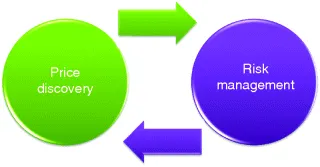
There are two widely recognized benefits of derivative instruments: price discovery and risk management.
A pictorial representation of two widely recognized benefits of derivative instruments. The circles depicts the two derivatives price discovery and risk management that are connected by a two way arrow.

Price Discovery

How do we determine prices? Prices depend on a continuous flow of information from around the world and require the highest possible degree of transparency. A broad range of various elements constantly have an impact on supply and demand for assets. Information flow concerning political situations, climatic and environmental conditions, debt situation, and societal behavioral patterns constantly impacts the price of a commodity, such as wheat, soybeans, and oil. This process is known as price discovery.
Futures markets in particular are a useful tool to help discover prices. Futures markets are considered a primary means for determining the spot price of an asset. The futures market is more active than the spot market; hence, information taken from it is often considered more reliable. Futures markets' underlying assets can be geographically quite dispersed and hence have more than one spot price in existence. The price of the contract with the shortest time to expiration often serves as a proxy for the underlying spot price of an asset.
Options are also relevant in price discovery, mostly in the way the market participants view markets' volatility. If investors think that the markets will be volatile, the option premiums (i.e., their purchase prices) will spike higher.

Risk Management

Companies and investors today use derivatives as tools in their strategies designed to enable them to manage risk exposures more effectively. Risk management is about both hedging and speculation. At times, investors want to increase their risk exposure to gain greater expected return. At other times, investors will want to protect themselves from undesirable risk exposure. Risk management has a very important purpose for the derivatives market. It is essentially the process of recognizing the desired level of risk, detecting the actual level of risk, and altering the actual to equal the desired.
Derivative securities represent additional risks to investors. Many of those risks are heightened by investors perhaps not fully understanding the proper use of said instruments. For example, options offer the potential for vast gains and losses. While the potential for gain is appealing, their complexity makes them suitable for only sophisticated investors with a high degree of risk tolerance.
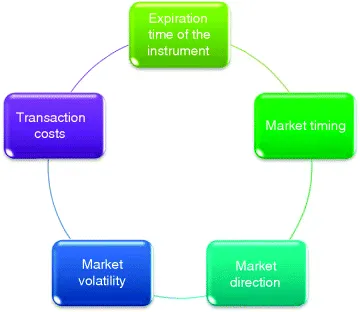
Professional traders and money managers can use derivatives effectively. They are aware and trained to work with risk exposures stemming from (1) expiration time of the instrument, (2) market timing, (3) market direction, (4) market volatility, and (5) transaction costs.
The figure depicts the cyclic arrangement of risks which are experienced by professional traders and money managers. These 5 risks are ā€œexpiration time of the instrument,ā€ ā€œmarket timing,ā€ ā€œmarket direction,ā€ ā€œmarket volatility,ā€ and ā€œtransaction costs.ā€
Derivative instruments have expiration dates. As each day passes, the expiration date approaches and investors lose more and more ā€œtime valueā€. In the case of options, that alone makes an option's value decrease. In order to make money with most derivatives, investors need to accurately predict the direction in which the ...

Table of contents

  1. Cover
  2. Title Page
  3. Copyright
  4. Dedication
  5. Preface
  6. Acknowledgments
  7. Table of Figures
  8. About the Companion Websites
  9. Chapter 1: Derivative Instruments: Concepts and Definitions
  10. Chapter 2: Forwards And Futures
  11. Chapter 3: Swaps
  12. Chapter 4: Options
  13. Literature
  14. Index
  15. End User License Agreement