The essential resource to an integrated approach to reservoir modelling by highlighting both the input of data and the modelling results
Reservoir Modelling offers a comprehensive guide to the procedures and workflow for building a 3-D model. Designed to be practical, the principles outlined can be applied to any modelling project regardless of the software used. The author — a noted practitioner in the field — captures the heterogeneity due to structure, stratigraphy and sedimentology that has an impact on flow in the reservoir.
This essential guide follows a general workflow from data QC and project management, structural modelling, facies and property modelling to upscaling and the requirements for dynamic modelling. The author discusses structural elements of a model and reviews both seismic interpretation and depth conversion, which are known to contribute most to volumetric uncertainty and shows how large-scale stratigraphic relationships are integrated into the reservoir framework. The text puts the focus on geostatistical modelling of facies and heterogeneities that constrain the distribution of reservoir properties including porosity, permeability and water saturation. In addition, the author discusses the role of uncertainty analysis in the static model and its impact on volumetric estimation. The text also addresses some typical approaches to modelling specific reservoirs through a mix of case studies and illustrative examples and:
Offers a practical guide to the use of data to build a successful reservoir model
Draws on the latest advances in 3-D modelling software
Reviews facies modelling, the different methods and the need for understanding the geological interpretation of cores and logs
Presents information on upscaling both the structure and the properties of a fine-scale geological model for dynamic simulation
Stresses the importance of an interdisciplinary team-based approach
Written for geophysicists, reservoir geologists and petroleum engineers, Reservoir Modelling offers the essential information needed to understand a reservoir for modelling and contains the multidisciplinary nature of a reservoir modelling project.
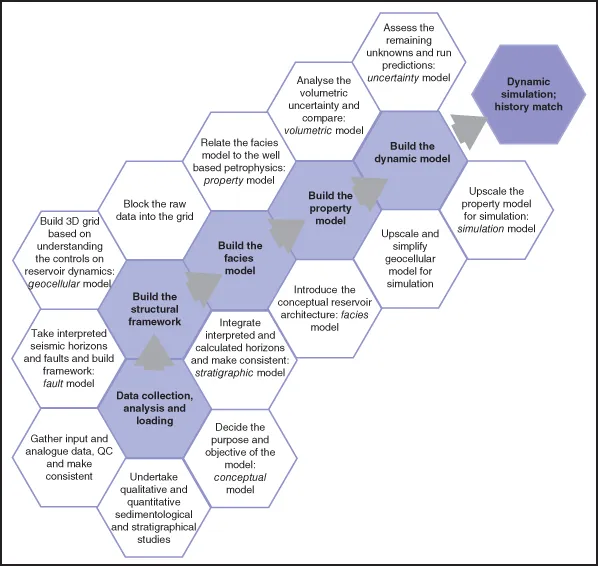
The purpose of this practical guide is to summarize the procedures and workflow towards building a 3D model: the principles are applicable to any modelling project regardless of the software; in other words, this is an attempt at a practical approach to a complex and varied workflow (Figure 1.1). What we are not trying to do in this book is to build detailed geological models of depositional environments but to capture the heterogeneity due to structure, stratigraphy and sedimentology that has an impact on flow in the reservoir.
Figure 1.1 Reservoir modelling workflow elements presented as a traditional linear process showing the links and stages of the steps as outlined in the following chapters.
The key to building a reservoir model is not the software; it is the thought process that the reservoir modeller has to go through to represent the hydrocarbon reservoir they are working on. This starts with a conceptual model of the geology and a diagram of the ‘plumbing’ model to represent how fluids might flow in the reservoir. Modern integrated modelling software starts with seismic input in terms of both interpreted horizons and faults and seismic attribute data that characterizes reservoir from non-reservoir and ends by linking to dynamic simulation; the so-called seismic-to-simulation solution. I have always been concerned that geophysicists and reservoir engineers might forget the geology that actually creates their oil or gas accumulation.
Wikipedia defines reservoir modelling as ‘the construction of a computer model of a petroleum reservoir, for the purposes of reserves estimation, field development planning, predicting future production, well placement and evaluating alternative reservoir management.’ The model comprises an array of discrete cells arranged as a 3D grid populated with various attributes such as porosity, permeability and water saturation. Geological models are static representations of the reservoir or field, whereas dynamic models use finite difference methods to simulate the flow of fluids during production. You could of course construct a reservoir model using paper and coloured pencils, but analysis of that model is challenging!
Geo-modelling is ‘the applied science of creating computerized representations of the Earth’s crust based on geophysical and geological observations.' Another definition is ‘the spatial representation of reservoir properties in an inter-well volume that captures key heterogeneities affecting fluid flow and performance.’ However you define it, geo-modelling requires a balance between hard data, conceptual models and statistical representation. Whether you are working on a clastic or carbonate reservoir, the workflow is the same, although the challenges are different: in carbonate reservoirs, characterizing the petrophysical properties properly is paramount because diagenesis will usually destroy any primary deposition controls on reservoir quality. We will look at carbonate reservoir characterization separately.
A few key statements should be made at the outset:
• Every field is unique and therefore has different challenges
• Every challenge will have a unique solution
• Every solution is only valid for the given situation and therefore …
• KEEP IT SIMPLE …… at least to begin with.
1.1 Reservoir Modelling Challenges
Building a model of an oil and gas reservoir is complex and challenging as much because of the variety of data types involved as the many different steps required. The process is made easier if you can establish why you are building the model; what is the objective of the model? Today, we generally build 3D geocellular models for volumetric estimation, dynamic simulation, well planning and production optimization or to understand the uncertainty inherent in any hydrocarbon reservoir. Above all, a successful 3D model aids in the communication of concepts and the interpretation of data used to characterize a potential or producing oil or gas field.
We model reservoirs in 3D because nature is three dimensional and because the reservoir is heterogeneous and we have restricted opportunities for sampling. Additionally, to understand flow in the reservoir, we need to consider connectivity in three dimensions, rather than simple well-to-well correlation. Having built a 3D representation of the reservoir, it can be used to store, edit, retrieve and display all the information used to build the model; in effect, a model is a means to integrate data from all the subsurface disciplines, so the data are not just stored in the minds of geologists.
Reservoir modelling is also a challenge because we are dealing with a mix of geological and spatial properties and also the complex fluids present in the reservoir. The data available to build a representative model are generally either sparse, well data or poorly resolved, seismic data. The resulting model is dependent on the structural complexity, the depositional model, the available data and the objectives of the project. Building a usable reservoir model is always a compromise: we are trying to represent the reservoir not replicate it.
The advances in computer processing power and graphics over the past 20 years has meant that geoscientists can build representative models of a reservoir to capture the variability present at all the appropriate scales from the microscopic to the field scale. However, as reservoirs are complex, we need to be highly subjective about the scale at which we model and the level of detail we incorporate: a gas reservoir may well be a tank of sand but faults may compartmentalize that tank into a number of separate accumulations.
1.2 Exploration to Production Uncertainty
Even before the first exploration well is drilled on a prospect, a geologist will h...
Table of contents
Cover
Title Page
Copyright
Dedication
Table of Contents
Preface
Chapter 1: Introduction
Chapter 2: Data Collection and Management
Chapter 3: Structural Model
Chapter 4: Stratigraphic Model
Chapter 5: Facies Model
Chapter 6: Property Model
Chapter 7: Volumetrics and Uncertainty
Chapter 8: Simulation and Upscaling
Chapter 9: Case Studies and Examples
Afterword
References
Appendix A: Introduction to Reservoir Geostatistics
Index
End User License Agreement
Trusted by 375,005 students
Access to over 1.5 million titles for a fair monthly price.
Study more efficiently using our study tools.
Frequently asked questions
Yes, you can cancel anytime from the Subscription tab in your account settings on the Perlego website. Your subscription will stay active until the end of your current billing period. Learn how to cancel your subscription
No, books cannot be downloaded as external files, such as PDFs, for use outside of Perlego. However, you can download books within the Perlego app for offline reading on mobile or tablet. Learn how to download books offline
Perlego offers two plans: Essential and Complete
Essential is ideal for learners and professionals who enjoy exploring a wide range of subjects. Access the Essential Library with 800,000+ trusted titles and best-sellers across business, personal growth, and the humanities. Includes unlimited reading time and Standard Read Aloud voice.
Complete: Perfect for advanced learners and researchers needing full, unrestricted access. Unlock 1.5M+ books across hundreds of subjects, including academic and specialized titles. The Complete Plan also includes advanced features like Premium Read Aloud and Research Assistant.
Both plans are available with monthly, semester, or annual billing cycles.
We are an online textbook subscription service, where you can get access to an entire online library for less than the price of a single book per month. With over 1.5 million books across 990+ topics, we’ve got you covered! Learn about our mission
Look out for the read-aloud symbol on your next book to see if you can listen to it. The read-aloud tool reads text aloud for you, highlighting the text as it is being read. You can pause it, speed it up and slow it down. Learn more about Read Aloud
Yes! You can use the Perlego app on both iOS and Android devices to read anytime, anywhere — even offline. Perfect for commutes or when you’re on the go. Please note we cannot support devices running on iOS 13 and Android 7 or earlier. Learn more about using the app
Yes, you can access Reservoir Modelling by Steve Cannon in PDF and/or ePUB format, as well as other popular books in Physical Sciences & Geophysics. We have over 1.5 million books available in our catalogue for you to explore.