- English
- ePUB (mobile friendly)
- Available on iOS & Android
eBook - ePub
About this book
This volume addresses the specific subject of fatigue, a subject not familiar to many engineers, but still relevant for proper and good design of numerous steel structures. It explains all issues related to the subject: Basis of fatigue design, reliability and various verification formats, determination of stresses and stress ranges, fatigue strength, application range and limitations. It contains detailed examples of applications of the concepts, computation methods and verifications.
Information
Chapter 1
INTRODUCTION
1.1 BASIS OF FATIGUE DESIGN IN STEEL STRUCTURES
1.1.1 General
Fatigue is, with corrosion and wear, one of the main causes of damage in metallic members. Fatigue may occur when a member is subjected to repeated cyclic loadings (due to action of fluctuating stress, according to the terminology used in the EN 1993-1-9) (TGC 10, 2006). The fatigue phenomenon shows itself in the form of cracks developing at particular locations in the structure. These cracks can appear in diverse types of structures such as: planes, boats, bridges, frames (of automobiles, locomotives or rail cars), cranes, overhead cranes, machines parts, turbines, reactors vessels, canal lock doors, offshore platforms, transmission towers, pylons, masts and chimneys. Generally speaking, structures subjected to repeated cyclic loadings can undergo progressive damage which shows itself by the propagation of cracks. This damage is called fatigue and is represented by a loss of resistance with time.
Fatigue cracking rarely occurs in the base material remotely from any constructional detail, from machining detail, from welds or from connections. Even if the static resistance of the connection is superior to that of the assembled members, the connection or joint remains the critical place from the point of view of fatigue.
Figure 1.1 shows schematically the example of a steel and concrete composite road bridge subjected to traffic loading. Every crossing vehicle results in cyclic actions and thus stresses in the structure. The stresses induced are affected by the presence of attachments, such as those connecting the cross girders to the main girders. At the ends of attachments, particularly at the toes of the welds which connect them with the rest of the structure, stress concentrations occur due to the geometrical changes from the presence of attachments. The very same spots also show discontinuities resulting from the welding process.
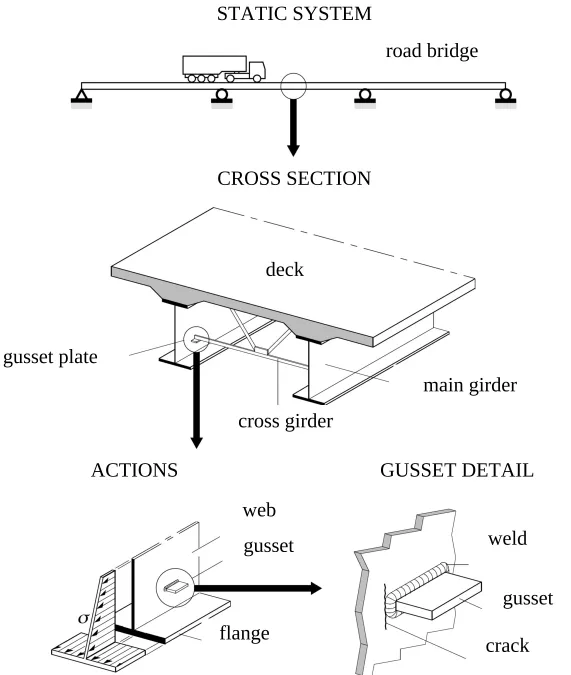
Figure 1.1 – Possible location of a fatigue crack in a road bridge (TGC 10, 2006)
Numerous studies were made in the field of fatigue, starting with Wöhler (1860) on rail car axles some 150 years ago. These demonstrated that the combined effect of discontinuities and stress concentrations could be the origin of the formation and the propagation of a fatigue crack, even if the applied stresses remain significantly below the material yield stress (by applied stresses, it is meant the stresses calculated with an elastic structural analysis considering the possible stress concentrations or residual stresses). A crack develops generally from discontinuities having a depth of the order of some tenth of millimetre. The propagation of such a crack can lead to failure by yielding of the net section or by brittle fracture, mainly depending upon material characteristics, geometry of the member, temperature and loading strain rate of the section. Thus, a structure subjected to repeated cyclic loadings has to be done by careful design and fabrication of the structural members as well as of the structural details, so as to avoid a fatigue failure. The methods of quality assurance have to guarantee that the number and the dimensions of the existing discontinuities stay within the tolerance limits. The purpose of this sub-chapter is to present an outline of the fatigue phenomenon, in order to provide the basic knowledge for the fatigue design of bolted and welded steel structures. To reach this objective, the sub-chapter is structured in the following way:
- − Section 1.1.2: The main factors influencing fatigue life are described.
- − Section 1.1.3: Fatigue testing and the expression of fatigue strength are explained.
- − Section 1.1.4: Variable amplitude and cycle counting.
- − Section 1.1.5: Concept of cumulative damage due to random stresses variations.
The principles of fatig...
Table of contents
- Cover
- Table of Contents
- FOREWORD
- PREFACE
- Chapter 1: INTRODUCTION
- Chapter 2: APPLICATION RANGE AND LIMITATIONS
- Chapter 3: DETERMINATION OF STRESSES AND STRESS RANGES
- Chapter 4: FATIGUE STRENGTH
- Chapter 5: RELIABILITY AND VERIFICATION
- Chapter 6: BRITTLE FRACTURE
- REFERENCES
- Annex A: STANDARDS FOR STEEL CONSTRUCTION
- Annex B: FATIGUE DETAIL TABLES WITH COMMENTARY
- Annex C: MAXIMUM PERMISSIBLE THICKNESSES TABLES
- End User License Agreement
Trusted by 375,005 students
Access to over 1.5 million titles for a fair monthly price.
Study more efficiently using our study tools.
Frequently asked questions
Yes, you can cancel anytime from the Subscription tab in your account settings on the Perlego website. Your subscription will stay active until the end of your current billing period. Learn how to cancel your subscription
No, books cannot be downloaded as external files, such as PDFs, for use outside of Perlego. However, you can download books within the Perlego app for offline reading on mobile or tablet. Learn how to download books offline
Perlego offers two plans: Essential and Complete
- Essential is ideal for learners and professionals who enjoy exploring a wide range of subjects. Access the Essential Library with 800,000+ trusted titles and best-sellers across business, personal growth, and the humanities. Includes unlimited reading time and Standard Read Aloud voice.
- Complete: Perfect for advanced learners and researchers needing full, unrestricted access. Unlock 1.5M+ books across hundreds of subjects, including academic and specialized titles. The Complete Plan also includes advanced features like Premium Read Aloud and Research Assistant.
We are an online textbook subscription service, where you can get access to an entire online library for less than the price of a single book per month. With over 1.5 million books across 990+ topics, we’ve got you covered! Learn about our mission
Look out for the read-aloud symbol on your next book to see if you can listen to it. The read-aloud tool reads text aloud for you, highlighting the text as it is being read. You can pause it, speed it up and slow it down. Learn more about Read Aloud
Yes! You can use the Perlego app on both iOS and Android devices to read anytime, anywhere — even offline. Perfect for commutes or when you’re on the go.
Please note we cannot support devices running on iOS 13 and Android 7 or earlier. Learn more about using the app
Please note we cannot support devices running on iOS 13 and Android 7 or earlier. Learn more about using the app
Yes, you can access Fatigue Design of Steel and Composite Structures by in PDF and/or ePUB format, as well as other popular books in Technology & Engineering & Civil Engineering. We have over 1.5 million books available in our catalogue for you to explore.