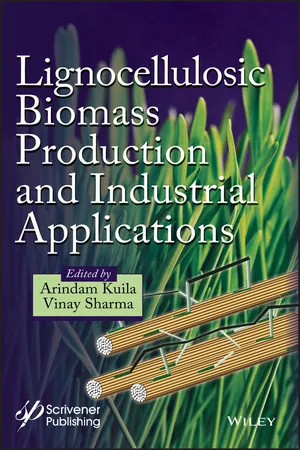
Lignocellulosic Biomass Production and Industrial Applications
eBook - ePub

Lignocellulosic Biomass Production and Industrial Applications

  1. English
  2. ePUB (mobile friendly)
  3. Available on iOS & Android
eBook - ePub

Lignocellulosic Biomass Production and Industrial Applications

About this book

This book covers the utilization of lignocellulosic biomass for biofuel production as well as other industrial applications such as in biotechnology, paper and pulp, chemical and bioplastics.

Lignocellulosic materials such as agricultural residues (e.g., wheat straw, sugarcane bagasse, corn stover), forest products (hardwood and softwood), and crops such as switchgrass and salix, are becoming a potent source for generating valuable products.

Lignocellulosic Biomass Production and Industrial Applications describes the utilization of lignocellulosic biomass for various applications. Although there have been numerous reports on lignocellulosic biomass for biofuel application, there have been very few other applications reported for lignocellulosic biomass-based biotechnology, chemicals and polymers. This book covers both application areas. Besides describing the various types of biofuel production, such as bioethanol, biobutanol, biodiesel and biogas from lignocellulosic biomass, it also presents various other lignocellulosic biomass biorefinery applications for the production of enzymes, chemicals, polymers, paper and bioplastics. In addition, there are chapters on valorization of lignocellulosic materials, alkali treatment to improve the physical, mechanical and chemical properties of lignocellulosic natural fibers, and a discussion of the major benefits, limitations and future prospects of the use of lignocellulosic biomass.

Frequently asked questions

Yes, you can cancel anytime from the Subscription tab in your account settings on the Perlego website. Your subscription will stay active until the end of your current billing period. Learn how to cancel your subscription.
No, books cannot be downloaded as external files, such as PDFs, for use outside of Perlego. However, you can download books within the Perlego app for offline reading on mobile or tablet. Learn more here.
Perlego offers two plans: Essential and Complete
  • Essential is ideal for learners and professionals who enjoy exploring a wide range of subjects. Access the Essential Library with 800,000+ trusted titles and best-sellers across business, personal growth, and the humanities. Includes unlimited reading time and Standard Read Aloud voice.
  • Complete: Perfect for advanced learners and researchers needing full, unrestricted access. Unlock 1.4M+ books across hundreds of subjects, including academic and specialized titles. The Complete Plan also includes advanced features like Premium Read Aloud and Research Assistant.
Both plans are available with monthly, semester, or annual billing cycles.
We are an online textbook subscription service, where you can get access to an entire online library for less than the price of a single book per month. With over 1 million books across 1000+ topics, we’ve got you covered! Learn more here.
Look out for the read-aloud symbol on your next book to see if you can listen to it. The read-aloud tool reads text aloud for you, highlighting the text as it is being read. You can pause it, speed it up and slow it down. Learn more here.
Yes! You can use the Perlego app on both iOS or Android devices to read anytime, anywhere — even offline. Perfect for commutes or when you’re on the go.
Please note we cannot support devices running on iOS 13 and Android 7 or earlier. Learn more about using the app.
Yes, you can access Lignocellulosic Biomass Production and Industrial Applications by Arindam Kuila, Vinay Sharma, Arindam Kuila,Vinay Sharma in PDF and/or ePUB format, as well as other popular books in Ciencias físicas & Energía. We have over one million books available in our catalogue for you to explore.

Information

Year
2017
Print ISBN
9781119323600
eBook ISBN
9781119323877
Edition
1
Subtopic
Energía

Chapter 1
Valorization of Lignocellulosic Materials to Polyhydroxyalkanoates (PHAs)

Arpan Das
Department of Microbiology, Maulana Azad College, Kolkata, West Bengal, India
Corresponding author: [email protected]

Abstract

Biobased products have generated great interest since sustainable development policies are expanding along with decreasing fossil fuel reserves and growing environmental concerns. Among the petrochemical products, synthetic plastic plays an important role in human daily life, but its recalcitrant properties cause pervasive environmental pollution. In this regard, Polyhydroxyalkanoates (PHAs) are very encouraging resources that might serve as an eco-friendly alternative to petrochemical plastics. But the main obstacle is the cost of that polymer material, which is used as a carbon source during the production of PHAs. Lignocellulosic biomasses represent a very promising substrate for PHA production as they are cheap, abundant and do not compete with the human food chain. Lignocellulosic hydrolysates with a wide range of sugars and organic acids can extensively influence the overall yield of PHAs. This chapter provides a glimpse into the current research focusing on the production of PHAs using lignocellulosic materials as main carbon source.
Keywords: Polyhydroxyalkanoates, agrowastes, lignocellulose, cellulose, hemicellulose, lignin

1.1 Introduction

The accumulation of petrochemical polymers in our surroundings and growing awareness of environmental pollution throughout the world has triggered the search for new biocompatible products for a safe environment. Currently, most polymer products are designed and prepared synthetically and very limited consideration is given to their ultimate disposal. However, these nondegradable plastics are building up in the environment at the rate of 25 million tons per year, which may persist for hundreds of years. Under these circumstances it is worth designing and developing appropriate biodegradable materials whose disposal ensures a better environment and ecosystem. Polyhydroxyalkanoates (PHAs) are biodegradable and biocompatible plastics that have been identified as an alternative to petroleum-based synthetic plastics. This type of polyester polymer is produced by many bacteria, archaea as well as some fungi. It accumulates as discrete granules to levels as high as 90% of cell dry weight as a response to environmental stress and nutrient imbalance (when the carbon substrate is in excess of other nutrients such as nitrogen, sulfur, phosphorus or oxygen [1]), and plays a role as a sink for intracellular energy and carbon storage. These water insoluble storage polymers are biodegradable, exhibit thermoplastic properties and can be produced from different renewable carbon sources. PHAs are high molecular mass polymers with properties similar to conventional plastics such as polypropylene. Therefore, they have a wide range of applications such as in the manufacture of bottles, packaging materials, films for agriculture and also in medical applications [2, 3]. The main advantage is that the biodegradable polymers are completely degraded to water, carbon dioxide and methane by anaerobic microorganisms in various environments such as soil, sea, lake water and sewage and, hence, are easily disposable without harm to the environment. However, the high cost of PHA production compared to cheap petrochemical polymers, prevents their use on an industrial scale. Continuous efforts are being made and several studies are going on to develop a cost-effective strategy by using inexpensive substrates as a carbon source, which can significantly affect the production of PHA and has become an important objective for the commercialization of bioplastics. Since about 45% of the total cost of PHA production are attributed to carbon sources, such as refined glucose or sucrose [4], cheap wastes from agriculture and the food industry are used as inexpensive carbon substrates, thus improving the economic feasibility of PHA production. Moreover, lignocellulosic biomasses are considered to be very promising renewable sources for the biotechnological production of fuels and chemicals, including PHA. Lignocellulose hydrolysate is a potentially inexpensive and renewable feedstock that can be processed through different physical, chemical or enzymatic processes to fermentable sugars such as glucose, galactose, xylose, and mannose. However, during the process to produce fermentable sugars, other by-products like acetic acid, 5-hydroxymethyl furfural, formic acid, phenolic compounds, etc., are released during the treatment of hemicellulose and lignin. These compounds are exceedingly toxic to microorganisms during subsequent fermentation processes. In order to increase the fermentability of the hydrolysate, a number of detoxifcation methods are also required to remove potential inhibitors. Overliming [5], activated charcoal [6], membrane filtration [7], ion exchange resins [8], and biological treatments [9] are among the most frequently used treatments.

1.1.1 What is PHA?

Polyhydroxyalkanoates (PHAs) are storage compounds that are widely produced by many microorganisms under nutrient-limited growth conditions, such as nitrogen, phosphorous or oxygen starvation, and when an excess of carbon source is present [10]. These storage materials serve as the carbon and energy reserves of the producing microorganisms. Generally, PHAs are considered as an alternative to petrochemical-based synthetic polymers. Based on the chain length of the fatty acid monomers, PHAs can be classified into three categories: short-chain-length (scl) PHAs with 3 to 5 carbon atoms, medium-chain-length (mcl) PHAs with 6 to 14 carbon atoms and long-chain-length (lcl) PHAs with more than 14 carbon atoms [11]. The difference in length and/or chemical structure of the alkyl side chain of the PHAs influences the material properties of the polymers to a great extent [12]. In general, the scl-PHAs are more crystalline than the mcl-PHAs. As such, scl-PHAs usually exhibit thermoplastic-like properties, while mcl-PHAs and lcl-PHAs behave like elastomers or adhesives. Due to their physical characteristics, scl-PHAs can be used for manufacturing items for packaging or everyday plastics commodities. However, PHAs are disadvantaged due to their significantly higher production costs, while a major portio...

Table of contents

  1. Cover
  2. Title page
  3. Copyright page
  4. Preface
  5. Chapter 1: Valorization of Lignocellulosic Materials to Polyhydroxyalkanoates (PHAs)
  6. Chapter 2: Biological Gaseous Energy Recovery from Lignocellulosic Biomass
  7. Chapter 3: Alkali Treatment to Improve Physical, Mechanical and Chemical Properties of Lignocellulosic Natural Fibers for Use in Various Applications
  8. Chapter 4: Biodiesel Production from Lignocellulosic Biomass Using Oleaginous Microbes
  9. Chapter 5: Biopulping of Lignocellulose
  10. Chapter 6: Second Generation Bioethanol Production from Residual Biomass of the Rice Processing Industry
  11. Chapter 7: Microbial Enzymes and Lignocellulosic Fuel Production
  12. Chapter 8: Sugarcane: A Potential Agricultural Crop for Bioeconomy through Biorefinery
  13. Chapter 9: Lignocellulosic Biomass Availability Map: A GIS-Based Approach for Assessing Production Statistics of Lignocellulosics and its Application in Biorefinery
  14. Chapter 10: Lignocellulosic Biomass Utilization for the Production of Sustainable Chemicals and Polymers
  15. Chapter 11: Utilization of Lignocellulosic Biomass for Biobutanol Production
  16. Chapter 12: Application of Lignocellulosic Biomass in the Paper Industry
  17. Index
  18. End User License Agreement