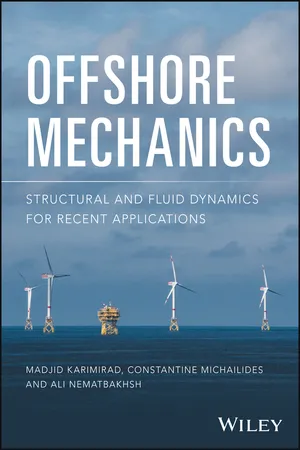
Covers theoretical concepts in offshore mechanics with consideration to new applications, including offshore wind farms, ocean energy devices, aquaculture, floating bridges, and submerged tunnels
This comprehensive book covers important aspects of the required analysis and design of offshore structures and systems and the fundamental background material for offshore engineering. Whereas most of the books currently available in the field use traditional oil, gas, and ship industry examples in order to explain the fundamentals in offshore mechanics, this book uses more recent applications, including recent fixed-bottom and floating offshore platforms, ocean energy structures and systems such as wind turbines, wave energy converters, tidal turbines and hybrid marine platforms.
Offshore Mechanics covers traditional and more recent methodologies used in offshore structure modelling (including SPH and hydroelasticity models). It also examines numerical techniques, including computational fluid dynamics and finite element method. Additionally, the book features easy-to-understand exercises and examples.
Provides a comprehensive treatment for the case of recent applications in offshore mechanics for researchers and engineers
Presents the subject of computational fluid dynamics (CFD) and finite element methods (FEM) along with the high fidelity numerical analysis of recent applications in offshore mechanics
Offers insight into the philosophy and power of numerical simulations and an understanding of the mathematical nature of the fluid and structural dynamics with focus on offshore mechanic applications
Offshore Mechanics: Structural and Fluid Dynamics for Recent Applications is an important book for graduate and senior undergraduate students in offshore engineering and for offshore engineers and researchers in the offshore industry.
Compared to inland structures, offshore structures have the added difficulty of being placed in the ocean environment. Hence, offshore structures are subjected to complicated loads and load effects. Important factors affect the design, functionality, structural integrity and performance of offshore structures, including but not limited to: fluid–structure interaction, intense dynamic effects, nonlinear loadings, extreme and harsh weather conditions and impact pressure loads. Offshore industry has seen rapid development in recent years. This includes the emergence of new marine structures in different areas such as offshore petroleum, marine renewable energy, sea transportation, offshore logistics and seafood production. As a result, new concepts and innovative offshore structures and systems have been proposed for use in the oceans.
An obvious need exists for a book providing the limitations and capabilities of theories and numerical analysis methods for structural and fluid dynamic analysis of recent applications in offshore mechanics. This book attempts to provide a comprehensive treatment of recent applications in offshore mechanics for researchers and engineers. The book covers important aspects of offshore structure and system analysis and design. Its contents cover the fundamental background material for offshore structure and system applications. Particular emphasis has been paid to the presentation of recent applications from the required theory and their applicability. The book covers recent applications in a broad area. This includes ship‐shaped offshore structures, recent fixed‐bottom and floating oil and gas platforms, ocean energy structures and systems (wind turbines, wave energy converters, tidal turbines and hybrid platforms), multipurpose offshore structures and systems, submerged tunnels and floating bridges for transportation purposes and aquacultures (fish farms).
Many of the applications of the theoretical principles are introduced, and several exercises as well as different simplified mathematical models are presented for recent applications in offshore engineering. In this book, practical design aspects of the aforementioned offshore structures are presented with handy design guides and examples, simple description of the various components for their robust numerical analysis and their functions. Additionally, special attention has been paid to present the subjects of computational fluid dynamics (CFD) and finite element methods (FEM) along with the high‐fidelity numerical analysis of recent applications in offshore mechanics.
The book makes available an insight into the philosophy and power of numerical simulations and an understanding of the mathematical nature of the fluid and structural dynamics, with focus on offshore mechanics applications. The current book helps students, researchers and engineers with mid‐engineering background gain good insights on theories and numerical analysis methods for structural and fluid dynamics for the cases of recent applications in offshore mechanics. Figure 1.1 presents the schematic layout of the book and shows different chapters as well as their roles in shaping this book.
Figure 1.1 Schematic layout, different chapters and their roles in forming the present book, Offshore Mechanics: Structural and Fluid Dynamics for Recent Applications.
The key features of the book are using “new” applications for describing the theoretical concepts in offshore mechanics, and covering both traditional and recent methodologies used in offshore structure modelling. Most of the books currently available in the field of offshore mechanics are based on using traditional oil, gas and ship industry examples to explain the fundamentals of offshore mechanics. Therefore, the reader becomes familiar with the basic concepts very well, but his or her viewpoint will remain limited to the traditional applications. This book tries to address this limitation by covering some recent applications, such as: offshore wind farms, ocean energy devices, aquaculture, floating bridges and submerged tunnels.
Furthermore, the current book not only covers traditional methodologies and concepts in the field of offshore mechanics, but also includes new approaches such as CFD and FEM techniques. The material in this book will help graduate students get needed knowledge in offshore industry for recent applications. Currently, due to the rapid increase in speed of computational resources, offshore industry is using various advanced CFD and FEM tools such as ANSYS and ABAQUS to analyse offshore structures. Therefore, qualified graduated students and engineers need to be familiar with both traditional methodologies and new methods applied in offshore mechanics proper for recent applications.
Structural fluid mechanics of offshore structures, the theories applied to recent applications and proper case studies to explain analytical and numerical methods make the core of this book. The hydrodynamic, stochastic dynamics and structural analyses are the book’s focus. What makes this book distinct from similar available books is that it covers recent applications in offshore industry by providing suitable examples. Simplified examples help students, researchers and engineers to understand the subjects and know how to use proper methods.
This book will help engineers and researchers in the field of offshore mechanics to become familiar with new trends and methodologies that have been applied recently. Different new offshore concepts such as offshore energy harvesters, floating bridges, submerged tunnels, multipurpose platforms, hybrid floaters as well as fish farms are going to play important roles in the future of offshore industry. Furthermore, new numerical techniques such as advanced CFD and FEM methods are currently used in industry.
We believe that the new offshore concepts that are now the focus of academic investigations gradually will be adopted by industry and probably result in greater popularity of this book. This book helps readers to learn the basic concepts of offshore mechanics not only by traditional standard applications, but also by applying these concepts for new structures in offshore engineering. In addition, it introduces the fundamentals of new numerical techniques that are emerging in offshore industry.
The book covers the fundamentals of offshore mechanics by teaching the reader how to use these concepts for traditional and (more specifically) current demands in offshore industry. The examples, given throughout the book, are for offshore structures that have been recently designed or are currently under development. For example, different offshore wind farms have been installed in Europe in recent years, and several projects are ongoing for harvesting energy from waves. We believe that a graduate student or an engineer in offshore industry should be well familiar with these concepts.
The methodologies for hydrodynamic and structural analyses of offshore structures are introduced and explained in this book. By learning the basics of the new methodologies, the reader has enough background to further expand his or her knowledge based on the needs in a specific industry. Throughout the chapters, special attention is given to familiarize the reader with numerical methods. These numerical methods cover both structural and hydrodynamic analysing of offshore structures.
This book is intended for graduate students, researchers, faculty members and engineers in the fields of: offshore structural engineering, offshore renewable energy (wind energy, wave energy and tidal energy), marine structures, ocean and coastal engineering, fluid dynamics and mechanical engineering. Its reading level can be considered as introductory or advanced. However, readers must have basic offshore engineering knowledge and interest related to the analysis and design of recent applications in offshore mechanics. The presented theories and applications are developed in a self‐contained manner, with an emphasis on fundamentals, concise derivations and simple examples.
The book has eight chapters. The first chapter introduces the book and explains its scope and objectives. The second chapter covers offshore structures, explaining different concepts such as ship‐shaped, oil and gas platforms (bottom‐fixed and floating), ocean energy devices (e.g. wind turbines, wave energy, ocean tidal turbines and hybrid platforms), multipurpose floaters, submerged tunnels, floating bridges and aquaculture and fish farms. The third chapter covers metocean and environmental conditions; in particular, wind, wave and current conditions, joint distribution of wave and wind, oceanography, bathymetry, seabed characteristics, extreme environmental conditions and environmental impacts of offshore structures. The fourth chapter explains the wave, wind and current kinematics as well as aerodynamic and hydrodynamic loads. This covers coupled hydrodynamic and aerodynamic analysis for offshore structures. Chapter 5 covers structural analysis and fundamental structural mechanics. This includes beam theories, stress–strain relation as well as buckling, bending, plate and plane theories and similar basic theories useful for studying the structural integrity of offshore and marine structures. In Chapter 6, the stress analysis, dynamics analysis, multibody formulation, time‐domain and frequency‐domain simulations, finite element methods, nonlinear analysis, extreme response calculation as well as testing and validation of offshore structures are discussed. The seventh chapter is dedicated to computational methods for fluid mechanics covering potential theories (i.e. a panel method covering radiation and diffraction as well as excitation forces). Computation fluid dynamics (CFD) is the core of this chapter, and different practical theories are included in this chapter. The eighth chapter covers mooring and foundation as well as theories related to soil mechanics and soil–foundation interaction.
The objective of the present book is to help the readers on different levels – namely, knowledge, comprehension, application, analysis, synthesis and evaluation – whenever they are dealing with physical problems that exist in offshore mechanics, especially with recent applications. As a result, the readers of the book will be able to: (a) exhibit learned material by recalling facts, terms and basic concepts; (b) demonstrate understanding of facts and basic concepts; (c) solve problems by applying acquired knowledge, facts, techniques and rules in a different way; (d) examine and split any possible information into parts by identifying motives or causes, making inferences and finding evidence to support solution methods; (e) compile information in a different way by combining elements in a new pattern; and (f) present and defend opinions by making judgments about relevant information based on a set of criteria.
In Chapter 2, we will review and present important information for different types of offshore structures, and we will try to identify an outline of their numerical analysis needs and the methods that have been used up to now. The types that will be presented are ship‐shaped offshore structures, oil and gas offshore platforms, offshore wind turbines, wave energy converters, tidal energy converters, multipurpose offshore structures and systems, submerged floating tunnels and aquaculture and fish farms. For all the types of recent applications of offshore structures, categorization and basic design aspects are presented.
In Chapter 3, we will present important information about the generation and the process of propagation of different environmental conditions that may affect the structural integrity of recent applications of offshore structures. Different environmental processes like the wave, wind, current, scour and erosion are described appropriately in connection with possible effects that they have on all the different types of offshore structures that are examined. Moreover, the effect of joint analysis on wind and wave is presented. Finally, insight is presented about the estimation of extreme environmental conditions that have straightforward relation with the survivability of offshore structures.
In Chapter 4, we deal with the three dominant excitation loading conditions that influence the lifetime of offshore structures: the wave, tidal and wind loadings. Wave kinematic theories that exist for addressing regular and irregular waves are presented. Moreover, methods for estimating the wave loads induced by inviscid flows in members of offshore structures are presented, too. In addition, tide and current kinematic methods are presented with emphasis on methods for estimating the current loads on offshore structures. Wind kinematic methods that have application for the design of offshore structures are presented along with numerical methods for estimating the wind loadings. Finally, fundamental topics of the required aerodynamic analysis for the design of offshore wind turbines are presented. Emphasis is on presenting numerical methods for estimating the aforementioned environmental loadings and on how these loads are used compared to different numerical tools.
In Chapter 5, some of the important principles of statics and dynamics and how these are used to determine the resultant internal loadings in an offshore structure are initially presented. Furthermore, the concepts of normal and shear stress are introduced along with the strains induced by the deformation of the body. Moreover, important information about the appropriate development of structural elements of offshore structures is presented. Beams and plates, and methods for developing numerical models with the use of these types of structural elements for the structural analysis of offshore structures, are presented.
In Chapter 6, numerical methods that are used in offshore engineering for the structural response dynamic analysis of different types of offshore structures are presented. Dynamic loadings dominate the response of offshore structures. Numerical methods for the development of numerical models and tools for the dynamic analysis of offshore structures in both frequency and time domain are presented. Also, special cases where a multibody approach is needed or nonlinear phenomena exist, and numerical methods for handling these special cases, are presented. Methods for estimating or predicting numerically the extreme response values of different components of offshore structures (e.g. mooring lines, pontoons of a semisubmersible platform and t...
Table of contents
Cover
Title Page
Table of Contents
About the Authors
Preface
Acknowledgements
1 Preliminaries
2 Offshore Structures
3 Offshore Environmental Conditions
4 Hydrodynamic and Aerodynamic Analyses of Offshore Structures
5 Fundamentals of Structural Analysis
6 Numerical Methods in Offshore Structural Mechanics
7 Numerical Methods in Offshore Fluid Mechanics
8 Mooring and Foundation Analysis
Index
End User License Agreement
Trusted by 375,005 students
Access to over 1.5 million titles for a fair monthly price.
Study more efficiently using our study tools.
Frequently asked questions
Yes, you can cancel anytime from the Subscription tab in your account settings on the Perlego website. Your subscription will stay active until the end of your current billing period. Learn how to cancel your subscription
No, books cannot be downloaded as external files, such as PDFs, for use outside of Perlego. However, you can download books within the Perlego app for offline reading on mobile or tablet. Learn how to download books offline
Perlego offers two plans: Essential and Complete
Essential is ideal for learners and professionals who enjoy exploring a wide range of subjects. Access the Essential Library with 800,000+ trusted titles and best-sellers across business, personal growth, and the humanities. Includes unlimited reading time and Standard Read Aloud voice.
Complete: Perfect for advanced learners and researchers needing full, unrestricted access. Unlock 1.5M+ books across hundreds of subjects, including academic and specialized titles. The Complete Plan also includes advanced features like Premium Read Aloud and Research Assistant.
Both plans are available with monthly, semester, or annual billing cycles.
We are an online textbook subscription service, where you can get access to an entire online library for less than the price of a single book per month. With over 1.5 million books across 990+ topics, we’ve got you covered! Learn about our mission
Look out for the read-aloud symbol on your next book to see if you can listen to it. The read-aloud tool reads text aloud for you, highlighting the text as it is being read. You can pause it, speed it up and slow it down. Learn more about Read Aloud
Yes! You can use the Perlego app on both iOS and Android devices to read anytime, anywhere — even offline. Perfect for commutes or when you’re on the go. Please note we cannot support devices running on iOS 13 and Android 7 or earlier. Learn more about using the app
Yes, you can access Offshore Mechanics by Madjid Karimirad,Constantine Michailides,Ali Nematbakhsh in PDF and/or ePUB format, as well as other popular books in Technology & Engineering & Mechanical Engineering. We have over 1.5 million books available in our catalogue for you to explore.