The Handbook of Behavioral Operations
eBook - ePub

The Handbook of Behavioral Operations

  1. English
  2. ePUB (mobile friendly)
  3. Available on iOS & Android
eBook - ePub

About this book

A comprehensive review of behavioral operations management that puts the focus on new and trending research in the field

The Handbook of Behavioral Operations offers a comprehensive resource that fills the gap in the behavioral operations management literature. This vital text highlights best practices in behavioral operations research and identifies the most current research directions and their applications. A volume in the Wiley Series in Operations Research and Management Science, this book contains contributions from an international panel of scholars from a wide variety of backgrounds who are conducting behavioral research.

The handbook provides succinct tutorials on common methods used to conduct behavioral research, serves as a resource for current topics in behavioral operations research, and as a guide to the use of new research methods. The authors review the fundamental theories and offer frameworks from a psychological, systems dynamics, and behavioral economic standpoint. They provide a crucial grounding for behavioral operations as well as an entry point for new areas of behavioral research. The handbook also presents a variety of behavioral operations applications that focus on specific areas of study and includes a survey of current and future research needs. This important resource:

  • Contains a summary of the methodological foundationsand in-depth treatment of research best practices in behavioral research.
  • Provides a comprehensive review ofthe research conducted over the past two decades in behavioral operations, including such classic topics as inventory management, supply chain contracting, forecasting, andcompetitive sourcing.
  • Covers a wide-range of currenttopics andapplications including supply chain risk, responsible and sustainable supplychain, health care operations, culture and trust.
  • Connects existing bodies of behavioral operations literature with related fields, including psychology and economics.
  • Providesa vision for futurebehavioral research in operations.

Written for academicians within the operations management community as well as for behavioral researchers, The Handbook of Behavioral Operations offers a comprehensive resource for the study of how individuals make decisions in an operational context with contributions from experts in the field.

Frequently asked questions

Yes, you can cancel anytime from the Subscription tab in your account settings on the Perlego website. Your subscription will stay active until the end of your current billing period. Learn how to cancel your subscription.
No, books cannot be downloaded as external files, such as PDFs, for use outside of Perlego. However, you can download books within the Perlego app for offline reading on mobile or tablet. Learn more here.
Perlego offers two plans: Essential and Complete
  • Essential is ideal for learners and professionals who enjoy exploring a wide range of subjects. Access the Essential Library with 800,000+ trusted titles and best-sellers across business, personal growth, and the humanities. Includes unlimited reading time and Standard Read Aloud voice.
  • Complete: Perfect for advanced learners and researchers needing full, unrestricted access. Unlock 1.4M+ books across hundreds of subjects, including academic and specialized titles. The Complete Plan also includes advanced features like Premium Read Aloud and Research Assistant.
Both plans are available with monthly, semester, or annual billing cycles.
We are an online textbook subscription service, where you can get access to an entire online library for less than the price of a single book per month. With over 1 million books across 1000+ topics, we’ve got you covered! Learn more here.
Look out for the read-aloud symbol on your next book to see if you can listen to it. The read-aloud tool reads text aloud for you, highlighting the text as it is being read. You can pause it, speed it up and slow it down. Learn more here.
Yes! You can use the Perlego app on both iOS or Android devices to read anytime, anywhere — even offline. Perfect for commutes or when you’re on the go.
Please note we cannot support devices running on iOS 13 and Android 7 or earlier. Learn more about using the app.
Yes, you can access The Handbook of Behavioral Operations by Karen Donohue, Elena Katok, Stephen Leider, Karen Donohue,Elena Katok,Stephen Leider in PDF and/or ePUB format, as well as other popular books in Business & Management. We have over one million books available in our catalogue for you to explore.

Information

Publisher
Wiley
Year
2018
Print ISBN
9781119138303
eBook ISBN
9781119138310
Edition
1
Subtopic
Management

Part I
Methodology

1
Designing and Conducting Laboratory Experiments

Elena Katok
Naveen Jindal School of Management, University of Texas at Dallas, Richardson, TX, USA

1.1 Why Use Laboratory Experiments?

Operations management (OM) is a field with strong tradition of analytical modeling. Most of the early analytical work in OM was primarily optimization based and dealt with central planning for such problems as job‐shop scheduling, lot sizing, and queuing. Starting in the 1980s, OM researchers became interested in modeling strategic settings that involve interactions between firms. Today, OM models tackle problems that deal with supply chain coordination, competition, and cooperation, which examine incentives and objectives of firms as well as individual decision makers. This type of work requires a model of decision‐making at individual and/or firm level.
Supply chains are not centralized, but consist of individual self‐interested firms – original equipment manufacturers (OEMs), different tiers of suppliers, transportation vendors, and retailers. These firms face uncertainty from the environment, such as production yield, processing times, and customer demand, as well as strategic uncertainty, which comes from the uncertainty about the actions of the other supply chain members. Traditionally, OM models assumed that firms are expected profit maximizers and are fully rational, meaning that they correctly anticipate the actions of the other supply chain members.
Behavioral operations management (BOM) started in order to first test, and then improve, modeling assumptions about decision‐making. Schweitzer and Cachon (2000) is the seminal BOM paper that tested how individuals solve the ā€œnewsvendor problem.ā€ It turned out that individuals generally do not solve the problem correctly, but are rather systematic and predictable in how their decisions deviate from optimal. Schweitzer and Cachon (2000) finding, and numerous studies that followed (see Chapter 11), has major implications for OM models, because the newsvendor problem is a building block for much of the inventory theory.
BOM work lives at the boundary of analytical and behavioral disciplines. It is aimed at developing models of decision‐making to better explain, predict, and improve analytical models in OM. There are many empirical methods for studying human behavior in general and human judgment and decision‐making in particular. Laboratory experiment, the topic of this chapter, is one of the empirical methods we use in BOM. Similar methods have been employed in a number of other social science fields, including psychology and sociology (social networks), law (jury behavior), political science (coalition formation), anthropology, biology (reciprocity), and especially experimental economics, that have a long and rich tradition of studying problems that are similar to the ones of interest to the OM community.
Laboratory experiments can be designed to test analytical models in a way that gives the theory the best possible shot to work. This is done by carefully controlling the environment, especially information available to the participants, to match theoretical assumptions. Parameters can be selected in a way that treatment effects predicted by the model are large enough to be detected in the laboratory, given appropriate sample sizes and the level of general ā€œnoiseā€ in human behavior. If the theory fails to survive such a test, a conclusion can be made that the model is likely to be missing some important behavioral aspect. If a theory survives such a test, we can conclude that that the model qualitatively captures enough of the behavioral factors to organize the data, and further robustness tests can be performed by manipulating parameters.
The ability to cleanly establish causality is a relative advantage of laboratory experiments, compared with other empirical methods. In the laboratory, causality is established by directly manipulating treatment variables at desired levels and randomly assigning participants to treatments. Random assignment ensures that treatment effects can be attributed to the treatment variables and not be confounded by any other, possibly unobservable, variables. Other empirical methods rely on existing field data, so neither random assignment nor direct manipulation of treatment conditions is possible, so causality cannot be directly established.
Another advantage of laboratory experiments is that they lend themselves well to being replicated by researchers in different laboratories. Replicating results is important because any single laboratory result can be an artifact of the protocols or settings in the specific laboratory.
Results that have been replicated in different contexts and by different research teams can be considered reliable. A recent article published in Science (Open Science Collaboration 2015) highlighted the importance of replicating experimental results. It reported that only 36% of psychology studies published in three important psychology journals and selected as part of a large‐scale replication project had statistically significant results when replicated. Replications done in the Science article showed that while in the original studies most reported r...
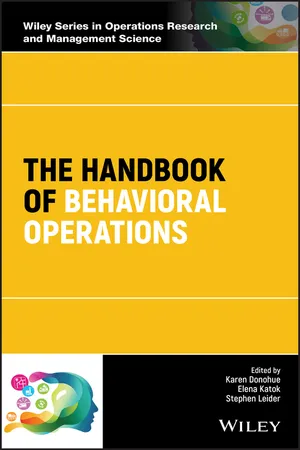
Table of contents

  1. Cover
  2. Table of Contents
  3. Preface
  4. Part I: Methodology
  5. Part II: Classical Approaches to Analyzing Behavior
  6. Part III: Applications within Operations Management
  7. Index
  8. End User License Agreement