- The first work of its kind to take students from brainstorming to outlining to sentence and paragraph construction to paper presentation, drawing on student-written examples
- Easy-to-understand explanations of passive voice, point of view, commonly accepted citation styles, and more, with current and relatable student-written examples
- Covers common writing assignments in communication and related courses, including the literature review, application paper, and empirical research paper
- Four pedagogical features enhance comprehension and support learning: "Write Away" quick exercises, integratable "Building Blocks" assignments, "Engaging Ethics" tips, and "Student Spotlight" examples
eBook - ePub
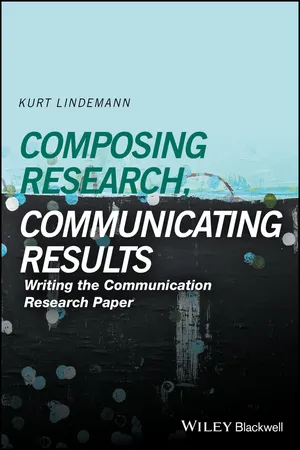
Composing Research, Communicating Results
Writing the Communication Research Paper
- English
- ePUB (mobile friendly)
- Available on iOS & Android
eBook - ePub
About this book
Composing Research, Communicating Results: Writing the Communication Research Paper provides communication students with the knowledge and necessary tools to compose a variety of course-required papers that are scholarly, accessible, and well-written.
Information
1
So You Have to Write a Research Paper …
CHAPTER CONTENTS
- Chapter Learning Outcomes
- Chapter Features
- What This Book Is Not …
- What This Book Is …
- Features of This Book
- The Purpose of This Chapter
- Writing Papers: Chore or Challenge?
- Challenge: How do I find time to write?
- Challenge: Is this supposed to be fact or opinion?
- Challenge: How do I find research on my topic?
- Challenge: Problems and potential of using published articles as models
- Debunking Myths about Research Papers
- The “Tao” of Writing
- Topic
- Audience
- Occasion
- Types of Papers
- Reviews of literature
- Analysis, application, and reaction papers
- Empirical research papers
- Thinking Beyond the Paper – Writing for a Professional Career
- Handbooks and manuals
- Policy manuals, vision statements, and mission statements
- E‐mails
- Reports and memos
- Blogs and website copy
- Chapter Summary
- References
- Further Reading
Chapter Learning Outcomes
- Identify Myths about Writing Research Papers
- Distinguish Types of Papers Commonly Written
- Identify the Purposes of Different Research Papers
- Apply Writing Skills to “Real‐World” Texts
Chapter Features
- “Write Away”
- Building Blocks
You are sitting in a cramped chair facing the front of the classroom. You look around the classroom and listen to the low chatter of students awaiting the start of class. Some faces and voices are familiar, others are not. You look forward to making new friends, talking to people with different experiences and ideas, and maybe learning something. You hope to get a good grade, too, of course. You check your phone for the time. Class is about start. The teacher enters the room: pleasant demeanor, conversational tone, funny. This might just be a fun class, you think. Then the teacher begins to explain the assignments for the upcoming term. The major one, the assignment upon which most of your grade rests: a research paper. Why?, you think. Why a research paper? You re‐evaluate the class and the teacher. Suddenly, all the positive things you initially thought about the class seem, well … not so positive.
The above scenario is likely a common one in many students’ experiences. The course research paper, sometimes called a “term paper,” is an object of much derision, disdain, and dread among students. And, certainly, writing a research paper is difficult. Writing a good research paper is even more difficult. I’m not writing this book to convince you otherwise. I do, however, think that, with some knowledge and skills, almost anyone can succeed in writing a good research paper. Some people think that good writers are born not made, that somehow – genetically blessed or with gifts granted by a divine being – some people just get writing. I do not believe this. Sure, some folks have an easier time writing papers; I’m not denying that. But I think that good writers can be made; otherwise, I wouldn’t be writing this book. And you probably don’t think good writers are born, not made; otherwise you wouldn’t be reading this book. Of course, it’s entirely possible you’re reading this because your teacher required you to read it. If this is the case, then at least your teacher probably thinks the same as I do.
What This Book Is Not …
Here’s what this book is not. While we will explore some common grammar mistakes, this is not a text on proper grammar and sentence diagramming. While we will talk about integrating scholarly and popular literature into a research paper, this is not a how‐to on library research, nor is it a summary of relevant communication and social science research. While I will provide some easy‐to‐remember steps to completing commonly assigned papers, this is not a fill‐in‐the‐blank template for outlines and papers.
What This Book Is …
I admit that I had selfish reasons for writing this book. I am a Professor of Communication at a university. I teach research methods, performance studies, organizational communication, and a few other courses. I regularly assign research papers to my undergraduate and graduate students. And while I have a Ph.D. in communication, I also have a graduate degree in English language and literature, which required me to teach English composition classes and work in the department’s writing tutoring center. As a result, much to my current students’ dismay, I found myself frequently commenting on sentence structure, topic sentence usage, grammar mistakes, and other writing issues. I found myself writing the same comments time and again. I began to think, “It would be great if there were a book that collected all these comments and explained them for students.” Shortly after thinking this, I began writing this book.
That said, this book isn’t meant to replace the instruction from your own teacher. It is meant to help guide you through a sometimes daunting and intimidating process. This book is not meant to convince you to like writing papers. If you don’t already, chances are a textbook isn’t going to change your mind. What this book is intended to do is to make the writing process easier and to help ensure the entire writing process results in successful outcomes: well‐written arguments and analysis and … oh, yeah, possibly a good grade!
Features of This Book
As you read this book, you’ll find several features I think will be helpful in understanding the concepts and practices covered in each chapter. The first are “Write Away” boxes that offer writing exercises you can immediately put into practice to improve your writing. “Building Blocks” are meant to be short “mini assignments” which, once completed, you can integrate into your larger writing assignment. Research papers are fraught with ethical challenges, from plagiarizing to improperly citing sources. For this reason, the “Engaging Ethics” feature provides some things to consider to better avoid the ethical pitfalls that may arise in the course of your research and writing. Finally, since we often learn best from our peers, the “Student Spotlight” sections provide actual examples of student writing that illustrate the concepts and assignments covered in this book. Each feature should not only help you better understand the concepts we cover in this book, they should also help you write better.
The Purpose of This Chapter
So, we “begin at the beginning,” as the King instructs the White Rabbit in Alice’s Adventures in Wonderland (Carroll 1920, 182). This chapter is a beginning: the first step, the first brick in a sidewalk path, the first word in a sentence, the first page of a book. No better place to start. And this is true for writing papers as well.
Put one word after another. Find the right word, put it down.
Neil Gaiman (2014)
This chapter will first try to debunk some myths about writing. Mental blocks are the most difficult obstacles to writing well; you can always learn proper sentence structure and new words, but it’s much harder to learn to unthink solidified beliefs. As such, we’ll address some of these commonly held beliefs or myths. Then we’ll review some of the major types of papers commonly assigned, which I’ll also cover in detail in subsequent chapters. Finally, we’ll discuss how the skills you gain from these assignments can transfer to other types of writing you might do in the “real world.”
We’ll start with some commonly held beliefs or myths about writing papers for class. I’ll reframe as challenges what we might normally think of as chores. After that, we’ll move on to myths specific to composing research papers, ones that I’ve heard students (and some professors!) say over and ove...
Table of contents
- Cover
- Title Page
- Table of Contents
- Preface
- Acknowledgments
- 1 So You Have to Write a Research Paper …
- 2 Brainstorm and Research
- 3 Making Arguments, Providing Support
- 4 Style and Format
- 5 Writing the Literature Review
- 6 Application and Reaction Papers
- 7 Writing Empirical Research Papers
- 8 What Next? Presenting and Publishing Papers
- Index
- End User License Agreement
Trusted by 375,005 students
Access to over 1.5 million titles for a fair monthly price.
Study more efficiently using our study tools.
Frequently asked questions
Yes, you can cancel anytime from the Subscription tab in your account settings on the Perlego website. Your subscription will stay active until the end of your current billing period. Learn how to cancel your subscription
No, books cannot be downloaded as external files, such as PDFs, for use outside of Perlego. However, you can download books within the Perlego app for offline reading on mobile or tablet. Learn how to download books offline
Perlego offers two plans: Essential and Complete
- Essential is ideal for learners and professionals who enjoy exploring a wide range of subjects. Access the Essential Library with 800,000+ trusted titles and best-sellers across business, personal growth, and the humanities. Includes unlimited reading time and Standard Read Aloud voice.
- Complete: Perfect for advanced learners and researchers needing full, unrestricted access. Unlock 1.5M+ books across hundreds of subjects, including academic and specialized titles. The Complete Plan also includes advanced features like Premium Read Aloud and Research Assistant.
We are an online textbook subscription service, where you can get access to an entire online library for less than the price of a single book per month. With over 1.5 million books across 990+ topics, we’ve got you covered! Learn about our mission
Look out for the read-aloud symbol on your next book to see if you can listen to it. The read-aloud tool reads text aloud for you, highlighting the text as it is being read. You can pause it, speed it up and slow it down. Learn more about Read Aloud
Yes! You can use the Perlego app on both iOS and Android devices to read anytime, anywhere — even offline. Perfect for commutes or when you’re on the go.
Please note we cannot support devices running on iOS 13 and Android 7 or earlier. Learn more about using the app
Please note we cannot support devices running on iOS 13 and Android 7 or earlier. Learn more about using the app
Yes, you can access Composing Research, Communicating Results by Kurt Lindemann in PDF and/or ePUB format, as well as other popular books in Social Sciences & Social Science Research & Methodology. We have over 1.5 million books available in our catalogue for you to explore.