Provides an all-encompassing look at the history of Russia, Central Asia, and Mongolia
Beginning with the breakup of the Mongol Empire in the mid-thirteenth century, Volume II of this comprehensive work covers the remarkable history of "Inner Eurasia," from 1260 up to modern times, completing the story begun in Volume I. Volume II describes how agriculture spread through Inner Eurasia, providing the foundations for new agricultural states, including the Russian Empire. It focuses on the idea of "mobilization"—the distinctive ways in which elite groups mobilized resources from their populations, and how those methods were shaped by the region's distinctive ecology, which differed greatly from that of "Outer Eurasia," the southern half of Eurasia and the part of Eurasia most studied by historians. This work also examines how fossil fuels created a bonanza of energy that helped shape the history of the Communist world during much of the twentieth century.
Filled with figures, maps, and tables to help give readers a fuller understanding of what has transpired over 750 years in this distinctive world region, A History of Russia, Central Asia and Mongolia: Volume II: Inner Eurasia from the Mongol Empire to Today, 1260-2000 is a magisterial but accessible account of this area's past, that will offer readers new insights into the history of an often misunderstood part of the world.
Situates the histories of Russia, Central Asia, and Mongolia within the larger narrative of world history
Concentrates on the idea of Inner Eurasia as a coherent ecological and geographical zone
Focuses on the powerful ways in which the region's geography shaped its history
Places great emphasis on how "mobilization" played a major part in the development of the regions
Offers a distinctive interpretation of modernity that highlights the importance of fossil fuels
Offers new ways of understanding the Soviet era
A History of Russia, Central Asia and Mongolia: Volume II is an ideal book for general audiences and for use in undergraduate and graduate courses in world history.
The Blackwell History of the World Series
The goal of this ambitious series is to provide an accessible source of knowledge about the entire human past, for every curious person in every part of the world. It will comprise some two dozen volumes, of which some provide synoptic views of the history of particular regions while others consider the world as a whole during a particular period of time. The volumes are narrative in form, giving balanced attention to social and cultural history (in the broadest sense) as well as to institutional development and political change. Each provides a systematic account of a very large subject, but they are also both imaginative and interpretative. The Series is intended to be accessible to the widest possible readership, and the accessibility of its volumes is matched by the style of presentation and production.
[1] INNER EURASIA IN THE LATE THIRTEENTH CENTURY: THE MONGOL EMPIRE AT ITS HEIGHT
THE WORLD IN 1250
First it should be known that in every clime of the world there have been and are people who dwell in cities, people who live in villages, and people who inhabit the wilderness. The wilderness dwellers are particularly numerous in territories that are grass lands, have fodder for many animals, and are also far from civilization and agricultural lands.1
In 1250, human societies were still divided into zones so disconnected that they could almost have lived on separate planets. Human communities in Afro-Eurasia, the Americas, Australasia, and the Pacific had barely any contact with each other.
Of these world zones, the Afro-Eurasian zone, reaching from the Cape of Good Hope to northeastern Siberia, was by far the largest, had the most people, the greatest variety of cultures, cuisines, and technologies, and enjoyed the most vibrant exchanges of goods, peoples, ideas, and even diseases. These exchanges were most vigorous within the densely populated agrarian societies of Outer Eurasia, from China through South-East Asia, to India, the Middle East, North Africa, the Mediterranean region, and Europe. But increasing exchanges also forged connections through the southern parts of Inner Eurasia, along the so-called Silk Roads.2 Many of these connections were created by regional pastoralists and traders. But they flourished best when Outer Eurasian empires that bordered on Inner Eurasia, such as China or Persia, became interested in long-distance trade through the region, and protected merchant caravans or sent caravans of their own, or when powerful Inner Eurasian empires tried to tap the wealth of neighboring regions of Outer Eurasia, or when both types of polities existed simultaneously.
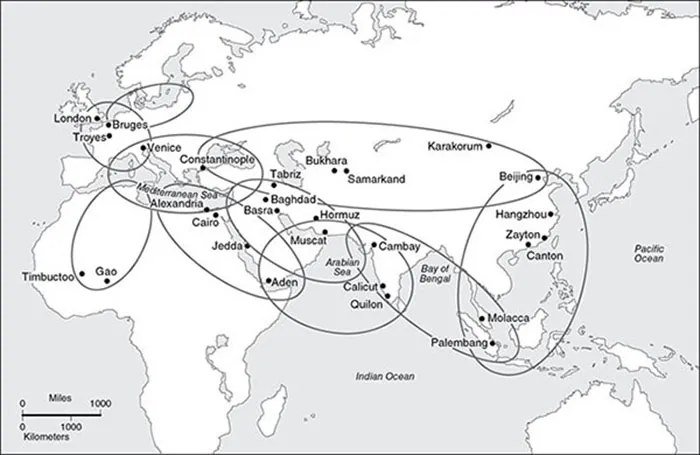
Since the first millennium BCE, such mechanisms had driven several pulses of trans-Eurasian integration. At the start of the Common Era, large empires in Han China, Persia, and the Mediterranean, and steppe empires such as the Xiongnu in Mongolia, or borderland empires such as the Kusana in modern Central Asia and Afghanistan, synergized transcontinental exchanges. A second integrative pulse coincided with the rise of Islam from the seventh century CE.3 It linked powerful empires in the Mediterranean region, Persia and China, with Turkic steppe empires. In the thirteenth century, the Mongol Empire emerged during a third integrative pulse, and helped create long-distance exchanges more vibrant than ever before.4 Janet Abu-Lughod has argued that this pulse created the first Afro-Eurasian “world system,” by briefly linking eight regional networks of exchange into a single system (Map 1.1).5
Map 1.1 Abu-Lughod map of Afro-Eurasian trade circuits prior to 1500. Abu-Lughod, Before European Hegemony, 34. Reproduced with permission of Oxford University Press.
The globalizing pulse of the thirteenth and early fourteenth centuries networked more of Afro-Eurasia more powerfully than ever before. In Inner Eurasia, with its scattered populations and limited surpluses, new flows of wealth could have a spectacular impact. Here, they jump-started political, economic, cultural, and military mobilization in a sort of “sparking across the gap.”6 The Mongol Empire's Chinggisid rulers understood what vast arbitrage profits could be made by moving goods such as silk or tea or silver, which were rare and expensive in one part of Eurasia but common and cheap in another, and many Mongolian leaders, including Chinggis Khan's own family, formed profitable trading partnerships, or ortoq, with Central Asian merchants.7 These yoked the financial and commercial expertise of Central Asian cities and merchants to the military power of Mongol armies, in alliances that mobilized what were, by Inner Eurasian standards, colossal amounts of wealth.
By protecting trans-Eurasian commerce, Mongol rulers encouraged travel and trade along the Silk Roads. For the first time in world history, many individuals crossed the entire continent. They included Marco Polo, the Mongol soldiers and commanders who campaigned from Mongolia to eastern Europe, and the Nestorian Christian missionary Rabban Sauma, who left northern China for Persia in about 1275, before traveling to Rome and Paris as an ambassador of the Mongol ruler of Persia, the Il-Khan.8 In about 1340, Francis Balducci Pegolotti, an agent of the Florentine mercantile company of the Bardi, compiled a handbook for Florentine merchants, which asserted confidently that, “The road you travel from Tana [modern Azov] to Cathay is perfectly safe, whether by day or by night, according to what the merchants say who have used it.”9 At about the time that Pegolotti's guidebook was published, the Muslim traveler Ibn Battuta accompanied caravans from the Black Sea through the Pontic and Khorezmian steppes to Central Asia and on to India. He may have traveled to China before returning to his native Morocco and making one final trip across the Sahara.10
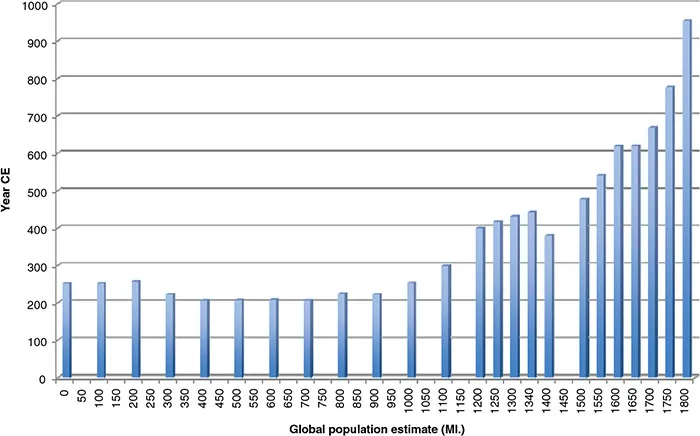
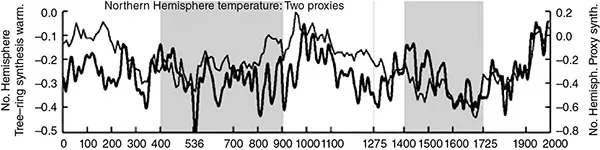
Warmer climates and several centuries of demographic growth helped drive the thirteenth-century pulse of integration. Particularly in previously underpopulated regions on the borders of major agrarian regions, populations rose fast from late in the first millennium CE, as peasants migrated down the demographic gradient into underpopulated regions in southern China or western Inner Eurasia, bringing new technologies and new crops or crop varieties, and driving commerce and urbanization (Figure 1.1). According to McEvedy and Jones, the population of Outer Eurasia changed little between 200 and 800 CE, by which time it was 180 million.11 Then growth picked up. By 1000 CE, 215 million people lived in Outer Eurasia, and by 1200 CE, 315 million. In much of Eurasia, population growth may have been linked to the generally warmer and wetter climates of the “Medieval Climate Anomaly,” which John L. Brooke dates to 900–1275.12 During this period northern hemisphere temperatures were on average more stable and warmer than they would be again until the twentieth century (Figure 1.2).13
Figure 1.1 Global populations over 1,800 years. Brooke, Climate Change, 259. Reproduced with permission of Cambridge University Press.
Figure 1.2 Climate change 1 CE to 2000 CE. Brooke, Climate Change, 250. Reproduced with permission of Cambridge University Press.
The Medieval Climate Anomaly played out somewhat differently in Inner Eurasia. Here, it generated long periods of drought and cold from 1000 CE until the late fourteenth century. These bleak conditions provide the background to the civil wars of Chinggis Khan's youth, as they limited livestock levels and impoverished pastoralists. Cli...
Table of contents
Cover
Title Page
Copyright
List of Maps
Series Editor's Preface
Acknowledgments
Preface: The Idea of Inner Eurasia
PART I INNER EURASIA IN THE AGRARIAN ERA: 1260–1850
PART II INNER EURASIA IN THE ERA OF FOSSIL FUELS: 1850–2000
Epilogue: After 2000: The End of Inner Eurasia?
Chronology
Index
EULA
Trusted by 375,005 students
Access to over 1.5 million titles for a fair monthly price.
Study more efficiently using our study tools.
Frequently asked questions
Yes, you can cancel anytime from the Subscription tab in your account settings on the Perlego website. Your subscription will stay active until the end of your current billing period. Learn how to cancel your subscription
No, books cannot be downloaded as external files, such as PDFs, for use outside of Perlego. However, you can download books within the Perlego app for offline reading on mobile or tablet. Learn how to download books offline
Perlego offers two plans: Essential and Complete
Essential is ideal for learners and professionals who enjoy exploring a wide range of subjects. Access the Essential Library with 800,000+ trusted titles and best-sellers across business, personal growth, and the humanities. Includes unlimited reading time and Standard Read Aloud voice.
Complete: Perfect for advanced learners and researchers needing full, unrestricted access. Unlock 1.5M+ books across hundreds of subjects, including academic and specialized titles. The Complete Plan also includes advanced features like Premium Read Aloud and Research Assistant.
Both plans are available with monthly, semester, or annual billing cycles.
We are an online textbook subscription service, where you can get access to an entire online library for less than the price of a single book per month. With over 1.5 million books across 990+ topics, we’ve got you covered! Learn about our mission
Look out for the read-aloud symbol on your next book to see if you can listen to it. The read-aloud tool reads text aloud for you, highlighting the text as it is being read. You can pause it, speed it up and slow it down. Learn more about Read Aloud
Yes! You can use the Perlego app on both iOS and Android devices to read anytime, anywhere — even offline. Perfect for commutes or when you’re on the go. Please note we cannot support devices running on iOS 13 and Android 7 or earlier. Learn more about using the app
Yes, you can access A History of Russia, Central Asia and Mongolia, Volume II by David Christian in PDF and/or ePUB format, as well as other popular books in History & Russian History. We have over 1.5 million books available in our catalogue for you to explore.