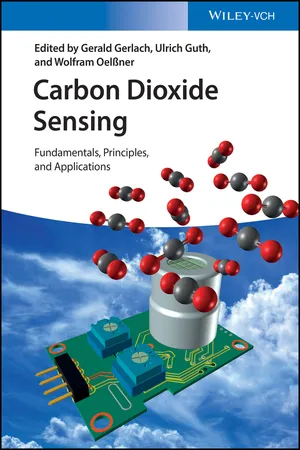
The book provides the reader with a profound knowledge of basic principles, properties and preferred applications of diverse kinds of CO2 measurement. It shows the advantages, disadvantages and limitations of several methods and gives a comprehensive overview of both possible applications and corresponding boundary conditions. Applications reach from environmental monitoring to safety control to biotechnology and food control and finally to medicine.
Kurt‐Schwabe‐Institut für Mess‐ und Sensortechnik e.V. Meinsberg, Kurt‐Schwabe‐Straße 4, 04736 Waldheim, Germany
Carbon dioxide (CO2) is one of the key components in our life and without any doubt the most important chemical substance in the global climate system. It presents the feedstock for plant assimilation and for the growth of plants and phyto cells in the biological carbon cycle as well as buffer system in the blood of humans and animals, and hence, it is important for total life on Earth. On the other hand, CO2 is the “waste” produced by the metabolism of most of the living creatures on our Earth and by combustion of fossil fuels using carbon stocks or biomass, and it is widely understood to be one of the crucial sources of the dangerous greenhouse effect. Observation of CO2 in the atmosphere and in the oceans yields important signals for long‐term predictions of the world's climate. Furthermore, in process technology, CO2 is an important reagent for the manufacture of a variety of products. Monitoring of CO2 in chemical as well as in biotechnological processes is a valuable tool to control the efficiency of the production processes. Since carbon dioxide in higher concentration can be lethal for human beings, CO2 warning devices are needed. This short listing indicates the general importance of CO2 and the need to determine it in gases as well as in liquids over a wide range of concentrations from ppm level up to 100% [1].
In publications and regulations the CO2 concentration is indicated in different units. The general formula for converting the units vol ppm to mg m−3 and vice versa is:
1.1
with M being the molar mass in g mol−1 (e.g. for CO2M = 44 g mol−1) and Vm being the molar volume in l mol−1 (e.g. for ideal gases at 25 °C Vm = 24.5 l mol−1).
Table 1.1 is intended to simplify the conversion.
Table 1.1 Conversion factors for CO2 concentrations.
To
To convert from the units on the left to the units on top, multiply by
vol%
vol ppm
mg m−3
From
vol%
1
104
1.8 × 10⁴
vol ppm
10−4
1
1.8
mg m−3
5.56 × 10⁻⁵
0.56
1
In medicine, the carbon dioxide partial pressure pCO2 is usually indicated in the unit mm Hg instead of in the SI unit Pa. The conversion is done according to Table 1.2.
Table 1.2 Conversion factors for CO2 partial pressures.
To
To convert from the units on the left to the units on top, multiply by
mm Hg
Pa
bar
From
mm Hg
1
133.32
1.33 × 10⁻³
Pa
7.50 × 10⁻³
1
10−5
bar
750.06
105
1
This means that typical CO2 partial pressures in the range pCO2 =35–45 mm Hg correspond to 4.6–6.0 kPa.
Depending on the medium in which CO2 needs to be measured and the requirements for measuring range, accuracy, long‐term stability, selectivity, and maintenance, different methods can be applied [1] :
Standard test methods for the analytical determination of total and dissolved carbon dioxide in water require the titration of test samples.
CO2 sensors that are based on various chemical or physical measuring methods are more user‐friendly and therefore preferably applied:
Because of their simple set‐up and the resulting low costs, membrane‐covered electrochemical CO2 sensors according to the Severinghaus principle have been manufactured and widely applied already for a long time. Unlike other types of CO2 sensors, Severinghaus sensors can be applied not only in gases but also for direct measurements in liquid media.
In comparison with these sensors with aqueous electrolytes, solid electrolyte CO2 sensors operating at high temperatures have the advantages of a short response time and maintenance‐free operation without calibration. They are used successfully in all cases of long‐term ...
Table of contents
Cover
Table of Contents
Scientific Biographies of the Authors
Scientific Biographies of the Co-Authors to Chapter 16
Preface
Part I: General
Part II: Principles of Carbon Dioxide Sensors and Measuring Methods
Part II: Applications
Index
End User License Agreement
Trusted by 375,005 students
Access to over 1.5 million titles for a fair monthly price.
Study more efficiently using our study tools.
Frequently asked questions
Yes, you can cancel anytime from the Subscription tab in your account settings on the Perlego website. Your subscription will stay active until the end of your current billing period. Learn how to cancel your subscription
No, books cannot be downloaded as external files, such as PDFs, for use outside of Perlego. However, you can download books within the Perlego app for offline reading on mobile or tablet. Learn how to download books offline
Perlego offers two plans: Essential and Complete
Essential is ideal for learners and professionals who enjoy exploring a wide range of subjects. Access the Essential Library with 800,000+ trusted titles and best-sellers across business, personal growth, and the humanities. Includes unlimited reading time and Standard Read Aloud voice.
Complete: Perfect for advanced learners and researchers needing full, unrestricted access. Unlock 1.5M+ books across hundreds of subjects, including academic and specialized titles. The Complete Plan also includes advanced features like Premium Read Aloud and Research Assistant.
Both plans are available with monthly, semester, or annual billing cycles.
We are an online textbook subscription service, where you can get access to an entire online library for less than the price of a single book per month. With over 1.5 million books across 990+ topics, we’ve got you covered! Learn about our mission
Look out for the read-aloud symbol on your next book to see if you can listen to it. The read-aloud tool reads text aloud for you, highlighting the text as it is being read. You can pause it, speed it up and slow it down. Learn more about Read Aloud
Yes! You can use the Perlego app on both iOS and Android devices to read anytime, anywhere — even offline. Perfect for commutes or when you’re on the go. Please note we cannot support devices running on iOS 13 and Android 7 or earlier. Learn more about using the app
Yes, you can access Carbon Dioxide Sensing by Gerald Gerlach,Ulrich Guth,Wolfram Oelßner in PDF and/or ePUB format, as well as other popular books in Technology & Engineering & Electrical Engineering & Telecommunications. We have over 1.5 million books available in our catalogue for you to explore.