An advanced Domain Name System (DNS) security resource that explores the operation of DNS, its vulnerabilities, basic security approaches, and mitigation strategies
DNS Security Management offers an overall role-based security approach and discusses the various threats to the Domain Name Systems (DNS). This vital resource is filled with proven strategies for detecting and mitigating these all too frequent threats. The authors—noted experts on the topic—offer an introduction to the role of DNS and explore the operation of DNS. They cover a myriad of DNS vulnerabilities and include preventative strategies that can be implemented.
Comprehensive in scope, the text shows how to secure DNS resolution with the Domain Name System Security Extensions (DNSSEC). In addition, the text includes discussions on security applications facility by DNS, such as anti-spam, SPF, DANE and related CERT/SSHFP records. This important resource:
Presents security approaches for the various types of DNS deployments by role (e.g., recursive vs. authoritative)
Discusses DNS resolvers including host access protections, DHCP configurations and DNS recursive server IPs
Examines DNS data collection, data analytics, and detection strategies
With cyber attacks ever on the rise worldwide, DNS Security Management offers network engineers a much-needed resource that provides a clear understanding of the threats to networks in order to mitigate the risks and assess the strategies to defend against threats.
The Domain Name System (DNS) is fundamental to the proper operation of virtually all Internet Protocol (IP) network applications, from web browsing to email, multimedia applications, and more. Every time you type a web address, send an email or access an IP application, you use DNS. DNS provides the lookup service to translate the website name you entered, for example, to its corresponding IP address that your computer needs to communicate via the Internet.
This lookup service is more commonly referred to as a name resolution process, whereby a worldwide web “www” address is resolved to its IP address. And a given web page may require several DNS lookups. If you view the source of a random web page, for example, count the number of link, hypertext reference (href), and source (src) tags that contain a unique domain name. Each of these stimulate your browser to perform a DNS lookup to fetch the referenced image, file or script, and perhaps pre-fetch links. And each time you click a link to navigate to a new page, the process repeats with successive DNS lookups required to fully render the destination page.
Email too relies on DNS for email delivery, enabling you to send email using the familiar user@destination syntax, where DNS identifies the destination's IP address for transmission of the email. And DNS goes well beyond web or email address resolution. Virtually every application on your computer, tablet, smartphone, security cameras, thermostats, and other “things” that access the Internet require DNS for proper operation. Without DNS, navigating and accessing Internet applications would be all but impossible.
Network Disruption
An outage or an attack that renders the DNS service unavailable or which manipulates the integrity of the data contained within DNS can effectively bring a network down from an end user perspective. Even if network connectivity exists, unless you already know the IP address of the site to which you'd like to connect and enter it into the browser address field, you'll be unable to connect, and you won't see any linked images or content.
Such an event of the unavailability of DNS will likely spur a flurry of old fashioned phone calls to your support desk or call center to politely report the problem. IP network administrators generally desire to minimize such calls to the support center, polite or otherwise, given that it forces those supporting the network to drop what they're doing and resolve the issue with the added pressure of visibility across the wider IT or Operations organization.
DNS as a Backdoor
Just as DNS is the first step in allowing users to connect to websites, it is likewise usable by bad actors to connect to internal targets within your enterprise and external command and control centers for updates and directives to perform nefarious tasks. Given the necessity of DNS, DNS traffic is generally permitted to flow freely through networks, exposing networks to attacks that leverage this freedom of communications for lookups or for tunneling of data out of the organization.
Thus, attacking DNS could not only effectively bring down a network from users' perspectives, leveraging DNS could enable attackers to communicate to malware-infected devices within the network to initiate internal attacks, to exfiltrate sensitive information, or to perform other malicious activity. Malware-infected devices may be enlisted to serve as remote robots or bots under the control of an attacker. A collection of such bots is referred to as a botnet. A botnet enables an attacker to enlist an army of devices potentially installed around the world to perform software programmable actions.
By its very nature, the global Internet DNS system serves as a distributed data repository containing domain names (e.g., for websites) and corresponding IP address information. The distributed nature of DNS applies not only to the global geographic distribution of DNS servers, but to the distribution of administration of the information published within respective domains of this repository. DNS has proven extremely effective and scalable in practice and most people take DNS for granted given this and its historical reliability. However, its essential function and decentralized architecture serve to attract attackers seeking to exploit the architecture and rich data store for sinister activities.
While DNS is the first step in IP communications, many enterprise security strategies trivialize or startlingly even ignore its role in communications and therefore its susceptibility to attacks on this vital network service or on the network itself. Most security strategies and solutions focus on filtering “in-band” communication flow in order to detect and mitigate cyber attacks. However, as we shall see, filtering DNS traffic can support a broader network security plan in providing additional information for use in identifying and troubleshooting attack incidents. This book is intended to provide details regarding the criticality of DNS, its vulnerabilities, and strategies you can implement to better secure your DNS infrastructure, which will in turn better secure your overall network.
DNS BASIC OPERATION
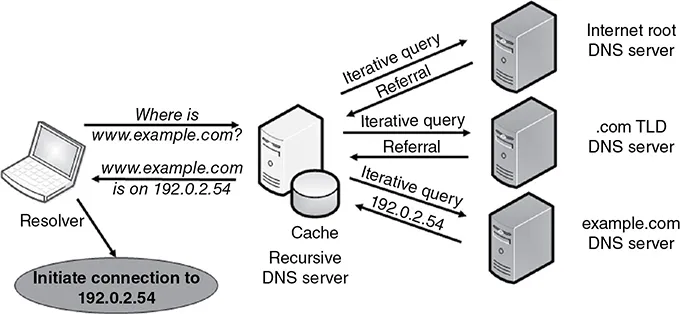
Figure 1.1 illustrates the basic flow of a DNS query. Upon entry of the desired destination by name, www.example.com in this case, software called a resolver is invoked by the application, for example, web browser. This resolver software is typically included with the device operating system. If a connection had recently been made to this website, its IP address may already be stored in the resolver cache. The resolver cache helps improve resolution performance by temporarily keeping track of recently resolved name-to-IP address mappings. In such a case, the resolver may return the IP address immediately to the application to establish a connection without having to query a DNS server.
Figure 1.1. Basic DNS Resolution Flow
If no relevant information exists in the resolver cache the device will query its recursive DNS server. The role of the recursive server is to locate the answer to the device's query. The recursive server is itself a resolver of the DNS query; we refer to the resolver on the originating device as a stub resolver as it initiates a query to its recursive server, and it relies solely on the recursive server to locate and return the answer. The stub resolver is configured with DNS server IP addresses to query as part of the IP network initialization process. For example, when a device boots up, it typically requests an IP address from a dynamic host configuration protocol (DHCP) server. The DHCP server can be configured to not only provide an IP address but the IP addresses of recursive DNS servers to which DNS queries should be directed. Use of DHCP in this manner facilitates mobility and efficiency as addresses can be shared and can be assigned based on the relevant point of connection to the IP network.
As we mentioned, the recursive DNS server's role is to resolve the query on behalf of the stub resolver. It performs this role using its own cache of previously resolved queries or by querying DNS servers on the Internet. The process of querying Internet DNS servers seeks to first locate a DNS server that is authoritative for the domain for which the query relates (example.com in this case) and then to query an authoritative server itself to obtain an answer that can be passed back to the client, thereby completing the resolution process. The location of the authoritative server is determined by querying Internet DNS servers that are responsible for the layers of the domain tree “above” or “to the right” of the domain in question. We'll discuss this process in more detail in Chapter 2. The recursive server caches the resolution information in order to respond more quickly to a similar query without having to re-seek the answer on the Internet.
To access your website, people need to know your web address, or technically your un...
Table of contents
Cover
Title page
Copyright
Acknowledgments
Preface
1 Introduction
2 Introduction to the Domain Name System (DNS)
3 DNS Protocol and Messages
4 DNS Vulnerabilities
5 DNS Trust Sectors
6 Security Foundation
7 Service Denial Attacks
8 Cache Poisoning Defenses
9 Securing Authoritative DNS Data
10 Attacker Exploitation of DNS
11 Malware and Apts
12 DNS Security Strategy
13 DNS Applications to Improve Network Security
14 DNS Security Evolution
Appendix A: Cybersecurity Framework Core DNS Example
Appendix B: DNS Resource Record Types
Bibliography
Index
IEEE Press Series on Networks and Services Management
ELUA
Trusted by 375,005 students
Access to over 1.5 million titles for a fair monthly price.
Study more efficiently using our study tools.
Frequently asked questions
Yes, you can cancel anytime from the Subscription tab in your account settings on the Perlego website. Your subscription will stay active until the end of your current billing period. Learn how to cancel your subscription
No, books cannot be downloaded as external files, such as PDFs, for use outside of Perlego. However, you can download books within the Perlego app for offline reading on mobile or tablet. Learn how to download books offline
Perlego offers two plans: Essential and Complete
Essential is ideal for learners and professionals who enjoy exploring a wide range of subjects. Access the Essential Library with 800,000+ trusted titles and best-sellers across business, personal growth, and the humanities. Includes unlimited reading time and Standard Read Aloud voice.
Complete: Perfect for advanced learners and researchers needing full, unrestricted access. Unlock 1.5M+ books across hundreds of subjects, including academic and specialized titles. The Complete Plan also includes advanced features like Premium Read Aloud and Research Assistant.
Both plans are available with monthly, semester, or annual billing cycles.
We are an online textbook subscription service, where you can get access to an entire online library for less than the price of a single book per month. With over 1.5 million books across 990+ topics, we’ve got you covered! Learn about our mission
Look out for the read-aloud symbol on your next book to see if you can listen to it. The read-aloud tool reads text aloud for you, highlighting the text as it is being read. You can pause it, speed it up and slow it down. Learn more about Read Aloud
Yes! You can use the Perlego app on both iOS and Android devices to read anytime, anywhere — even offline. Perfect for commutes or when you’re on the go. Please note we cannot support devices running on iOS 13 and Android 7 or earlier. Learn more about using the app
Yes, you can access DNS Security Management by Michael Dooley,Timothy Rooney in PDF and/or ePUB format, as well as other popular books in Technology & Engineering & Electrical Engineering & Telecommunications. We have over 1.5 million books available in our catalogue for you to explore.