This 6th edition is thoroughly revised and updated, and now additionally includes all commercially important flavor and fragrance materials that entered the market over the past 10 years.
In one handy and up-to-date source, this classic reference surveys those natural and synthetic materials that are commercially available, produced, and used on a relatively large scale, covering their properties, manufacturing methods employed, and areas of application.
For this new edition the chapter on essential oils has been completely revised with regard to production volumes, availability, and new product specifications, while new legal issues, such as REACH regulation aspects, are now included. Finally, the CAS registry numbers and physicochemical data of over 350 single substances and 100 essential oils have been updated and revised.
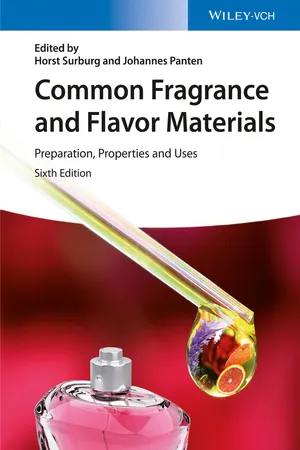
eBook - ePub
Common Fragrance and Flavor Materials
Preparation, Properties and Uses
- English
- ePUB (mobile friendly)
- Available on iOS & Android
eBook - ePub
About this book
Information
Chapter 1
Introduction
1.1 History
Since early antiquity, spices and resins from animal and plant sources have been used extensively for perfumery and flavor purposes and to a lesser extent for their observed or presumed preservative properties. Fragrance and flavor materials vary from highly complex mixtures to single chemicals. Their history began when people discovered that component characteristic of the aroma of natural products could be enriched by simple methods. Recipes for extraction with olive oil and for distillation have survived from pre-Christian times to this day.
Although distillation techniques were improved, particularly in the ninth century A.D. by the Arabs, the production and application of these concoctions remained essentially unchanged for centuries. Systematic development began in the thirteenth century, when pharmacies started to prepare the so-called remedy oils and later recorded the properties and physiological effects of these oils in pharmacopoeias. Many essential oils currently used by perfumers and flavorists were originally prepared by distillation in pharmacies in the sixteenth and seventeenth centuries.
Another important step in the history of natural fragrance materials occurred in the first half of the nineteenth century, when the production of essential oils was industrialized due to the increased demand for these oils as perfume and flavor ingredients. Around 1850, single organic compounds were also used for the same purposes. This development resulted from the isolation of cinnamaldehyde from cinnamon oil by Dumas and Pèligot in 1834, and the isolation of benzaldehyde from bitter almond oil by Liebig and Wöhler in 1837. The first synthetic “aroma oils” were introduced between 1845 and 1850. These consisted of lower molecular mass fatty acid esters of several alcohols and were synthesized by the chemical industry for their fruity odor. Methyl salicylate was introduced in 1859 as “artificial wintergreen oil” and benzaldehyde in 1870 as “artificial bitter almond oil.” With the industrial synthesis of vanillin (1874) and coumarin (1878) by Haarmann & Reimer (Holzminden, Germany), a new branch of the chemical industry was founded.
The number of synthetically produced fragrance and flavor chemicals has since expanded continually as a result of the systematic investigation of essential oils and fragrance complexes for odoriferous compounds. Initially, only major components were isolated from natural products; their structure was then elucidated and processes were developed for their isolation or synthesis. With the development of modern analytical techniques, however, it became possible to isolate and identify characteristic fragrance and flavor substances that occur in the natural products in only trace amounts. The isolation and structure elucidation of these components require the use of sophisticated chromatographic and spectroscopic techniques. Interesting products can then be synthesized.
1.2 Definition
Fragrance and flavor substances are comparatively strong-smelling organic compounds with characteristic, usually pleasant odors. They are, therefore, used in perfumes and perfumed products, as well as for the flavoring of foods and beverages. Whether a particular product is called a fragrance or a flavor substance depends on whether it is used as a perfume or a flavor. Fragrances and flavors are, similar to taste substances, chemical messengers, their receptors being the olfactory cells in the nose [1, 2].
1.3 Physiological Importance
Chemical signals are indispensable for the survival of many organisms which use chemoreceptors to find their way, to hunt for and inspect food, to detect enemies and harmful objects, and to find members of the opposite sex (pheromones). These functions are no longer vitally important for humans. The importance of flavor and fragrance substances in humans has evolved to become quantitatively and qualitatively different from that in other mammals; this is because humans depend to a greater extent on acoustic and optical signals for orientation. However, humans have retained the ability to detect odors, and human behavior can undoubtedly be affected by fragrances and aromas.
Sensory information obtained from the interaction of fragrance and flavor molecules with olfactory and taste receptors is processed in defined cerebral areas, resulting in perception. During the past 15 years, much research was done concerning sensory perception, and the results have been published in, for example, [2–23].
Although food acceptance in humans is determined mainly by appearance and texture, flavor is nevertheless also important. For example, spices are added to food not for their nutritional value but for their taste and flavor. Furthermore, aromas that develop during frying and baking enhance the enjoyment of food. Unlike flavoring substances, fragrances are not vitally important for humans. The use of fragrances in perfumery is primarily directed toward invoking pleasurable sensations by shifting the organism's emotional level. Whereas “naturalness” is preferred in aromas (generally mixtures of many compounds), the talent and imagination of the perfumer are essential for the creation of a perfume.
1.4 Natural, Nature-Identical, and Artificial Products
Natural compounds are obtained directly from natural sources by physical or biotechnological (enzymatic, microbial) procedures. As a result of the rapid development and expansion of biotechnology in the past two decades, far more than 100 natural flavoring substances are available from biocatalytic processes today [24–26]. Nature-identical compounds are produced synthetically but are chemically identical to their natural counterparts. Artificial flavor substances are compounds that have not yet been identified in plant or animal products for human consumption [27]. Alcohols, aldehydes, ketones, esters, and lactones are classes of compounds that are represented most frequently in natural and artificial fragrances.
Nature-identical aroma substances are, with very few exceptions, the only synthetic compounds used in flavors besides natural products. The primary functions of the olfactory and taste receptors, as well as their evolutionary development, may explain why artificial flavor substances are far less important. A considerable proportion of compounds used in fragrances are those identified as components of natural products, for example, constituents of essential oils or resins. The fragrance characteristics of artificial compounds nearly always mimic those of natural products.
1.5 Sensory Properties and Chemical Structure
Similarity between odors arises because dissimilar substances or mixtures of compounds may interact with receptors to create similar sensory impressions in the sensory centers of the brain. The group of musk fragrances (comprising macrocyclic ketones and esters as well as arom...
Table of contents
- Cover
- Related Titles
- Title Page
- Copyright
- Table of Contents
- Preface to the Sixth Edition
- Preface to the Fifth Edition
- Preface to the Fourth Edition
- Preface to the Third Edition
- Preface to the Second Edition
- Preface to the First Edition
- Chapter 1: Introduction
- Chapter 2: Individual Fragrance and Flavor Materials
- Chapter 3: Natural Raw Materials in the Flavor and Fragrance Industry
- Chapter 4: Analytical Methods/Quality Control
- Chapter 5: Safety Evaluation and Regulatory Aspects
- References
- Formula Index
- Subject Index
- End User License Agreement
Trusted by 375,005 students
Access to over 1.5 million titles for a fair monthly price.
Study more efficiently using our study tools.
Frequently asked questions
Yes, you can cancel anytime from the Subscription tab in your account settings on the Perlego website. Your subscription will stay active until the end of your current billing period. Learn how to cancel your subscription
No, books cannot be downloaded as external files, such as PDFs, for use outside of Perlego. However, you can download books within the Perlego app for offline reading on mobile or tablet. Learn how to download books offline
Perlego offers two plans: Essential and Complete
- Essential is ideal for learners and professionals who enjoy exploring a wide range of subjects. Access the Essential Library with 800,000+ trusted titles and best-sellers across business, personal growth, and the humanities. Includes unlimited reading time and Standard Read Aloud voice.
- Complete: Perfect for advanced learners and researchers needing full, unrestricted access. Unlock 1.5M+ books across hundreds of subjects, including academic and specialized titles. The Complete Plan also includes advanced features like Premium Read Aloud and Research Assistant.
We are an online textbook subscription service, where you can get access to an entire online library for less than the price of a single book per month. With over 1.5 million books across 990+ topics, we’ve got you covered! Learn about our mission
Look out for the read-aloud symbol on your next book to see if you can listen to it. The read-aloud tool reads text aloud for you, highlighting the text as it is being read. You can pause it, speed it up and slow it down. Learn more about Read Aloud
Yes! You can use the Perlego app on both iOS and Android devices to read anytime, anywhere — even offline. Perfect for commutes or when you’re on the go.
Please note we cannot support devices running on iOS 13 and Android 7 or earlier. Learn more about using the app
Please note we cannot support devices running on iOS 13 and Android 7 or earlier. Learn more about using the app
Yes, you can access Common Fragrance and Flavor Materials by Horst Surburg,Johannes Panten in PDF and/or ePUB format, as well as other popular books in Physical Sciences & Industrial & Technical Chemistry. We have over 1.5 million books available in our catalogue for you to explore.