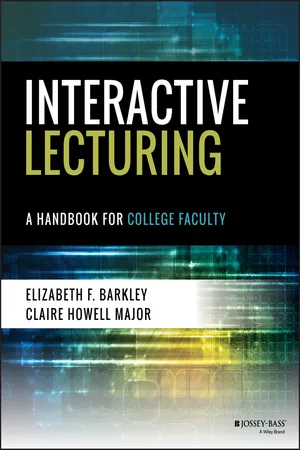
Interactive Lecturing
eBook - ePub

Interactive Lecturing

A Handbook for College Faculty

  1. English
  2. ePUB (mobile friendly)
  3. Available on iOS & Android
eBook - ePub

Interactive Lecturing

A Handbook for College Faculty

About this book

Tips and techniques to build interactive learning into lecture classes

Have you ever looked out across your students only to find them staring at their computers or smartphones rather than listening attentively to you? Have you ever wondered what you could do to encourage students to resist distractions and focus on the information you are presenting? Have you ever wished you could help students become active learners as they listen to you lecture?

Interactive Lecturing is designed to help faculty members more effectively lecture. This practical resource addresses such pertinent questions as, "How can lecture presentations be more engaging?" "How can we help students learn actively during lecture instead of just sitting and passively listening the entire time?" Renowned authors Elizabeth F. Barkley and Claire H. Major provide practical tips on creating and delivering engaging lectures as well as concrete techniques to help teachers ensure students are active and fully engaged participants in the learning process before, during, and after lecture presentations.

Research shows that most college faculty still rely predominantly on traditional lectures as their preferred teaching technique. However, research also underscores the fact that more students fail lecture-based courses than classes with active learning components. Interactive Lecturing combines engaging presentation tips with active learning techniques specifically chosen to help students learn as they listen to a lecture. It is a proven teaching and learning strategy that can be readily incorporated into every teacher's methods.

In addition to providing a synthesis of relevant, contemporary research and theory on lecturing as it relates to teaching and learning, this book features 53 tips on how to deliver engaging presentations and 32 techniques you can assign students to do to support their learning during your lecture. The tips and techniques can be used across instructional methods and academic disciplines both onsite (including small lectures and large lecture halls) as well as in online courses.

This book is a focused, up-to-date resource that draws on collective wisdom from scholarship and practice. It will become a well-used and welcome addition for everyone dedicated to effective teaching in higher education.

Frequently asked questions

Yes, you can cancel anytime from the Subscription tab in your account settings on the Perlego website. Your subscription will stay active until the end of your current billing period. Learn how to cancel your subscription.
No, books cannot be downloaded as external files, such as PDFs, for use outside of Perlego. However, you can download books within the Perlego app for offline reading on mobile or tablet. Learn more here.
Perlego offers two plans: Essential and Complete
  • Essential is ideal for learners and professionals who enjoy exploring a wide range of subjects. Access the Essential Library with 800,000+ trusted titles and best-sellers across business, personal growth, and the humanities. Includes unlimited reading time and Standard Read Aloud voice.
  • Complete: Perfect for advanced learners and researchers needing full, unrestricted access. Unlock 1.4M+ books across hundreds of subjects, including academic and specialized titles. The Complete Plan also includes advanced features like Premium Read Aloud and Research Assistant.
Both plans are available with monthly, semester, or annual billing cycles.
We are an online textbook subscription service, where you can get access to an entire online library for less than the price of a single book per month. With over 1 million books across 1000+ topics, we’ve got you covered! Learn more here.
Look out for the read-aloud symbol on your next book to see if you can listen to it. The read-aloud tool reads text aloud for you, highlighting the text as it is being read. You can pause it, speed it up and slow it down. Learn more here.
Yes! You can use the Perlego app on both iOS or Android devices to read anytime, anywhere — even offline. Perfect for commutes or when you’re on the go.
Please note we cannot support devices running on iOS 13 and Android 7 or earlier. Learn more about using the app.
Yes, you can access Interactive Lecturing by Elizabeth F. Barkley,Claire H. Major in PDF and/or ePUB format, as well as other popular books in Education & Education Administration. We have over one million books available in our catalogue for you to explore.

Information

Publisher
Jossey-Bass
Year
2018
Print ISBN
9781119277309
eBook ISBN
9781119277446

PART ONE
A CONCEPTUAL FRAMEWORK FOR INTERACTIVE LECTURING

Introduction

In classrooms around the country, college teachers work hard to engage students in the kind of learning that will prepare them to meet the demands of an increasingly complex world. Some professors lecture, others use a variety of approaches that fall under the banner of active learning. All want students to learn. But what is the most effective way to help students learn? For decades, many educators have been caught up in a debate arguing which approach is best, but what if we reframed the debate and instead looked for ways to maximize the benefits of both pedagogies?
What if college teachers who lecture used a little more active learning? Would instruction be more effective if students spent some of their class time participating in discussions or engaging in group projects instead of spending all of their class time listening? Alternately, what if college teachers who now use only active learning strategies spent a little more time in engaging modes of telling? Would instruction be more effective if students spent some of their class time listening to professors directly share knowledge about the disciplines and fields that they love instead of students having to discover everything on their own? We believe that the answer to all of these questions is yes.
In Part 1 of this book, we present the conceptual framework for blending engaging lectures and active learning methods. In so doing, we lay out the key assumptions, concepts, and research related to the interactive lecturing model. It is a representation of the essential elements of the model and relationships between them. We have organized our framework into two chapters:
  • Chapter 1. Lecture versus Active Learning: Reframing the Debate. Here we describe the ongoing debate between educators who are at odds with each other over whether lecture or active learning is the better instructional method, and we suggest that we reframe the issue.
  • Chapter 2. Integrating Lectures and Active Learning. In this chapter, we present our model for interactive lecturing and share the research that underpins the model.

CHAPTER 1
Lecture versus Active Learning: Reframing the Debate

Educators today would be hard-pressed to identify a teaching technique more heartily maligned than the lecture. Lectures are boring: ā€œSome people talk in their sleep. Lecturers talk while other people sleepā€ (Albert Camus1). Lectures are ineffective: ā€œA lecture is a process in which information passes from the notes of the lecturer into the notes of the student without passing through the minds of eitherā€ (Mark Twain2). Lectures are pointless: ā€œLectures were once useful; but now, when all can read and books are so numerous, lectures are unnecessaryā€ (Samuel Johnson). Lecturing is currently considered to be so bad that one author imagines a future when universities are required to issue a warning to students that ā€œlectures may stunt your academic performance and increase risk of failureā€ (Dawson, 2016). The list of criticisms continues and includes charges such as old-fashioned, overused, obsolete, and even unfair (see, for example, Abrams, 2012; Jensen & Davidson, 1997; Lambert, 2012; Paul, 2015; Segesten, 2012; Wieman, 2014).
Most of us have experienced listening to a lecture in which the speaker droned on and on; our minds wandered, our bodies fidgeted, and we would have dashed for the door had that been an option. One student expressed a similar sentiment: ā€œI was so bored, I feared all the blood had left my head and I would pass out in the aisleā€ (El-Shamy, 2004, p. 24). Despite the surfeit of disparagements, research indicates that most college and university faculty members still lecture.3 Lectures have remained popular for many reasons, including that they serve several important instructional purposes. Furthermore, lectures don't have to be dreary and mind-numbing. We—and students—have encountered situations in which we sat transfixed as we listened to a particularly captivating lecture. Indeed, a colleague recently shared that these kinds of lectures were the transformative events of his undergraduate education.
Although most college professors continue to lecture, researchers have also found that few today rely on the lecture entirely;4 instead, they use lecture in combination with a variety of other teaching techniques, such as small-group work, case studies, discussion, and problem-solving—strategies that fall under the banner of ā€œactive learning.ā€ Active learning is a pedagogical approach that puts into practice over a half-century of research that demonstrates that, to truly learn, we need to make new information our own by working it into our personal knowledge and experience. As attractive as active learning is conceptually, however, many college teachers struggle with promoting it in practice. For example, assigning students to group work is a popular active learning pedagogy, yet teachers know that it is not safe to assume that students who are talking to each other are learning and that it is equally risky to conclude that students are learning when they are listening to other students talking. Furthermore, although lectures can leave some students disengaged, active learning strategies can engender full-blown resistance. We once overhead a student passionately protest, ā€œToday was awful! My teacher . . .ā€ [with our curiosity piqued, we waited for her to complete her complaint so that we could hear what terrible thing the professor had done] ā€œassigned us to group work!ā€
Thus lecturing and active learning strategies have potential pitfalls, and although neither method is perfect, neither is despicable. Yet currently there is a fierce debate that sometimes intimates otherwise. This either-or dispute sets educators against each other in ways that we propose are unproductive. In this book, we aim to move past the premise that instructors must choose one or the other approach and suggest instead that faculty members can combine lectures with active learning to create a vibrant instructional environment that capitalizes on the benefits while minimizing the constraints of each. Our approach, a form of interactive lecturing, helps professors navigate the process of integrating lectures and active learning into a seamless whole that promotes deep learning.
We begin in Part 1 of this book by establishing our conceptual framework, which is grounded in research evidence. In this chapter, we answer the following questions:
  • What is a lecture, and what is it good for?
  • What is active lear...

Table of contents

  1. COVER
  2. TITLE PAGE
  3. TABLE OF CONTENTS
  4. ACKNOWLEDGMENTS
  5. ABOUT THE AUTHORS
  6. PART ONE: A CONCEPTUAL FRAMEWORK FOR INTERACTIVE LECTURING
  7. PART TWO: ENGAGING PRESENTATION TIPS
  8. PART THREE: ACTIVE LEARNING TECHNIQUES
  9. REFERENCES
  10. NAME INDEX
  11. SUBJECT INDEX
  12. END USER LICENSE AGREEMENT