C. S. Lewis
eBook - ePub

C. S. Lewis

  1. English
  2. ePUB (mobile friendly)
  3. Available on iOS & Android
eBook - ePub

C. S. Lewis

About this book

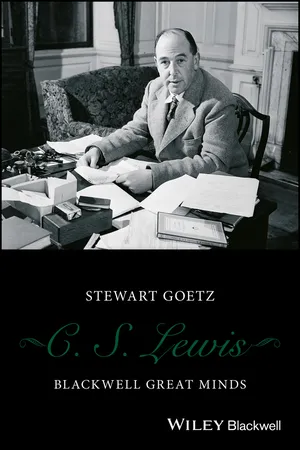
The definitive exploration of C.S. Lewis's philosophical thought, and its connection with his theological and literary work

Arguably one of the most influential writers of the twentieth century, C.S. Lewis is widely hailed as a literary giant, his seven-volume Chronicles of Narnia having sold over 65 million copies in print worldwide. A prolific author and scholar whose intellectual contributions transcend the realm of children's fantasy literature, Lewis is commonly read and studied as a significant theological figure in his own right. What is often overlooked is that Lewis first loved and was academically trained in philosophy.

In this newest addition to the Blackwell Great Minds series, well-known philosopher and Lewis authority Stewart Goetz discusses Lewis's philosophical thought and illustrates how it informs his theological and literary work. Drawing from Lewis's published writing and private correspondence, including unpublished materials, C.S. Lewis is the first book to develop a cohesive and holistic understanding of Lewis as a philosopher. In this groundbreaking project, Goetz explores how Lewis's views on topics of lasting interest such as happiness, morality, the soul, human freedom, reason, and imagination shape his understanding of myth and his use of it in his own stories, establishing new connections between Lewis's philosophical convictions and his wider body of published work.

Written in a scholarly yet accessible style, this short, engaging book makes a significant contribution to Lewis scholarship while remaining suitable for readers who have only read his stories, offering new insight into the intellectual life of this figure of enduring popular interest.

Frequently asked questions

Yes, you can cancel anytime from the Subscription tab in your account settings on the Perlego website. Your subscription will stay active until the end of your current billing period. Learn how to cancel your subscription.
No, books cannot be downloaded as external files, such as PDFs, for use outside of Perlego. However, you can download books within the Perlego app for offline reading on mobile or tablet. Learn more here.
Perlego offers two plans: Essential and Complete
  • Essential is ideal for learners and professionals who enjoy exploring a wide range of subjects. Access the Essential Library with 800,000+ trusted titles and best-sellers across business, personal growth, and the humanities. Includes unlimited reading time and Standard Read Aloud voice.
  • Complete: Perfect for advanced learners and researchers needing full, unrestricted access. Unlock 1.4M+ books across hundreds of subjects, including academic and specialized titles. The Complete Plan also includes advanced features like Premium Read Aloud and Research Assistant.
Both plans are available with monthly, semester, or annual billing cycles.
We are an online textbook subscription service, where you can get access to an entire online library for less than the price of a single book per month. With over 1 million books across 1000+ topics, we’ve got you covered! Learn more here.
Look out for the read-aloud symbol on your next book to see if you can listen to it. The read-aloud tool reads text aloud for you, highlighting the text as it is being read. You can pause it, speed it up and slow it down. Learn more here.
Yes! You can use the Perlego app on both iOS or Android devices to read anytime, anywhere — even offline. Perfect for commutes or when you’re on the go.
Please note we cannot support devices running on iOS 13 and Android 7 or earlier. Learn more about using the app.
Yes, you can access C. S. Lewis by Stewart Goetz in PDF and/or ePUB format, as well as other popular books in Philosophy & Philosophy of Religion. We have over one million books available in our catalogue for you to explore.

Information

chapter 1
a philosophical mind

Those of us who have been true readers all our life seldom fully realise the enormous extension of our being which we owe to authors. We realise it best when we talk with an unliterary friend. He may be full of goodness and good sense but he inhabits a tiny world. In it, we should be suffocated … My own eyes are not enough for me, I will see through those of others … [I]n reading great literature I become a thousand men and yet remain myself. Like the night sky in the Greek poem, I see with a myriad eyes, but it is I who see. Here, as in worship, in love, in moral action, and in knowing, I transcend myself; and am never more myself than when I do.
(Lewis 1961a, 140–1)
As soon as the mind of the maker has been made manifest in a work, a way of communication is established between other minds and his. That is to say, it is possible for a reader, by reading a book, to discover something about the mind of the writer.
(Sayers 1987, 49)

1.1 A Brief Biography

Clive Staples Lewis was born on November 29, 1898, in Belfast, Ireland. He was the second of two children, his brother Warnie being three years his elder. According to Warnie, one morning during a holiday at the sea, his younger brother, while still a child with the habit of referring to himself in the third person,
marched up to my mother, put a forefinger on his chest, and announced, ā€œHe is Jacksieā€; an announcement no doubt received by our mother with an absentminded, ā€œYes dearā€. But on the following day he was still Jacksie, and as he refused absolutely to answer to any other name, Jacksie it had to be; a name afterwards contracted to Jacks, and finally to Jack. So to the family and his intimate friends he remained Jack for the rest of his life. (W. H. Lewis n.d., 8; ā€œJacksieā€ was apparently borrowed from the name of a recently‐deceased dog of which the young Lewis had been fond.
(Gresham 2005, 2))
Jack’s parents were Albert and Florence Lewis. Albert was a career solicitor, who by all accounts had a strained relationship with his sons. Florence, an educated woman gifted in logic and mathematics, earned first‐ and second‐class honors respectively in those subjects at the Royal University (now Queen’s University) in Belfast. She tutored the young Jack in French and Latin, and he loved her dearly. Tragically, her life was cut short by abdominal cancer in August of 1908, when Jack was nine years of age. He recounted his thoughts about the effects of her demise in the following memorable words:
With my mother’s death all settled happiness, all that was tranquil and reliable, disappeared from my life. There was to be much fun, many pleasures … ; but no more of the old security. It was sea and islands now; the great continent had sunk like Atlantis.
(Lewis 1955, 21)
Though there were certainly pleasures, Lewis tersely wrote in his forties that ā€œI had a not very happy boyhood … ā€ (Lewis 1967, 57).
With his mother dead not even a month, Jack’s unhappiness from her passing was compounded by his being sent off to Wynyard School in England, a boarding school which his parents chose without ever having set eyes on it (Sayer 1994, 57). His life there was nightmarish (Lewis in his later years referred to the school as Belsen, after the World War II German concentration camp). The headmaster of the school was tyrannical and cruel (he regularly flogged his few and decreasing number of students). The school permanently closed in June of 1910, with the headmaster soon thereafter committed to an asylum. In the fall of 1910, Jack was enrolled at Campbell College, a boarding school not far from his home in Belfast. Because of an illness in November of that year and an ensuing convalescence at home, his time at the school was brief. In January of 1911, Jack was sent off again to England and another boarding school, Cherbourg, a preparatory school for entrance into Malvern College, a public school which Albert believed would prepare his son for possible admission to a university like Oxford. Jack’s experience in school this time was not as bad as that which he had on the first go‐around, and a reader of an examination taken by Jack at Cherbourg for a scholarship at Malvern saw academic promise: ā€œCame into his own in the verse. Some of his rendering truly alpha, with a poetic feeling rare in any boy. I believe he is just the sort to develop to gain a Classics award at Oxfordā€ (Sayer 1994, 75).
Jack entered Malvern College in the fall of 1913. In his first term there, he wrote a poem CARPE DIEM? After Horace, which Albert sent to William Kirkpatrick, the former headmaster of a school Albert had attended in his youth. Kirkpatrick was impressed by Jack’s work: ā€œIt is an amazing performance for a boy of his age—indeed for a boy of any ageā€ (Sayer 1994, 89). Despite his academic development, Lewis was not happy at Malvern, and he more than once petitioned his father to remove him. Much later in his life, Lewis wrote generally about his life at school that ā€œI never hated anything as much, not even the front line trenches in World War Iā€ (2007, 1325). Warnie believed the idea of placing his brother in boarding school was a mistake from the beginning:
The fact is that Jack should never have been sent to a Public School at all. It would have been a miracle if the boy who in his first term wrote Carpe Diem could have found a congenial companion amongst those of his own age, or for that matter at any age level … [H]e would have found himself much more at home amongst first year undergraduates … For the main function of the Public School in those days was to produce a standardized article. With two or three notable exceptions they were factories turning out the spare parts and replacements needed to keep Imperial and commercial machinery functioning efficiently, and obviously it was essential that the new part should be identical with the worn‐out one. But no polishing, filing, or grinding could have made Jack a cog in any machine …
(W. H. Lewis, n.d., 35–6)
In September, 1914, after only one year at Malvern, Lewis’s life in public school was over. Albert sent Jack to live and study with Kirkpatrick, whom Lewis came to refer to as ā€œKirkā€ or ā€œThe Great Knock.ā€ Kirkpatrick was a rationalist and atheist, and Lewis, who also did not believe in God, thrived intellectually under Kirkpatrick’s instruction. The Great Knock worked one‐on‐one with Lewis, schooling him to articulate and defend his views with cold, analytic rigor. By this time, Lewis was proficient in Greek, Latin, and French, with more than a little knowledge of Italian. Kirkpatrick was so impressed with his student that he wrote the following to Albert on January 7, 1915:
I do not think there can be much doubt as to the genuine and lasting quality of Clive’s intellectual abilities. He was born with the literary temperament, and we have to face that fact with all that it implies. This is not a case of early precocity showing itself in rapid assimilation of knowledge … As I said before, it is the maturity and originality of his literary judgements which is so unusual and surprising. By an unerring instinct he detects first rate quality in literary workmanship, and the second rate does not interest him in any way. Now you will observe that these endowments, in themselves remarkable, do not in some ways facilitate the work of the teacher, whose business, let us say, is to prepare the pupil for a Classical Scholarship in entering Oxford University. The ideal pupil for that purpose is a boy gifted with memory, receptiveness, patience, and strict attention to grammatical accuracy, and so on … The fact is that a critical and original faculty, whatever may be its promise for the future, is as much of a hindrance as a help in the drudgery of early classical training—Clive has ideas of his own and is not at all the sort of boy to be made a mere receptive machine.
(W. H. Lewis 1933, 279)
In December of the same year, Kirkpatrick once again wrote to Albert:
Of Clive himself we may say that it is difficult to conceive of him doing anything else than what he is doing now. Anything else is so repugnant to him that he simply excludes it from his thoughts … In dealing with a natural bias of temperament so strongly accentuated, we must make great allowances, but what is perfectly clear in the case is this: that outside a life of literary study, a career of literary interests, life has neither meaning nor attraction for him … [H]e is adapted for nothing else. You may make up your mind on that.
(W. H. Lewis 1934, 39)
About four months later in April, 1916, Kirkpatrick could not refrain from expressing further praise of Lewis in a letter to Albert:
I do not look on Clive as a school boy in any sense of the term. He is a student who has no interest except in reading and study … He hardly realizes – how could he at his age – with what a liberal hand nature has bestowed her bounties upon him … [A]s far as preparation [for university] is concerned, it is difficult to conceive of any candidate who ought to be in better position to face the ordeal. He has read more classics than any boy I ever had – or indeed I might add than any I ever heard of, unless it be an Addison or Landor or Macaulay. These are people we read of, but I have never met any.
(W. H. Lewis 1934, 74)
Finally, in December, 1916, toward the end of his time tutoring Lewis, Kirkpatrick penned the following words to Albert: ā€œAs a dialectician, an intellectual disputant, I shall miss him, and he will have no successor. Clive can hold his own in any discussion, and the higher the range of the conversation, the more he feels himself at homeā€ (W. H. Lewis 1934, 165). Even though Lewis would write in later years that ā€œwe of the teaching professions often exaggerate the influence of teachersā€ (1954, 350), when he learned of Kirk’s death in March, 1921, he spared no praise for his former mentor:
I at least owe to him in the intellectual sphere as much as one human being can owe another. That he enabled me to win a scholarship is the least that he did for me. It was an atmosphere of unrelenting clearness and rigid honesty of thought that one breathed from living with him – and this I shall be the better for as long as I live.
(Lewis 2004a, 535)
Summing up his life in school, Lewis wrote: ā€œI was at four schools, and learnt nothing at three of them; but on the other hand I was lucky in having a first class tutorā€ (2007, 1047).
The scholarship to which Lewis referred in the penultimate quote was in classics at University College, Oxford,1 where he went to reside as a student in April of 1917. He headed to University College, even though in late March he had failed an Oxford university entrance exam called ā€œResponsions,ā€ which included mathematics, a subject at which Lewis was extremely weak. Lewis again failed Responsions in June of that year, and never passed the exam, but was allowed to continue at Oxford nevertheless because of his service in World War I. He entered the war in November, 1917, in the trenches in France, and in the spring of 1918 was wounded there. As to the nature of his war experience, it is best to let Lewis speak for himself:
I have gone to sleep marching and woken again and found myself marching still. One walked in the trenches in thigh gum boots with water above the knee; one remembers the icy stream welling up inside the boot when you punctured it on concealed barbed wire. Familiarity both with the very old and the very recent dead confirmed that view of corpses which had been formed the moment I saw my dead mother. I came to know and pity and reverence the ordinary man: particularly dear Sergeant Ayres, who was (I suppose) killed by the same shell that wounded me … But for the rest, the war—the frights, the cold, … the horribly smashed men still moving like half‐crushed beetles, the sitting or standing co...

Table of contents

  1. Cover
  2. Title Page
  3. Table of Contents
  4. acknowledgments
  5. introduction
  6. chapter 1: a philosophical mind
  7. chapter 2: the thinking, reasoning, and sensing soul
  8. chapter 3: the meaning of life
  9. chapter 4: morality
  10. chapter 5: free choice and miracles
  11. chapter 6: the grand miracle, death to self, and myth
  12. chapter 7: belief in god
  13. chapter 8: the problem of evil
  14. chapter 9: an enduring mind
  15. bibliography
  16. index
  17. End User License Agreement