eBook - ePub
Metal-Organic Frameworks
Applications in Separations and Catalysis
- English
- ePUB (mobile friendly)
- Available on iOS & Android
eBook - ePub
Metal-Organic Frameworks
Applications in Separations and Catalysis
About this book
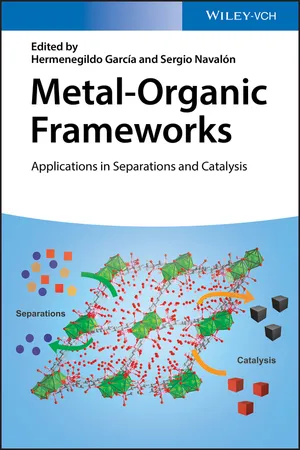
Focusing on applications in separation, adsorption and catalysis, this handbook underlines the importance of this hot and exciting topic. It provides an excellent insight into the synthesis and modification of MOFs, their synthesis on an industrial scale, their use as CO2 and chemical warfare adsorbers, and the role of defects in catalysis. In addition, the authors treat such new aspects as biocatalysis and applications in photocatalysis and optoelectronic devices.
Information
Chapter 1
The Stability of Metal–Organic Frameworks
Georges Mouchaham1, Sujing Wang2 and Christian Serre2
1Université Paris Saclay, Université de Versailles St‐Quentin en Yvelines, Institut Lavoisier, UMR CNRS 8180, 45 Avenue des Etats‐Unis, 78035, Versailles Cedex, France
2 PSL Research University, Institut des Matériaux Poreux de Paris, FRE 2000 CNRS, Ecole Normale Supérieure, Ecole Supérieure de Physique et des Chimie Industrielles de Paris, 75005, Paris, France
1.1 Introduction
Metal–organic frameworks (MOFs), also known as porous coordination polymers (PCPs), are a recent class of hybrid materials that have attracted considerable attention during the last few decades. Their crystalline structure constructed from the association of inorganic building units connected through complexing organic linkers can be wisely and finely tuned [1, 2], in terms of the chemical nature (metal cations, organic linkers), pore size (micro‐ or mesoporous), and the shape/type of cavities (cages or channels and triangular, square, or hexagonal, etc.). As a consequence, the versatile and tunable characteristics of MOFs have, nowadays, made them very promising candidates for various applications including gas storage, molecular separation, biomedicine, sensing, catalysis, and so on [3, 4].
Because the particularity of each MOF, for a given property or application, derives from its unique well‐defined crystalline chemical structure, its porous framework shall be expected (and mandatory) to be retained without any alteration over the course of a process. In other words, for practical applications, one shall carefully consider the stability as one of the most important requirements to be fulfilled.
In a general manner, and particularly in the field of MOFs, “robustness” or “stability” cannot be considered as an absolute qualification, and one shall consider a predefined set of parameters. These depend on the targeted application where the porous material will be exposed to a given environment (i.e., organic solvents, water, corrosive media, etc.; high temperature and/or compression), at a certain concentration and for a given duration. Consequently, depending on the considered criteria, three main categories of stabilities can be identified: (i) chemical stability, (ii) thermal stability, and (iii) mechanical stability, where, henceforth, stability of a MOF refers to the resistance of its structure to degradation upon exposure to the operating conditions. Though, it is worthy of note that thermal stability (except in the case of amorphization and melting; see Section 1.3) is closely related to chemical stability because heating may also alter the chemical structure of the MOFs by initiating and/or accelerating the chemical reaction inducing the degradation of the corresponding crystalline framework. This affects mainly the coordination sphere of the metal cation due to the disruption of the coordination bonding between the organic ligand and the inorganic moiety (i.e., hydrolysis, redox activity, etc.), or, sometimes, it can affect the organic linker itself (i.e., decarboxylation, alkyne oxidation, etc.).
Regarding an application of interest, an MOF shall possess one or more types of stabilities. For example, chemical stability is crucial for applications in aqueous media and/or at different pH, such as in molecular separation or drug delivery [5], while both chemical and thermal stabilities are important for catalytic processes performed under harsh conditions as for chemical feedstock and fuel production [6]. Mechanical stability is mainly considered in MOF shaping such as making pellets or other compact forms required in industrial processes [7].
If, at the early stage of MOF exploration, one of the main concerns was to synthesize frameworks possessing the highest surface area and the largest pore volume, more recently considerable efforts have been devoted to the design of highly stable structures, allowing applications under ambient conditions as well as in harsh and corrosive media. This chapter aims at giving a comprehensive overview of the three aforementioned categories of stabilities and their importance in MOFs. Particular attention will be paid to address strategies allowing the synthesis of robust MOFs.
1.2 Chemical Stability
While thousands of different structures of MOFs have been reported to date, relatively, only a limited number have exhibited promising properties under non inert conditions (i.e., outside their mother liquor), in which they can be manipulated without alteration of their porous framework. MOFs consist of divalent cations (M2+) and carboxylate‐based linkers are typical fragile materials [8, 9]. For instance, Zn2+ terephthalate MOF‐5 degrades rapidly in water [8, 10–13], while Cu2+ trimesate HKUST‐1 degrades over time in water at room temperature [14, 15]. The lack of stability for water is clearly a strong limitation on the use of MOFs not only for practical applications requiring a direct contact with water (e.g., separation processes from flue gas, which may contain considerable amounts of water, or water splitting catalysis [16, 17]), but also for clean applications such as hydrogen storage for fuel cells [18] in which water is itself a product of the reaction or could be a contaminant during the refueling process, for instance. In this context, chemical stability, in general, is one of the most basic criteria one should take into account in order to synthesize an MOF that is resistant to the ambient atmosphere in which water or moisture may be a considerable risk of degradation.
In 2009, Low et al. [9] have investigated, through a dual computational and experimental study, the effect of water (and steam) on a series of MOFs. They have highlighted the fact that the probability of the hydrolysis of the metal–ligand bond (involving breaking of coordination bonds and displacement of water (or hydroxide), ligated cations, and ligands) is inversely correlated with the strength of the bond between the metal cation and the organic linker from which the MOF is constructed. To some extent, this correlation can also be applied to all molecules (i.e., phosphate, H2S, SO x , NO x , NH3, phenolate, etc.) that can potentially compete with the organic linker and break the cation–ligand bond. Hence, regarding the potential competing agent (or reactive species), chemical stability can be subdivided into different categories such as moisture and water stability, stability to acidic or basic media, stability under harsh conditions (e.g., physiological media,...
Table of contents
- Cover
- Titlepage
- Table of Contents
- Preface
- Chapter 1: The Stability of Metal-Organic Frameworks
- Chapter 2: Tuning the Properties of Metal-Organic Frameworks by Post-synthetic Modification
- Chapter 3: Synthesis of MOFs at the Industrial Scale
- Chapter 4: From Layered MOFs to Structuring at the Meso-/Macroscopic Scale
- Chapter 5: Application of Metal-Organic Frameworks (MOFs) for CO2 Separation
- Chapter 6: Current Status of Porous Metal-Organic Frameworks for Methane Storage
- Chapter 7: MOFs for the Capture and Degradation of Chemical Warfare Agents
- Chapter 8: Membranes Based on MOFs
- Chapter 9: Composites of Metal-Organic Frameworks (MOFs): Synthesis and Applications in Separation and Catalysis
- Chapter 10: Tuning of Metal-Organic Frameworks by Pre- and Post-synthetic Functionalization for Catalysis and Separations
- Chapter 11: Role of Defects in Catalysis
- Chapter 12: MOFs as Heterogeneous Catalysts in Liquid Phase Reactions
- Chapter 13: Encapsulated Metallic Nanoparticles in Metal-Organic Frameworks: Toward Their Use in Catalysis
- Chapter 14: MOFs as Supports of Enzymes in Biocatalysis
- Chapter 15: MOFs as Photocatalysts
- Index
- End User License Agreement
Trusted by 375,005 students
Access to over 1.5 million titles for a fair monthly price.
Study more efficiently using our study tools.
Frequently asked questions
Yes, you can cancel anytime from the Subscription tab in your account settings on the Perlego website. Your subscription will stay active until the end of your current billing period. Learn how to cancel your subscription
No, books cannot be downloaded as external files, such as PDFs, for use outside of Perlego. However, you can download books within the Perlego app for offline reading on mobile or tablet. Learn how to download books offline
Perlego offers two plans: Essential and Complete
- Essential is ideal for learners and professionals who enjoy exploring a wide range of subjects. Access the Essential Library with 800,000+ trusted titles and best-sellers across business, personal growth, and the humanities. Includes unlimited reading time and Standard Read Aloud voice.
- Complete: Perfect for advanced learners and researchers needing full, unrestricted access. Unlock 1.5M+ books across hundreds of subjects, including academic and specialized titles. The Complete Plan also includes advanced features like Premium Read Aloud and Research Assistant.
We are an online textbook subscription service, where you can get access to an entire online library for less than the price of a single book per month. With over 1.5 million books across 990+ topics, we’ve got you covered! Learn about our mission
Look out for the read-aloud symbol on your next book to see if you can listen to it. The read-aloud tool reads text aloud for you, highlighting the text as it is being read. You can pause it, speed it up and slow it down. Learn more about Read Aloud
Yes! You can use the Perlego app on both iOS and Android devices to read anytime, anywhere — even offline. Perfect for commutes or when you’re on the go.
Please note we cannot support devices running on iOS 13 and Android 7 or earlier. Learn more about using the app
Please note we cannot support devices running on iOS 13 and Android 7 or earlier. Learn more about using the app
Yes, you can access Metal-Organic Frameworks by Hermenegildo García, Sergio Navalón, Hermenegildo García,Sergio Navalón in PDF and/or ePUB format, as well as other popular books in Biological Sciences & Biochemistry. We have over 1.5 million books available in our catalogue for you to explore.