Positive Thinking Pocketbook
eBook - ePub

Positive Thinking Pocketbook

Little Exercises for a Happy and Successful Life

  1. English
  2. ePUB (mobile friendly)
  3. Available on iOS & Android
eBook - ePub

Positive Thinking Pocketbook

Little Exercises for a Happy and Successful Life

About this book

Think your way to a more positive life

Positive thinking is an approach and a set of skills that we can all learn. But it's not just about how and what you think; you've got to do something! In a range of situations, positive thinking needs to be followed by positive action. The good news is that whatever life has thrown at you in the past and whatever is you want to achieve in the future, the Positive Thinking Pocketbook will help you think and behave more positively.

Inside, you'll find out how to use tips, techniques and advice on creating a positive mindset and developing your positive thinking. Next, you'll find out how to apply that positive thinking to a range of potentially difficult situations.

  • Little approachable exercises make it easy to get started
  • Full of scenarios, ideas, advice, tips and techniques
  • Learn how to overcome negative thinking, get motivated and stay motivated
  • Discover how to make positive thinking a habit

Whenever you want a shot of positivity, simply pick out a few ideas, tips and techniques that appeal to you and give them a try!

Frequently asked questions

Yes, you can cancel anytime from the Subscription tab in your account settings on the Perlego website. Your subscription will stay active until the end of your current billing period. Learn how to cancel your subscription.
No, books cannot be downloaded as external files, such as PDFs, for use outside of Perlego. However, you can download books within the Perlego app for offline reading on mobile or tablet. Learn more here.
Perlego offers two plans: Essential and Complete
  • Essential is ideal for learners and professionals who enjoy exploring a wide range of subjects. Access the Essential Library with 800,000+ trusted titles and best-sellers across business, personal growth, and the humanities. Includes unlimited reading time and Standard Read Aloud voice.
  • Complete: Perfect for advanced learners and researchers needing full, unrestricted access. Unlock 1.4M+ books across hundreds of subjects, including academic and specialized titles. The Complete Plan also includes advanced features like Premium Read Aloud and Research Assistant.
Both plans are available with monthly, semester, or annual billing cycles.
We are an online textbook subscription service, where you can get access to an entire online library for less than the price of a single book per month. With over 1 million books across 1000+ topics, we’ve got you covered! Learn more here.
Look out for the read-aloud symbol on your next book to see if you can listen to it. The read-aloud tool reads text aloud for you, highlighting the text as it is being read. You can pause it, speed it up and slow it down. Learn more here.
Yes! You can use the Perlego app on both iOS or Android devices to read anytime, anywhere — even offline. Perfect for commutes or when you’re on the go.
Please note we cannot support devices running on iOS 13 and Android 7 or earlier. Learn more about using the app.
Yes, you can access Positive Thinking Pocketbook by Gill Hasson in PDF and/or ePUB format, as well as other popular books in Personal Development & Mental Health & Wellbeing. We have over one million books available in our catalogue for you to explore.

Information

PART 1
POSITIVE THINKING VS NEGATIVE THINKING

UNDERSTANDING THE POWER OF POSITIVE AND NEGATIVE THINKING

Once you replace negative thoughts with positive ones, you'll start having positive results. —Willie Nelson
Positive thinking can be understood in terms of an ‘explanatory style’. Your explanatory style is how you explain situations and events; how you interpret, make sense and meaning of how and why things do and don't happen.
When you interpret an event, a situation or circumstances in a positive way, you take a favourable view of past, present and future events, situations and circumstances. You're likely to look for the best in other people, and to view yourself and your abilities in a positive light. You're optimistic – you expect a favourable outcome for future events. You're not unrealistic though – you know that things don't always work out. But if things go wrong – when there are problems – you don't dwell on them; instead you look for positive solutions. You also look for the silver linings; you recognise that often, challenges and difficult situations have a positive aspect to them.
However, if you have a negative way of explaining and interpreting things, you resign yourself to having no control over or solutions to problems. Negative thinkers are pessimistic – they tend to see and anticipate difficulties and problems. In a variety of situations, if you think in negative ways, you may see yourself as a victim; you feel that you've been deceived or cheated and you look to lay blame when things go wrong. Even when good things happen, negative thinkers tend to notice and dwell on the negative parts – the not so good aspects – of a situation.
Let negative thoughts take a hold, and in a variety of situations, you're likely to feel overwhelmed and powerless. But if you can think positively, you'll feel able to manage and do well.

In Practice

It takes but one positive thought when given a chance to survive and thrive to overpower an entire army of negative thoughts. —Dr Robert H. Schuller
What you think and say to yourself can influence what you can and can't do, as shown by this simple exercise. Try it for yourself. You'll need another person to help.
Part 1:
  • Ask the other person to stand and extend their dominant arm horizontally, at shoulder level.
  • Ask them to think of a time when they failed something – a test, an exam or a job interview, for example. Then ask them to think negative thoughts about themselves: ‘I'm weak. I'm stupid. I'm hopeless. I'm pathetic. I'm no good at anything. I can't do this.’
  • Ask the person to continue thinking these thoughts. Tell them you are going to stand behind them and attempt to pull their dominant arm down to their side. Ask them to resist you pulling their arm down.
Part 2:
  • Now, ask the person to hold up their dominant arm again at shoulder level.
  • This time, ask them to think of a time when they succeeded and did well at something – passed a test or exam, achieved something at work, did well in a sport. Then ask them to think positive things about themselves: ‘I do my best. I can do well. I am a good person. I am strong. I can do this.’
  • Ask them to repeat the positive statements to themselves while you attempt to pull their arm down to your side. Ask them to resist the pull.
Typically, in the first part of the exercise, the person's arm is more likely to give way to your pull. Negativity overwhelms them and it's not easy for them to be strong. However, when the person's thoughts are positive, their body has the ability to resist the force that's pulling their arm down. They are more likely to stay strong and resist your pull.

UNDERSTANDING THE POSITIVE INTENTIONS OF NEGATIVE THINKING

You are what you think. And what you think, you are. —Author unknown
If positive thinking is the most helpful, beneficial way to think, why, then, do we think in negative ways? Negative thoughts are integral parts of emotions such as fear, anxiety, disappointment, guilt, regret, resentment and jealousy. These emotions often include thoughts such as ‘I can't do it’. ‘It's not fair’. ‘I'm such an idiot’. ‘It's their fault’. ‘Nothing ever goes right for me’. ‘I wish I hadn't done that’.
Because emotions such as fear, worry and guilt make us feel bad, we usually think of them as ‘negative emotions’. And yet these emotions, like all other emotions, do actually have a positive intent.
Take, for example, the emotion of guilt. Typically, the thoughts that accompany guilt are ‘I've screwed up, I shouldn't have done that, it's my fault. I feel bad about what I did’. How can this way of thinking be positive? Well, the positive intent of guilt is to prompt you to recognise your wrongdoing and to do something to put it right or make up for what you did. If, though, you simply wallow in your guilt, berate yourself for what you did wrong or ignore or deny how you feel, then your thoughts and actions (or lack of action) remain negative. They do you no good.
The positive intentions of ‘negative’ emotions act in the same way as the positive intention of physical pain. If you touch something really hot, the pain makes you pull away; it feels bad, but the positive intention of that pain is to protect you. It's the same with emotional pain – it can prompt you to think of positive ways you can take positive action.
And not only can an emotion such as guilt make you feel bad and prompt you to respond positively, the fact that you know that guilt can make you feel bad can actually motivate you, too. It can motivate you not to do something in future that could result in you feeling guilty!

In Practice

For there is nothing either good or bad, but thinking makes it so. —Shakespeare
Know that every emotion has a positive purpose. No emotion is bad or pointless. When you experience a ‘negative’ emotion, if you understand the positive purpose behind that ‘negative’ emotion, it can help you think more positively about the situation and do something positive about it.
The positive intention of sadness, for example, is to slow you down and allow you time to take in and accept what has happened. Sadness then helps you to adjust, to get used to changed, different circumstances. Disappointment is a form of sadness. The positive purpose of disappointment is to prompt you to identify what went wrong and to work out what needs to be adjusted or changed in order to lessen the chance of similar disappointments in the future.
Think about it.
  • Anger is a natural reaction to feeling wronged by something or someone. It's a reaction to unfairness, dishonesty, being treated badly, being let down, being lied to or being ignored. So, what do you think might be the positive purpose of anger?
  • Jealousy happens when you feel that someone or something is threatening something you value – you worry that someone will take what you have. What do you thi...
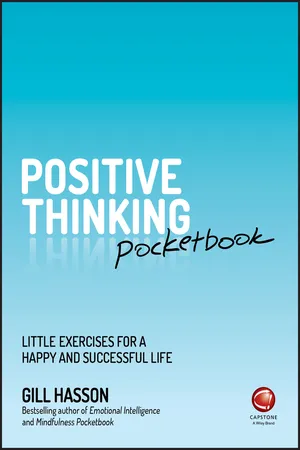
Table of contents

  1. COVER
  2. TABLE OF CONTENTS
  3. INTRODUCTION
  4. PART 1: POSITIVE THINKING VS NEGATIVE THINKING
  5. PART 2: POSITIVE THINKING AND POSITIVE ACTION
  6. PART 3: MAKING POSITIVE THINKING A HABIT
  7. PART 4: POSITIVE THINKING FOR DIFFICULT SITUATIONS
  8. ANSWERS TO IN PRACTICE QUESTIONS IN PART ONE
  9. MORE POSITIVE THINKING QUOTES
  10. ABOUT THE AUTHOR
  11. END USER LICENSE AGREEMENT