- A simplified introductory approach to the complex and technical subject of evidence-based medicine from experienced teachers
- Approaches learning from the vantage point of clinical questions on therapy, diagnosis, prognosis or harm rather than the framework of study designs
- Provides tables and boxed case studies throughout highlighting key topics, or difficult issues, in an easy to read manner
- Emphasizes applicability of EBM, encouraging readers to dissect the evidence and how results can be applied to individual patients with different circumstances, varying values and preferences
- New to the Second Edition are chapters on health screening, clinical practice guidelines, and major updates incorporating recommended trial criteria
eBook - ePub
Painless Evidence-Based Medicine
- English
- ePUB (mobile friendly)
- Available on iOS & Android
eBook - ePub
About this book
This updated edition of Painless Evidence-Based Medicine presents basic concepts and application of research statistics in simple and practical manner creating an introductory approach to the complex and technical subject of evidence-based medicine from experienced teachers.
Information
Chapter 1
Introduction
Antonio L. Dans, Leonila F. Dans and Maria Asuncion A. Silvestre
Half of what you'll learn in medical school will be shown to be either dead wrong or out of date within five years of graduation. The trouble is that nobody can tell you which half – so the important thing to learn is how to learn on your own.
Dr. Dave Sackett, the Father of Evidence-Based Medicine[1]
This statement is often heard by freshmen as they are ushered into medical school, but it probably rings true for students in nursing, dentistry, midwifery, physical therapy and other allied medical professions as well. A lot of truth dwells in it. Just a few years ago, we thought that enlarged tonsils had to be removed, that women had to be shaved before they delivered, and that vitamin C enhanced immunity against respiratory tract infections. These were non-debatable bits of “knowledge” then. Today, they are nothing more than somber testimony to the fallibility of the human mind. Our problem is not healthcare education per se. Our problem is progress. Science evolves so fast that what we know now will quickly be outdated if we don't keep up with the literature.
If there was any problem with education in medicine and its allied professions in the last century, it was that professionals were not taught how to keep up with science. We were certainly told that we had to keep up to date, but we didn't know how to do this efficiently…until 1991. In that year, Dr. Gordon Guyatt of McMaster University Medical College in Ontario, Canada, described what he believed were important improvements in the way medicine was taught in his university:
Clinicians were formerly taught to look to authority (whether a textbook, an expert lecturer, or a local senior physician) to resolve issues of patient management. Evidence-based medicine uses additional strategies, including quickly tracking down publications of studies that are directly relevant to the clinical problem, critically appraising these studies, and applying the results of the best studies to the clinical problem at hand.[2]
This is the first use of the term “evidence-based medicine” (EBM) in published literature. While the emphasis in this passage is on decision-making, the key process has to do with keeping up to date with the literature. The faculty of McMaster University thought they were on to something exciting[2] – and they were! In the years that followed, the concept spread like wildfire, with “evidence-based” becoming one of the most widely used phrases in the medical literature (see Figure 1.1). EBM was introduced into the curricula of healthcare professionals, first in medicine and later in other fields.[3] Hundreds of seminars and workshops are now conducted across the globe every year, involving tens of thousands of practitioners from various healthcare disciplines.
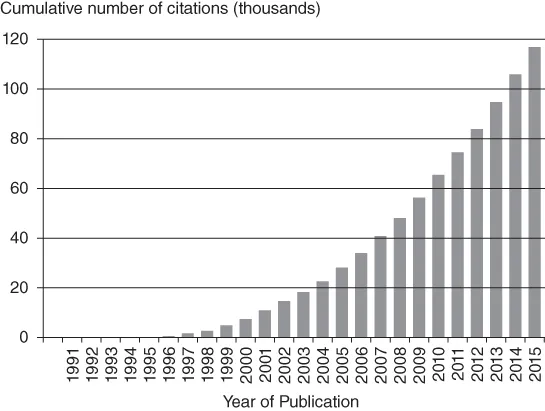
Figure 1.1 Cumulative number of MEDLINE citations containing the phrase “evidence- based” in the title or abstract
The popularity of EBM is easy to understand. For many, the proposed “rules of evidence” were simple and easy to follow. These rules demystified scientific research, turning it into something busy practitioners could understand, challenge, and keep up with. A few critics have debated whether EBM deserves the popularity it has gained,[4, 5] but their debate has been confusing rather than helpful, fuelled by misconceptions and hurt rather than meaningful differences in opinion. An example of just how confusing the debate has been is as follows:
The authors reframe the evidence-based medicine debate by pointing out an underappreciated epistemological deficiency: evidence-based medicine as currently conceptualized cannot accommodate concepts that resist quantitative analysis and therefore cannot logically differentiate human beings from complex machines. The authors use Michael Polanyi's philosophy of tacit knowing (which refers to the taken-for-granted knowledge at the periphery of attention that allows persons to understand the world and discern meaning in it) as a starting point for rectifying this deficiency and for working towards an improved, person-centred epistemology of medical practice.[6]
We are sure the intellectual ruminations would be fascinating. The debate, however, is for philosophers and not for busy healthcare practitioners. For now, all we want to say is this: if you're overwhelmed by the literature in healthcare, then it doesn't matter if you're a physician, dentist, nurse, midwife, therapist, or any other healthcare professional. EBM is for you!
1.1 The definition of EBM
Choosing an acceptable definition of EBM is difficult, as so many are available.[7] This is partly because EBM has evolved so much since 1992, and partly because various healthcare professions have modified it to suit particular fields. Thus, there are definitions for evidence-based surgery,[8] evidence-based nursing,[9] evidence-based pediatrics,[10] evidence-based psychiatry,[11] evidence-based healthcare,[12] and even evidence-based alternative medicine,[13] to name but a few. Our search for the best definition led to the conclusion that there are too many definitions, so what the heck, here's our own:
EBM is a systematic approach to the acquisition, appraisal, and application of research evidence to guide decisions in healthcare.
We explain the components of ...
Table of contents
- Cover
- Title Page
- Copyright
- Table of Contents
- List of Contributors
- Foreword to the First Edition
- Foreword to the Second Edition
- Preface
- Chapter 1: Introduction
- Chapter 2: Evaluation of Articles on Therapy
- Chapter 3: Evaluation of Articles on Diagnosis
- Chapter 4: Evaluation of Articles on Harm
- Chapter 5: Evaluation of Articles on Prognosis
- Chapter 6: Evaluation of Systematic Reviews
- Chapter 7: Evaluation of Clinical Practice Guidelines
- Chapter 8: Evaluation of Articles on Health Screening
- Chapter 9: Literature Searches
- Index
- End User License Agreement
Trusted by 375,005 students
Access to over 1.5 million titles for a fair monthly price.
Study more efficiently using our study tools.
Frequently asked questions
Yes, you can cancel anytime from the Subscription tab in your account settings on the Perlego website. Your subscription will stay active until the end of your current billing period. Learn how to cancel your subscription
No, books cannot be downloaded as external files, such as PDFs, for use outside of Perlego. However, you can download books within the Perlego app for offline reading on mobile or tablet. Learn how to download books offline
Perlego offers two plans: Essential and Complete
- Essential is ideal for learners and professionals who enjoy exploring a wide range of subjects. Access the Essential Library with 800,000+ trusted titles and best-sellers across business, personal growth, and the humanities. Includes unlimited reading time and Standard Read Aloud voice.
- Complete: Perfect for advanced learners and researchers needing full, unrestricted access. Unlock 1.5M+ books across hundreds of subjects, including academic and specialized titles. The Complete Plan also includes advanced features like Premium Read Aloud and Research Assistant.
We are an online textbook subscription service, where you can get access to an entire online library for less than the price of a single book per month. With over 1.5 million books across 990+ topics, we’ve got you covered! Learn about our mission
Look out for the read-aloud symbol on your next book to see if you can listen to it. The read-aloud tool reads text aloud for you, highlighting the text as it is being read. You can pause it, speed it up and slow it down. Learn more about Read Aloud
Yes! You can use the Perlego app on both iOS and Android devices to read anytime, anywhere — even offline. Perfect for commutes or when you’re on the go.
Please note we cannot support devices running on iOS 13 and Android 7 or earlier. Learn more about using the app
Please note we cannot support devices running on iOS 13 and Android 7 or earlier. Learn more about using the app
Yes, you can access Painless Evidence-Based Medicine by Antonio L. Dans, Leonila F. Dans, Maria Asuncion A. Silvestre, Antonio L. Dans,Leonila F. Dans,Maria Asuncion A. Silvestre,Antonio L. Dans,Leonila F. Dans,Maria Asuncion A. Silvestre in PDF and/or ePUB format, as well as other popular books in Medicina & Teoría, práctica y referencia médicas. We have over 1.5 million books available in our catalogue for you to explore.