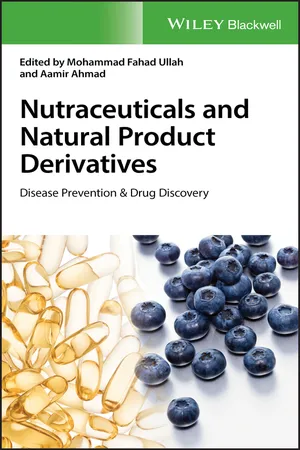
Nutraceuticals and Natural Product Derivatives
eBook - ePub

Nutraceuticals and Natural Product Derivatives

Disease Prevention & Drug Discovery

  1. English
  2. ePUB (mobile friendly)
  3. Available on iOS & Android
eBook - ePub

Nutraceuticals and Natural Product Derivatives

Disease Prevention & Drug Discovery

About this book

Introduces readers to the growing applications of nutraceuticals and other natural product derivatives

This comprehensive book presents a prophylactic and therapeutic approach to chronic disease prevention strategy by highlighting the translational potential of plant-derived dietary and non-dietary factors from epidemiological, laboratory, and clinical studies. It also shares the experiences of highly reputed experts working in the area of phytomedicine and nutraceutical agents in chemoprevention, to promote the significance of natural products and dietary factors as an elite priority for containing chronic diseases in the human population.

Nutraceuticals and Natural Product Derivatives: Disease Prevention & Drug Discovery starts by examining natural food sources for the control of glycemia and the prevention of diabetic complications. It then looks at the anti-aging effects of sulfur-containing amino acids and nutraceuticals, and the potential of garcinia fruits to combat metabolic syndrome. Other topics covered include honey- and propolis-mediated regulation of protein networks in cancer cells; recent trends in drug discovery against Alzheimer's disease; the therapeutic potential of metalloherbal nanoceuticals; and much more.

  • Offers an alternative, natural approach to the prevention of chronic diseases
  • Emphasizes the potential of plant-derived dietary and non-dietary factors from epidemiological, laboratory, and clinical studies
  • Features contributions from world-renowned experts in the field of phytomedicine and nutraceutical agents in chemoprevention
  • Includes prevention strategies in normal/risk populations through routine inclusion of specific dietary regimens and as therapeutic strategy for better management through adjuvant interventions with conventional treatment protocols

Nutraceuticals and Natural Product Derivatives: Disease Prevention & Drug Discovery will appeal to graduate students and professionals in cell and molecular biology, translational research, pharmacology/drug discovery, medicinal chemistry, and clinical nutrition.

Frequently asked questions

Yes, you can cancel anytime from the Subscription tab in your account settings on the Perlego website. Your subscription will stay active until the end of your current billing period. Learn how to cancel your subscription.
No, books cannot be downloaded as external files, such as PDFs, for use outside of Perlego. However, you can download books within the Perlego app for offline reading on mobile or tablet. Learn more here.
Perlego offers two plans: Essential and Complete
  • Essential is ideal for learners and professionals who enjoy exploring a wide range of subjects. Access the Essential Library with 800,000+ trusted titles and best-sellers across business, personal growth, and the humanities. Includes unlimited reading time and Standard Read Aloud voice.
  • Complete: Perfect for advanced learners and researchers needing full, unrestricted access. Unlock 1.4M+ books across hundreds of subjects, including academic and specialized titles. The Complete Plan also includes advanced features like Premium Read Aloud and Research Assistant.
Both plans are available with monthly, semester, or annual billing cycles.
We are an online textbook subscription service, where you can get access to an entire online library for less than the price of a single book per month. With over 1 million books across 1000+ topics, we’ve got you covered! Learn more here.
Look out for the read-aloud symbol on your next book to see if you can listen to it. The read-aloud tool reads text aloud for you, highlighting the text as it is being read. You can pause it, speed it up and slow it down. Learn more here.
Yes! You can use the Perlego app on both iOS or Android devices to read anytime, anywhere — even offline. Perfect for commutes or when you’re on the go.
Please note we cannot support devices running on iOS 13 and Android 7 or earlier. Learn more about using the app.
Yes, you can access Nutraceuticals and Natural Product Derivatives by Mohammad Fahad Ullah, Aamir Ahmad, Mohammad Fahad Ullah,Aamir Ahmad in PDF and/or ePUB format, as well as other popular books in Sciences biologiques & Biochimie. We have over one million books available in our catalogue for you to explore.

Information

Year
2018
Print ISBN
9781119436676
eBook ISBN
9781119436737
Edition
1
Subtopic
Biochimie

1
Natural Food Sources for the Control of Glycemia and the Prevention of Diabetic Complications

Carlo Pesce1Carla Iacobini2 and Stefano Menini2
1 Dipartimento di Neuroscienze, Riabilitazione, Oftalmologia, Genetica e Scienze Materno‐Infantili (DINOGMI), Università di Genova, Genova, Italy
2 Dipartimento di Medicina Clinica Molecolare, Università “La Sapienza”, Roma, Italy

1.1 Introduction: Obesity, Metabolic Syndrome, and Type 2 Diabetes Epidemics: The Role of Nutrition

Over the last 50 years, people have experienced drastic changes in their living environment, behavior, and lifestyle. These changes have led to an alarming increase in the incidence of type 2 diabetes, overweight, and frank obesity [1]. The replacement of human labor with automation, increased consumption of “empty calories,” globalization of technology, and improvement in transportation are some of the factors that have led to this sad state of affairs [2]. A study on the prevalence of obesity, carried out by the World Health Organization (WHO) and the International Obesity Task Force, found that the worldwide prevalence of overweight individuals, after adjusting for ethnic differences, was 1700 million, of which 312 million were obese [1, 3]. Data from successive cohorts of the National Health and Nutrition Examination Survey [4] show that the average waist circumference of adults in the USA increased progressively from 95.5 cm in 1999–2000 to 98.5 cm in 2011–2012. The same study reported that prevalence of abdominal obesity increased significantly from 46.4% in 1999–2000 to 54.2% in the same period of observation. Of note, over the past 20 years, prevalence rates for obesity have tripled in those developing countries that have adopted western lifestyles [1], including reduced physical activity and overconsumption of high‐calorie meals. Accordingly, obesity is now considered one of the greatest health threats in the world, for it is the major risk factor of a wide range of noncommunicable disease and, particularly, type 2 diabetes [1, 3].
Today, the extent of the type 2 diabetes epidemic is growing worldwide, in both developed and emerging countries. WHO reports that the number of people with diabetes has almost quadrupled in a quarter of a century, from 108 million in 1980 to 422 million in 2014, that is, from 4.7% to 8.5% of the general population. Prevalence of diabetes has risen even more rapidly in middle‐ and low‐income countries (http://www.who.int/mediacentre/factsheets/fs312/en), an alarming trend that represents a major burden for public health systems worldwide. WHO estimated that 1.6 million deaths worldwide were directly linked to diabetes in 2015 (http://www.who.int/mediacentre/factsheets/fs312/en). The control of diabetes, a major risk factor for vascular diseases, is crucial for the prevention of debilitating and life‐threatening conditions such as kidney failure, blindness, stroke, heart attacks, and lower limb complications [5]. Vascular complications are among the most serious manifestations of type 2 diabetes. Atherosclerosis is the main factor limiting life expectancy; retinopathy and diabetic nephropathy (DN) cause blindness and end‐stage renal disease [5]. The most efficacious approach to prevent vascular complications of diabetes includes strict blood glucose control with antidiabetic drugs and/or insulin, antihypertensive treatment, and statin administration to decrease cholesterol levels. Despite current therapeutic advances, diabetes complications are a persistent concern because keeping blood glucose in check, which is effective to delay the onset of nephropathy and retinopathy, is less effective at reducing diabetes‐associated cardiovascular disease [6]. Therefore, identification of novel therapeutic approaches for diabetes, obesity, metabolic syndrome, and their vascular complications is an enthusiastic area of research.
Lifestyle adjustment is a key point for treatment of type 2 diabetes, metabolic syndrome, and obesity [7], which result from a predisposing genetic background exacerbated by an unhealthy lifestyle, namely sedentary behavior and poor diet quality. The crucial step is weight loss, which is associated with numerous beneficial effects, including lipid profile improvement, reduction of glucose and inflammation marker levels, and normalization of blood pressure and left ventricular mass. The combined long‐term gain of these changes is abatement of the diabetes‐associated death risk and, in obese subjects and in patients with metabolic syndrome, delayed progression to type 2 diabetes [8, 9]. Both exercise and diet correction contribute to reduction and maintenance of body weight [10], which is associated with improvement of all manifestations of metabolic syndrome and reduction of incidence of vascular complications [11]. In particular, diet interventions can help prevent the onset and progression of cardiometabolic disorders and DN [12].
The diet composition can also affect vascular health through the protective effects provided by specific food components. Besides well‐established general recommendations, such as restricting intake of fat of animal origin; increasing servings of fruits, vegetables, and fiber‐rich cereals; avoiding industrially processed foods; and increasing the protein fraction of white meat and fish, a major area of discussion today is supplementing the diet with functional foods. These sources provide nutraceuticals with antiglycemic, anti‐inflammatory, antioxidant, and additional protective effects for metabolic disorders and diabetic vascular complications [13]. Our chapter deals with the vast literature that has appeared in the last decade on specific food nutrients with purported beneficial effects to prevent diabetes and its microvascular and macrovascular complications, including nephropathy, retinopathy, ischemic heart disease, and cerebrovascular disease.
1.2 Phytochemicals of Nutraceutical Importance and Functional Foods of Plant Origin

1.2.1 Dietary Oils

Considerable attention has been paid in recent decades to the possible beneficial effects of olive oil, especially that of extra‐virgin grade – one of the three pillars, with cereals and grapes, of the “Mediterranean diet.” In an experimental setting with mice fed a high‐fat (lard) diet, extra‐virgin olive oil substitution for lard improved plasma lipid profile, and it reduced body weight; plasma and epidydimal‐fat interferon‐γ (INFγ), interleukin‐6 (IL6), and leptin levels; and macrophage infiltration [14]. The positive effects of extra‐virgin olive oil are ascribed to its polyphenol compounds content, which has antioxidant properties. A possible confirmation of the popularity of the Mediterranean diet is the steady rise in olive oil consumption in Central and Northern Europe.
Olive oil supplement administered to healthy volunteers from Scotland led to a significant improvement in the proteomic coronary artery disease score change; both normal and extra‐virgin olive oils were related to positive changes in the urinary proteomic biomarkers and other indicators such as triacylglycerols, oxidized low‐density lipoprotein (LDL), and LDL cholesterol [15]. In the clinical setting, the effects of a polyphenol‐rich extra‐virgin olive oil on the metabolic control and the production of specific pro‐ and anti‐inflammatory adipokines were evaluated in overweight patients with type 2 diabetes mellitus. This diet reduced fasting plasma glucose levels, body mass index (BMI), and body weight, and it lowered serum levels of aspartate aminotransferase and alanine aminotransferase [16].
Non‐olive vegetable oils have also been investigated. Canola oil was administered as a food ...

Table of contents

  1. Cover
  2. Table of Contents
  3. Editor Biographies
  4. List of Contributors
  5. Foreword
  6. Preface
  7. About the Book
  8. Expert Commentary: Dietary Factors and Natural Product Derivatives in Cancer Therapy
  9. 1 Natural Food Sources for the Control of Glycemia and the Prevention of Diabetic Complications
  10. 2 Anti‐Aging Effects of Sulfur‐Containing Amino Acids and Nutraceuticals
  11. 3 Garcinia Fruits: Their Potential to Combat Metabolic Syndrome
  12. 4 Pro‐Angiogenic and Anti‐Angiogenic Effects of Small Molecules from Natural Products
  13. 5 Nutraceuticals and Natural Product Derivatives in the Premises of Disease Prevention
  14. 6 Honey‐ and Propolis‐Mediated Regulation of Protein Networks in Cancer Cells
  15. 7 Antiproliferative Effects and Mechanism of Action of Phytosterols Derived from Bioactive Plant Extracts
  16. 8 Yerba Mate (Ilex paraguariensis A. St. Hil.): A Promising Adjuvant in the Treatment of Diabetes, Obesity, and Metabolic Syndrome
  17. 9 Role of Natural Antioxidants from Selected Plants Belonging to the Scrophulariaceae and Buddlejaceae Families in the Prevention and Treatment of Neurodegenerative Diseases
  18. 10 Recent Trends in Drug Discovery against Alzheimer's Disease: Use of Natural Products and Nutraceuticals from Botanicals
  19. 11 Therapeutic Potential of Metalloherbal Nanoceuticals: Current Status and Future Perspectives
  20. 12 Green Tea Polyphenols: A Putative Mechanism for Cytotoxic Action against Cancer Cells
  21. 13 Nature's Armamentarium against Malaria: Antimalarials and Their Semisynthetic Derivatives
  22. 14 Nutraceutical‐Based Pharmacological Intervention in the Management of Liver Diseases
  23. Index
  24. End User License Agreement