Presents a comprehensive overview and analysis of the recent developments in signal processing for Chipless Radio Frequency Identification Systems
This book presents the recent research results on Radio Frequency Identification (RFID) and provides smart signal processing methods for detection, signal integrity, multiple-access and localization, tracking, and collision avoidance in Chipless RFID systems. The book is divided into two sections: The first section discusses techniques for detection and denoising in Chipless RFID systems. These techniques include signal space representation, detection of frequency signatures using UWB impulse radio interrogation, time domain analysis, singularity expansion method for data extraction, and noise reduction and filtering techniques. The second section covers collision and error correction protocols, multi-tag identification through time-frequency analysis, FMCW radar based collision detection and multi-access for Chipless RFID tags as we as localization and tag tracking.
Describes the use of UWB impulse radio interrogation to remotely estimate the frequency signature of Chipless RFID tags using the backscatter principle
Reviews the collision problem in both chipped and Chipless RFID systems and summarizes the prevailing anti-collision algorithms to address the problem
Proposes state-of-the-art multi-access and signal integrity protocols to improve the efficacy of the system in multiple tag reading scenarios
Features an industry approach to the integration of various systems of the Chipless RFID reader-integration of physical layers, middleware, and enterprise software
Chipless Radio Frequency Identification Reader Signal Processing is primarily written for researchers in the field of RF sensors but can serve as supplementary reading for graduate students and professors in electrical engineering and wireless communications.
Radio frequency identification (RFID) is a wireless data communication technology widely used in various aspects in identification and tracking. In this era of communication, information, and technology, RFID is undergoing tremendous research and developments. It has the potential of replacing barcodes due to its information capacity, flexibility, reliability, and versatilities in application [1]. The unique identification, tracking, and tracing capabilities of RFID systems have the potential to be used in various fields like real-time asset monitoring, tracking of item and animals, and in sensor environments. However, the mass application of RFID is hindered due to its high price tag, and many ambitious projects had been killed due to the cost of chipped tags. The low-cost alternative of chipped RFID system is the printable chipless RFID that has the potential to penetrate mass markets for low-cost item tagging [2]. The chipless tag doesn’t have any chips, and hence, the most burdens for signal and data processing go to the reader side. This introduces a set of new challenges and requirements for the chipless RFID reader that need to be addressed. This book comprises the new advanced signal processing and tag detection methods that are being used in chipless RFID for identification and tracking of tags.
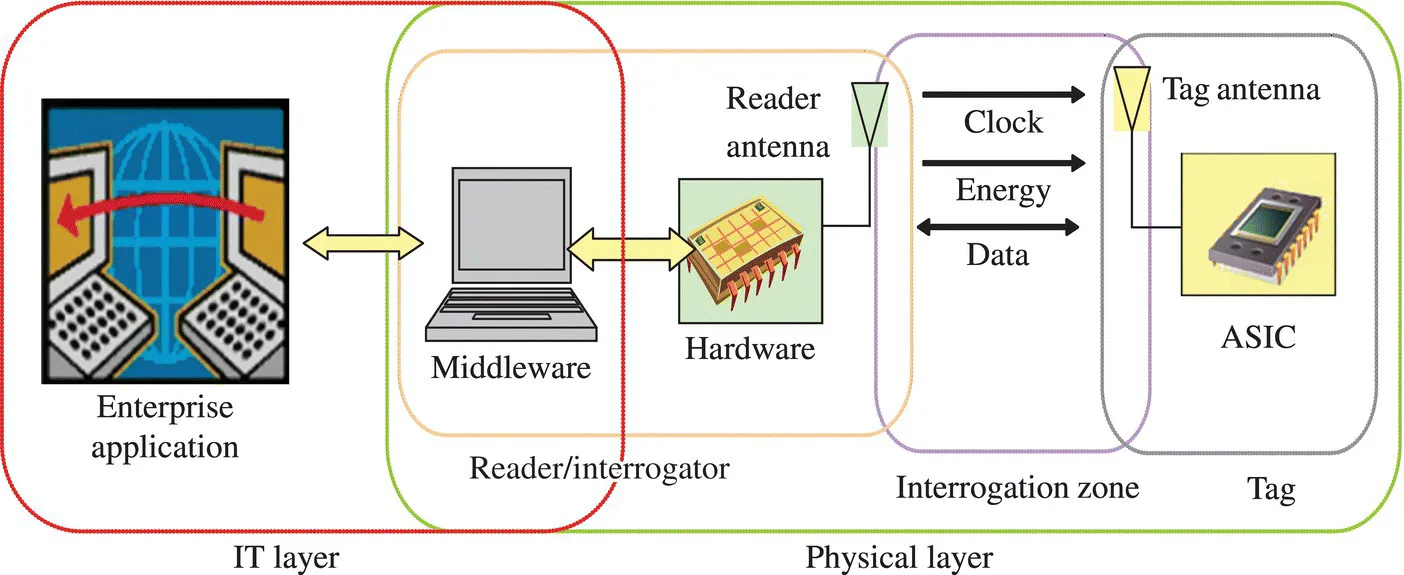
RFID is an evolving wireless technology for automatic identifications, access controls, asset tracking, security and surveillance, database management, inventory control, and logistics. A generic RFID system has two main components: a tag and a reader [3]. As shown in Figure 1.1, the reader sends an interrogating radio frequency (RF) signal to the tag. The interrogation signal comprises clock signal, data, and energy. In return, the tag responds with a unique identification code (data) to the reader. The reader processes the returned signal from the tag into a meaningful identification code. Some tags coupled with sensors can also provide data on surrounding environment such as temperature, pressure, moisture contents, acceleration, and location. The tags are classified into active, semi-active and passive tags based on their onboard power supplies. An active tag contains an onboard battery to energize the processing chip and to amplify signals. A semi-active tag also contains a battery, but the battery is used only to energize the chip, hence yields better longevity compared to an active tag. A passive tag does not have a battery. It scavenges power for its processing chip from the interrogating signal emitted by a reader; hence, it lasts forever. However, the processing power and reading distance are limited by the transmitted power (energy) of the reader. The middleware does the back-end processing, command, and control and interfacing with enterprise application as shown in Figure 1.1.
Figure 1.1 Architecture of conventional radio frequency identification system.
As mentioned previously, the main hindrance in mass deployment of RFID tags for low-cost item tagging is the cost of the tag. The cost of the tag mainly comes from the application-specific integrated circuit (ASIC) or the microchip of the tag. The removal of chip from the tag will lower the cost of tag to a great extent. This can be an excellent alternative for traditional barcodes, which suffer from several issues such as the following: (a) each barcode is individually read, (b) needs human intervention, (c) has less data handling capability, (d) soiled barcodes cannot be read, and (e) barcodes need line-of-sight operation. Despite these limitations, the low-cost benefit of the optical barcode makes it very attractive as it is printed almost without any extra cost. Therefore, there is a pressing need to remove the ASIC from the RFID tag to make it competitive in mass deployment. After removing the ASIC from the RFID tag, the tag can be printed on paper or polymer, and the cost will be less than a cent for each tag [4]. The IDTechEx research report [2] advocates that 60% of the total tag market will be occupied by the chipless tag if the tag can be made less than a cent. As most of the tasks for RFID tag are performed in the ASIC, it’s not a trivial task to remove it from the tag. It needs tremendous investigation and investment in designing low-cost but robust passive microwave circuits and antennas using conductive ink on low-cost substrates. Additionally to these, obtaining high-fidelity response from low-cost lossy materials is very difficult [4]. In the interrogation and decoding aspects of the RFID system is the development of the RFID reader, which is capable to read the chipless RFID tag. Conventional methods of reading RFID tags are not implementable in reading chipless RFID tags. Therefore, dedicated chipless RFID tag readers need to be implemented [5]. This is the first book in this discipline that presents detailed aspects, challenges, and solutions for advanced signal processing for chipless RFID readers for detection, tracking, and anticollision.
The market of chipless RFID is emerging slowly, and the demand is increasing day by day. As forecasted by IDTechEx, the market volume of chipless RFID was less than $5 million in 2009. However, this market will grow to approximately $4 billion in 2019 [6, 7]. In contrast to 4–5 billion optical barcodes that are printed yearly, approximately 700 billion chipless tags will be sold in 2019. Therefore, a significant interest is growing in researchers for the development and implementation of low-cost chipless RFID systems. This book is presenting the advanced signal processing methods that are being used in chipless RFID system for detection, identification, and tracking, and collision avoidance.
The development of chipless RFID systems has already come a long way. Compared to early days, it has already in its second-generation development phase with more data capacity, reliability, and compliances of some existing standards. RF-SAW tags got new standards, can be made smaller with higher data capacity, and currently are being sold in millions. Approximately 30 companies have been developing TFTC. TFTC targets HF (13.65 MHz) band (60% of existing RFID market) and has the read–write capability [7].
In generation I, only a few chipless RFID tags, which were in the inception stage, were reported in the open literature. They include a capacitive gap coupled dipole array [8], a reactively loaded transmission line [9], a ladder network [10], and finally a piano and a Hilbert curve fractal resonators [11]. These tags were in prototype stage, and no further development in commercial grade was reported so far.
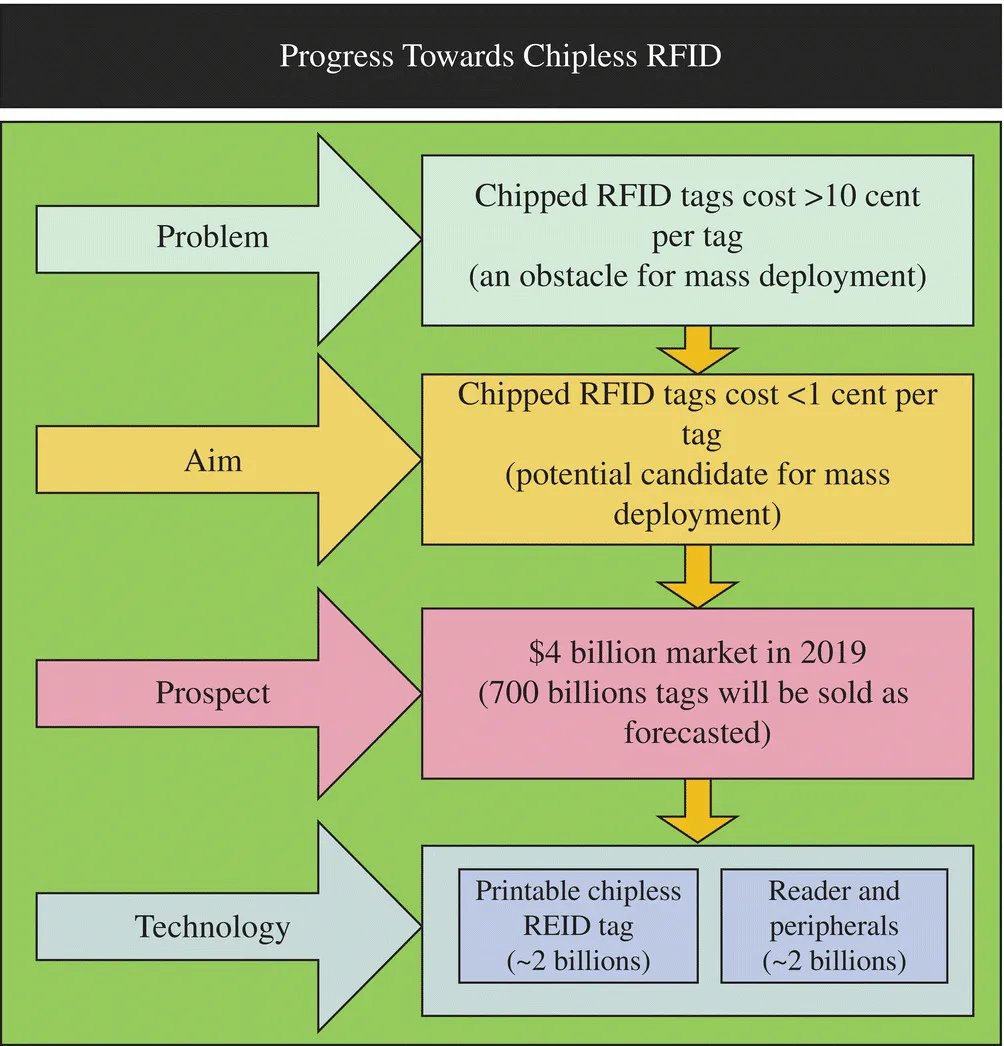
It is obvious that chipless RFID is a potential option for replacing barcodes and hence realizing the fact big industry players such as IBM, Xerox, Toshiba, Microsoft, HP, and new players such as Kavio and Inksure have been investing tremendously in the development of low-cost chipped and chipless RFID. Figure 1.2 shows the motivational factors in developing chipless RFID tags and reader systems. The data shown in the figure is approximated from two sources [6, 7]. Currently, the conventional chipped tags cost more than 10¢ if purchased in large quantities. This high tag price hinders mass deployment of RFID in low-cost item-level tagging. The goal is to develop sub-cent chipless tags that will augment the low-cost item-level tagging. The technological advancements in both the chipless tags and their readers and peripherals will create approximately $4 bn market in 2019 [6, 7].
Figure 1.2 Prospect of chipless RFID technology.
According to the prediction of www.MarketsandMarkets.com (accessed on June 9, 2012) [6], the revenue generated in global chipless RFID market is expected to reach $3925 million in 2016 from $1087 million in 2011, at an estimated combined annual growth rate of 29.3% from 2011 to 2016. The targeted market sectors for the chipless RFID include retail, supply chain management, access cards, airline luggage tagging, aged care and general healthcare, public transit, and library database management system. The author’s group has been developing chipless RFID tag technologies targeting many of these sectors since 2004.
To the best of the author’s knowledge, there is only one book so far by the same author group regarding the chipless RFID reader development [12]. The published book mainly focuses on the hardware development and implementation for chipless RFID tag reader. However, the background signal processing and identification have not been discussed in detail. This book focuses on the signal postprocessing for tag identification, tracking, noise mitigation, ...
Table of contents
COVER
TITLE PAGE
TABLE OF CONTENTS
PREFACE
CHAPTER 1: INTRODUCTION
CHAPTER 2: SIGNAL SPACE REPRESENTATION OF CHIPLESS RFID SIGNATURES
CHAPTER 3: TIME-DOMAIN ANALYSIS OF FREQUENCY SIGNATURE-BASED CHIPLESS RFID
CHAPTER 4: SINGULARITY EXPANSION METHOD FOR DATA EXTRACTION FOR CHIPLESS RFID
CHAPTER 5: DENOISING AND FILTERING TECHNIQUES FOR CHIPLESS RFID
CHAPTER 6: COLLISION AND ERROR CORRECTION PROTOCOLS IN CHIPLESS RFID
CHAPTER 7: MULTI-TAG IDENTIFICATION THROUGH TIME–FREQUENCY ANALYSIS
Access to over 1.5 million titles for a fair monthly price.
Study more efficiently using our study tools.
Frequently asked questions
Yes, you can cancel anytime from the Subscription tab in your account settings on the Perlego website. Your subscription will stay active until the end of your current billing period. Learn how to cancel your subscription
No, books cannot be downloaded as external files, such as PDFs, for use outside of Perlego. However, you can download books within the Perlego app for offline reading on mobile or tablet. Learn how to download books offline
Perlego offers two plans: Essential and Complete
Essential is ideal for learners and professionals who enjoy exploring a wide range of subjects. Access the Essential Library with 800,000+ trusted titles and best-sellers across business, personal growth, and the humanities. Includes unlimited reading time and Standard Read Aloud voice.
Complete: Perfect for advanced learners and researchers needing full, unrestricted access. Unlock 1.5M+ books across hundreds of subjects, including academic and specialized titles. The Complete Plan also includes advanced features like Premium Read Aloud and Research Assistant.
Both plans are available with monthly, semester, or annual billing cycles.
We are an online textbook subscription service, where you can get access to an entire online library for less than the price of a single book per month. With over 1.5 million books across 990+ topics, we’ve got you covered! Learn about our mission
Look out for the read-aloud symbol on your next book to see if you can listen to it. The read-aloud tool reads text aloud for you, highlighting the text as it is being read. You can pause it, speed it up and slow it down. Learn more about Read Aloud
Yes! You can use the Perlego app on both iOS and Android devices to read anytime, anywhere — even offline. Perfect for commutes or when you’re on the go. Please note we cannot support devices running on iOS 13 and Android 7 or earlier. Learn more about using the app
Yes, you can access Chipless Radio Frequency Identification Reader Signal Processing by Nemai Chandra Karmakar,Prasanna Kalansuriya,Rubayet E. Azim,Randka Koswatta in PDF and/or ePUB format, as well as other popular books in Technology & Engineering & Microwaves. We have over 1.5 million books available in our catalogue for you to explore.