A guide to environmental and communication issues related to fracking and the best approach to protect communities
Environmental Considerations Associated with Hydraulic Fracturing Operations offers a much-needed resource that explores the complex challenges of fracking by providing an understanding of the environmental and communication issues that are inherent with hydraulic fracturing. The book balances the current scientific knowledge with the uncertainty and risks associated with hydraulic fracking. In addition, the authors offer targeted approaches for helping to keep communities safe.
The authors include an overview of the historical development of hydraulic fracturing and the technology currently employed. The book also explores the risk, prevention, and mitigation factors that are associated with fracturing. The authors also include legal cases, regulatory issues, and data on the cost of recovery. The volume presents audit checklists for gathering critical information and documentation to support the reliability of the current environmental conditions related to fracking operations and the impact fracking can have on a community. This vital resource:
Contains the technical information and mitigation recommendations for safety and environmental issues related to hydraulic fracturing
Offers an historical overview of conventional and unconventional oil and gas drilling
Explains the geologic and technical issues associated with fracking of tight sand and shale formulations
Presents numerous case studies from the United States EPA and other agencies
Discusses issues of co-produced waste water and induced seismicity from the injection of wastewater
Written for environmental scientists, geologists, engineers, regulators, city planners, attorneys, foresters, wildlife biologists, and others, Environmental Considerations Associated with Hydraulic Fracturing Operations offers a comprehensive resource to the complex environmental and communication issues related to fracking.
As a nation, and since the 1970s, energy independence has been more of a dream than a reality as we have witnessed the ups and downs of the oil and gas industry over the past several decades. The history of the oil and gas industry is that of ups and downs, but also one of technological innovation and ingenuity since the first well for gas was drilled in 1825 in the Marcellus Shale of Devonian age in the village of Fredonia, Chautauqua County, New York, and the first successfully drilled oil well near Titusville, Pennsylvania, by Edwin Drake in 1859. In the twenty‐first century, technological advances continue to drive the energy landscape and have significant benefit beyond just energy policy. Our nation’s independence and reemergence as an energy leader largely reflects technological advances in the extraction of oil and natural gas from shale formations.
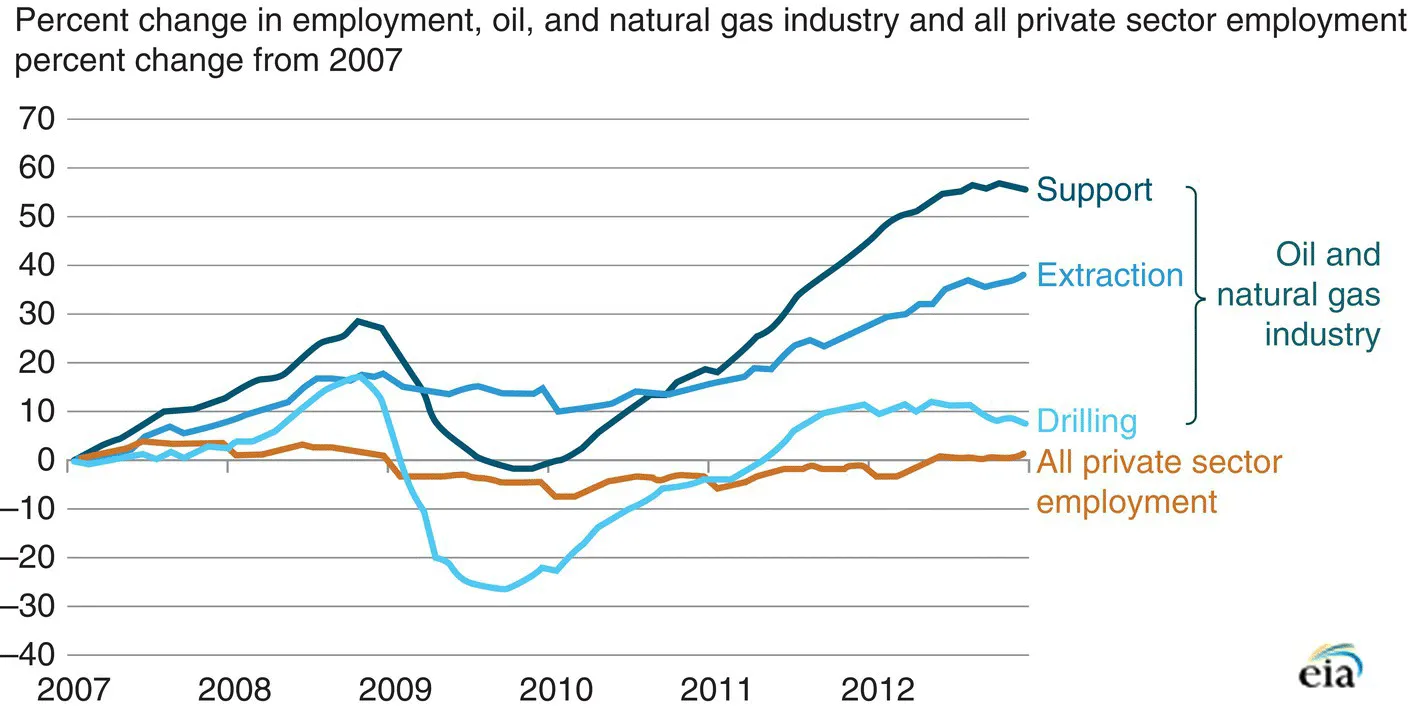
Since the beginning of the twentieth century, the oil and gas industry has been vital to our energy needs. This industry and the infrastructure that supports it employ more people than any other industry. As of 2013, the entire natural gas and oil industry supported 9.2 million US jobs, accounted for 7.7% of the US economy, and delivered $86 million per day in revenue to the federal government. Between 2007 and the end of 2012, the Energy Information Administration (EIA) in 2013 reported that total US private sector employment increased by more than one million jobs, or about a 1% increase, whereas employment within the oil and natural gas industry increased by more than 162 000 jobs, or about a 40% increase (Figure 1.1). However, employment in oil and natural gas extraction and support activities continued declining from levels reached in the fall of 2014–2011 levels, just before the onset of falling oil prices (EIA 2016).
Figure 1.1 From the start of 2007 through the end of 2012, total US private sector employment increased by more than one million jobs, about 1%. Over the same period, the oil and natural gas industry increased by more than 162 000 jobs, a 40% increase (USEIA 2013).
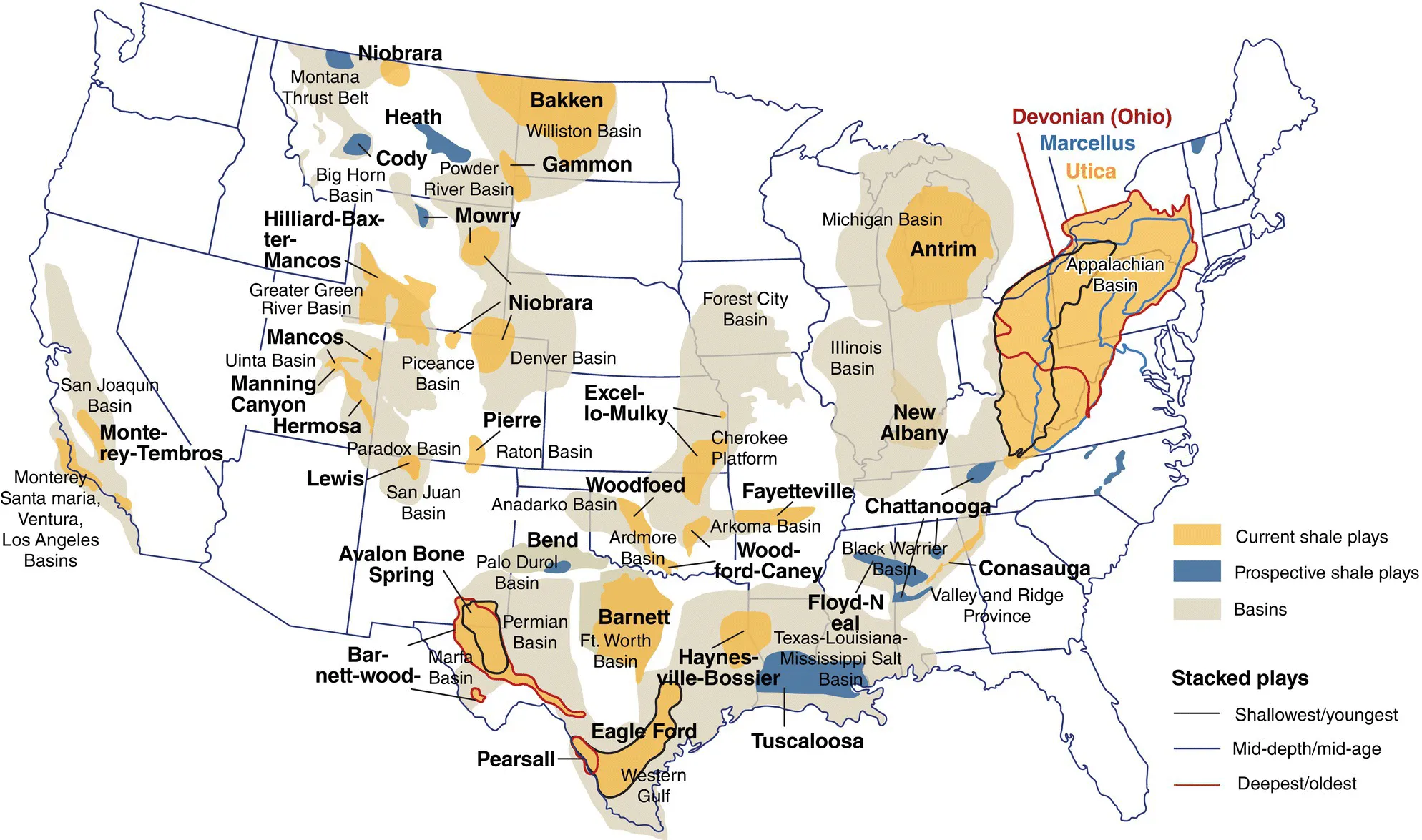
Currently, there are 27 states that account for 99.9% of the oil and natural gas production in the United States, with about 33 states reporting oil or gas production. What is interesting about this however is that as of 2015 there were no <25 significant plays, and 6 prospective plays, noted in the conterminous United States (Figure 1.2). These shale plays extend from east coast to west coast and from the northern to southern extent of the country. What makes these shale plays of interest is a result of two primary technological advances: horizontal drilling and well stimulation techniques with the most innovative being hydraulic fracturing or fracking.
Figure 1.2 Oil–gas basins and shale gas plays in the lower United States (API 2015).
It was not that long ago that the term fracking became part of our everyday consciousness. What Daniel Yergin (2011) in his book The Quest calls the “Shale Gale,” a sudden surge in the domestic production of US natural gas was observed for 2007 and into 2008. The output of natural gas would continue to increase, and with the increase in supply, cost declined. This phenomenon was also referred to as a “shale revolution” – revolution of productivity and abundance as reflected in extraordinary natural gas production growth, lower natural gas prices, and a reduction in natural gas imports. Shale gas that made up only about 1% of the natural gas supply in 2000 would by 2011 make up 25%. Yergin would go on to state: “By the beginning of this decade, the rapidity and sheer scale of the shale breakthrough – and its effect on markets – qualified it as the most significant innovation in energy so far since the start of the twenty‐first century.” It is estimated that hydraulic fracturing will eventually account for nearly 70% of natural gas development in North America. Furthermore, the US EIA in 2015 reported that dry natural gas production in the United States increased by 35% from 2005 to 2013 resulting largely from the development of shale gas resources (including natural gas from tight oil formations) in the lower 48 states. The EIA in 2015 summarized:
Growth in US energy production, led by crude and natural gas, and only modest growth in demand reduce US reliance on imported energy supplies.
A strong growth in domestic crude oil production from tight formations will lead to a decline in net petroleum imports and growth in net petroleum product exports in all Annual Energy Outlook cases.
In 2017, the United States will transition from being a modest net importer of natural gas to a net exporter.
It is estimated that the Unites States now has 200 years’ worth of natural gas and is predicted to be the largest oil producer in the world by the end of the decade, thanks to fracking. By 1988, hydraulic fracturing had been successfully applied nearly one million times, and as of today, more than 2.5 million hydraulic fracturings have occurred worldwide. The public has also benefited with over 600 trillion cubic feet of natural gas that has been provided to the American consumer as a result of this technology. Today, hydraulic fracturing is used for over 60% of all oil and gas wells worldwide and will, for example, be used for over 60% of wells drilled in Kansas over the next decade. In addition, nearly 9 out of 10 onshore oil and gas wells require fracture simulation to remain or become viable. As an added benefit, with the use of more natural gas as a result of the fracking revolution, US CO2 emissions are at a six‐year low.
1.2 Cultural Influences
With all this good news, why is there so much fuss and environmental concern regarding fracking? Not since the eruption of Mount Pinatubo, Climategate, the BP spill, or the Japan Tohoku earthquake/tsunami and Fukushima disaster has something in earth science captured the public’s attention. Certainly there is a political perspective and the desire to wean ourselves off of fossil fuels and go totally green via renewables, which is simply not achievable considering the immense amount of energy consumed by society on a daily basis. There is also an environmental perspective, and such concerns can be divided into subsurface and aboveground related. Subsurface issues relate primarily to water quality and impacts, induced seismicity, and management and disposal of produced water and fluids. Aboveground concerns reflect aesthetics, noise, traffic, and fugitive emissions. How real these issues and concerns are, and how they are managed and mitigated, is the primary theme of this book.
The 2010 documentary Gasland attracted wide attention and the information projected was not helpful to the national dialogue. In lieu of appreciation of the innovation and technological advancements related to the energy revolution, the public’s attention was placed on alleged groundwater contamination. Gasland featured three Weld County landowners – Mike Markham, Renee McClure, and Aimee Ellsworth – whose water wells were allegedly contaminated by oil and gas development. The Colorado Oil and Gas Conservation Commission (COGCC) investigated complaints from all three landowners in 2008 and 2009 and subsequently issued reports of findings on each. It was concluded that Aimee Ellsworth’s well contained a mixture of biogenic and thermogenic methane that was in part attributable to oil and gas development, and Mrs. Ellsworth and an operator reached a settlement in that case. However, using the same investigative techniques, COGCC concluded that Mike Markham’s and Renee McClure’s wells contained biogenic gas that was not related to oil and gas activity (COGCC 2015). These wells ...
Table of contents
Cover
Table of Contents
List of Figures
List of Tables
Foreword
Acknowledgments
1 Introduction
2 Historical Development from Fracturing to Hydraulic Fracturing
3 Geology of Unconventional Resources
4 Overview of Drilling and Hydraulic Fracture Stimulation Techniques for Tight Oil and Gas Shale Formations
5 Overview of Impacts from Tight Oil and Shale Gas Resource Development
6 Surface and Groundwater Risks, Resource Quality Management, and Impacts
7 Induced Seismicity
8 Air Quality Resources and Mitigation Measures
9 Land Use Resources and Socioeconomics
10 Ecological Resources
11 Legislative Trends Associated with Well Stimulation and Hydraulic Fracturing
12 Sampling, Exposure Pathways, and Site Conceptual Models
13 Financial Issues
14 Legal Considerations and Case Law
15 Spills, Forensic Evaluation, and Case Studies
16 Conclusions
Appendix A: Selected University Studies, State, and Federal Reports
Appendix B: Glossary
Appendix C: List of Acronyms and Abbreviations
Appendix D: Conversions
Appendix E: Summary of Potential Job Hazards During Hydraulic Fracture Stimulation Process
Appendix F: Chemical Additives Used in the High‐Volume Hydraulic Fracturing Operations
Appendix G: Exposure Planning, Emergency Response, and Toxicity Tables
Appendix H: Selected Sampling Methods and Documentation
Appendix I: Environmental Checklists
Appendix J: Metric Conversion of Table 3.4 (Metric Units in Bold italics)
Appendix K: US Crude Oil Prices 1859–2016
Index
End User License Agreement
Trusted by 375,005 students
Access to over 1.5 million titles for a fair monthly price.
Study more efficiently using our study tools.
Frequently asked questions
Yes, you can cancel anytime from the Subscription tab in your account settings on the Perlego website. Your subscription will stay active until the end of your current billing period. Learn how to cancel your subscription
No, books cannot be downloaded as external files, such as PDFs, for use outside of Perlego. However, you can download books within the Perlego app for offline reading on mobile or tablet. Learn how to download books offline
Perlego offers two plans: Essential and Complete
Essential is ideal for learners and professionals who enjoy exploring a wide range of subjects. Access the Essential Library with 800,000+ trusted titles and best-sellers across business, personal growth, and the humanities. Includes unlimited reading time and Standard Read Aloud voice.
Complete: Perfect for advanced learners and researchers needing full, unrestricted access. Unlock 1.5M+ books across hundreds of subjects, including academic and specialized titles. The Complete Plan also includes advanced features like Premium Read Aloud and Research Assistant.
Both plans are available with monthly, semester, or annual billing cycles.
We are an online textbook subscription service, where you can get access to an entire online library for less than the price of a single book per month. With over 1.5 million books across 990+ topics, we’ve got you covered! Learn about our mission
Look out for the read-aloud symbol on your next book to see if you can listen to it. The read-aloud tool reads text aloud for you, highlighting the text as it is being read. You can pause it, speed it up and slow it down. Learn more about Read Aloud
Yes! You can use the Perlego app on both iOS and Android devices to read anytime, anywhere — even offline. Perfect for commutes or when you’re on the go. Please note we cannot support devices running on iOS 13 and Android 7 or earlier. Learn more about using the app
Yes, you can access Environmental Considerations Associated with Hydraulic Fracturing Operations by James A. Jacobs,Stephen M. Testa in PDF and/or ePUB format, as well as other popular books in Tecnologia e ingegneria & Ingegneria chimica e biochimica. We have over 1.5 million books available in our catalogue for you to explore.