- Features numerous updates and revisions reflecting new information that has come to light on surveyors Charles Mason and Jeremiah Dixon
- Reveals the true origin of the survey's starting point and the actual location of the surveyors' observatory in Embreeville
- Offers expanded information on Mason and Dixon's transit of Venus adventures, which would be an important influence on their future work, and on Mason's final years pursuing a share of the fabulous Longitude prize, and his death in Philadelphia
- Includes a new, more comprehensive appendix describing the surveying methods utilized to establish the Mason-Dixon Line
eBook - ePub
Drawing the Line
How Mason and Dixon Surveyed the Most Famous Border in America
- English
- ePUB (mobile friendly)
- Available on iOS & Android
eBook - ePub
About this book
The second edition of Drawing the Line: How Mason and Dixon Surveyed the Most Famous Border in America updates Edwin Danson's definitive history of the creation of the Mason - Dixon Line to reflect new research and archival documents that have come to light in recent years.
Information
1
In the Reign of George the Third
Their names were Charles Mason and Jeremiah Dixon. And they were the last best hope for peace. But little did they know what started as a mere border dispute would come to mark the greatest divide in American history.
Later in history, their names would become irrevocably linked with the boundary itself: the Mason–Dixon Line, best remembered today as the symbolic Civil War divide between North and South, the partition between slave and free states. In human terms, the Mason–Dixon Line was the eighteenth century’s most ambitious border survey, a perfect curve of latitude, two hundred forty-five miles from end to end.
The long war with France was over, but the costs had crippled the Exchequer. In London, the new Prime Minister was the unpopular Sir George Grenville, intent on reducing the war debt, and meeting the rising costs of maintaining the army in North America, by taxing the colonies. He was also rumored to be planning restrictions on settlement west of the Alleghenies to appease the restless Indians. In the frontier lands, far to the west, there was serious trouble and reports of massacres.
Seventeen sixty-three was the year when every ship from England brought news of another tax or more stifling regulations to the American colonists, but for the small cluster of people gathered on the river quay at Marcus Hook, there was at least some good news. The Hanover Packet had just berthed with a cargo from England, and London merchants with an eye to business. Among the fifteen or so passengers disembarking that gray November day were the two young Englishmen, recently engaged by the landowners who held the royal grants, the so-called proprietors of Maryland and Pennsylvania. Their appointment had been a secret, a last-ditch attempt at ending eighty years of acrimony, bloodshed, and war. The men who finally solved the contentious border were not lawyers or politicians, but astronomers; men of science.
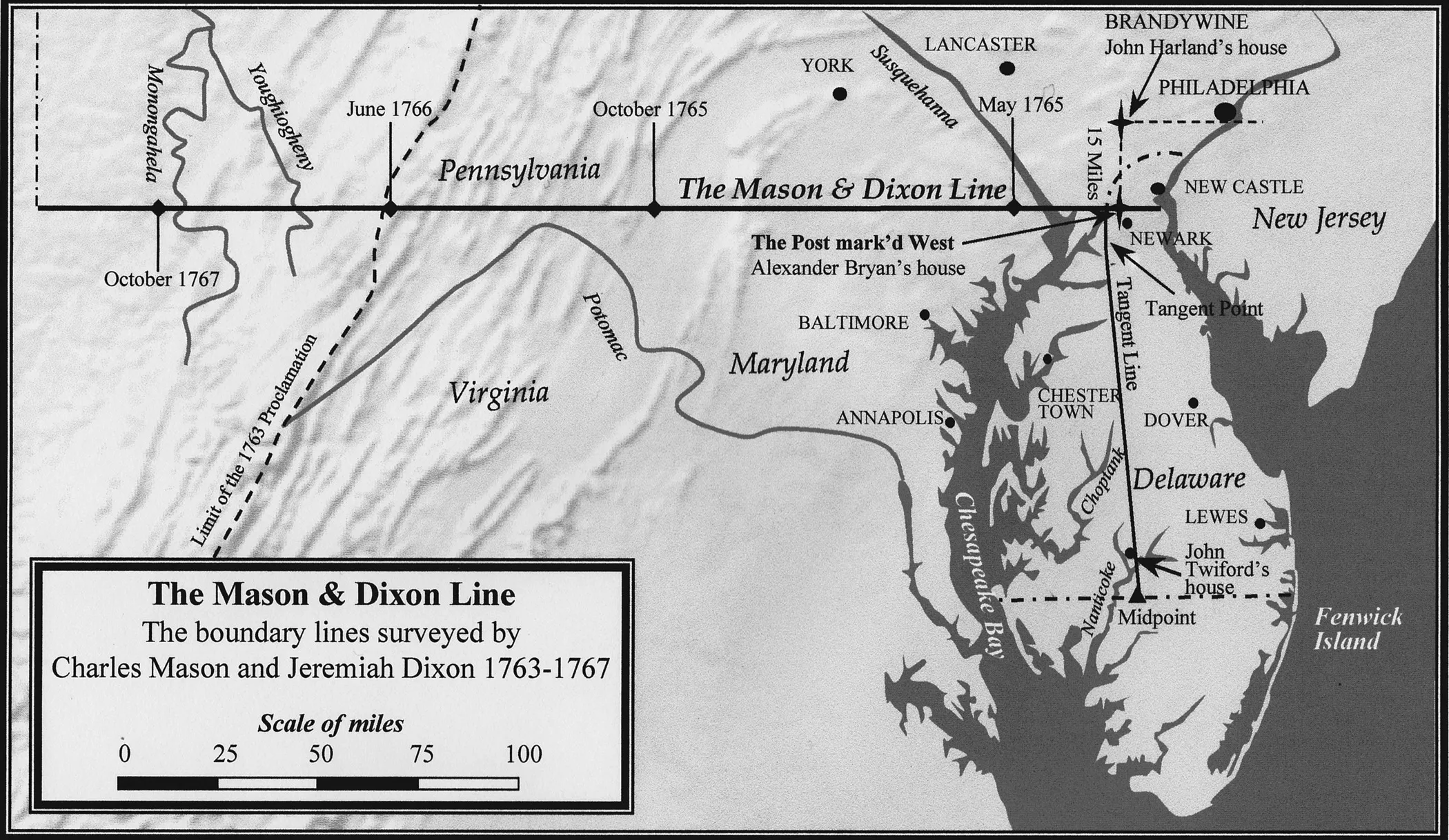
Figure 1 Map of the lines surveyed by Mason and Dixon, 1763–1768.
In the Age of Enlightenment, when intellectuals across Europe and in North America were embracing reason, logic, and the concepts of civil freedom, where mathematicians and astronomers were beginning to make sense of the natural world, so religion and politics tried pulling it apart.
In the seventeenth century, the new English lords of America owed their good fortunes as much to their religious affiliations as they did to their enormous wealth. Tensions between Catholic and Protestant interests waxed and waned throughout the period as monarch succeeded monarch. Towards the end of the century, the Dutch Prince William of Orange became king and finally established in England the supremacy of Protestantism and Parliament, and the modern era began. British America grew apace as settlers poured into the territories, and vast new trading patterns emerged. Colonial expansion outpaced the political processes and when Mason and Dixon stepped ashore in America in the gray chill of a November day, the land they found was substantially different from the one they expected.
In England, most people, and certainly most members of Parliament, regarded the North American colonies as if they were distant English shires. Unlike their English counterparts, qualifying colonists had neither the vote nor representation in Parliament. Discontent and anger were growing towards the way the British government, and especially King George III, was running American affairs.
At the time, the British Empire as such did not exist and the nineteenth-century plantation regime, with its exceptional brutality, was still in its infancy. To be sure, there were slaves in America, perhaps as many as a million, but not all the enslaved were black. The colonial broadsheets of the time contained almost as many advertisements requesting the apprehension of transported white convicts and indentured servants as they did for African runaways. Even so, the overwhelming majority of slaves were kidnapped West African natives and their progeny. In 1750, the African Company of Merchants, the last major London company engaged in the nefarious trade, began slaving out of Bristol. Also known as the Merchants Trading to Africa Company, it was the direct successor of the Company of Royal Adventurers Trading to Africa founded by James Stuart, Duke of York, later the despised King James II. Slaving was big business. In the year Mason and Dixon voyaged to America, the slave trade was at its height, with more than one hundred fifty ships transporting forty-five thousand Africans annually across the Atlantic to the American colonies, the majority ending up in the middle and southern provinces; by 1763, nearly forty percent of Maryland’s population, working the tobacco fields, were forced labor.
Although at its peak in the colonies, slavery was becoming morally unacceptable, at least in England. In 1772, Lord Chief Justice William Murray, the Earl Mansfield, presided over the case of James Somersett, a fugitive Virginian slave who had escaped to England. In Somerset v. Stewart (1772) Lord Mansfield, whose decisions reflected the morals of the Enlightenment, ruled that:
The state of slavery is . . . so odious, that nothing can be suffered to support it, but positive law. Whatever inconveniences, therefore, may follow from the decision, I cannot say this case is allowed or approved by the law of England; and therefore [Somersett] must be discharged.1
No longer could a slave be repatriated forcibly to face retributive punishment at the hand of his master. The poet William Cowper was moved to write:
We have no slaves at home – Then why abroad?And they themselves, once ferried o’er the waveThat parts us, are emancipate, and loos’dSlaves cannot breathe in England; if their lungsReceive our air, that moment they are free;They touch our country, and their shackles fall.2
Within ten years of Murray’s judgment, the beginning of the true abolitionist movement was underway. However, all that lay in the future. During Mason and Dixon’s travels in America, slaves doing sweat labor in the fields would have been a familiar sight.
Apart from the imported slaves, there were also the indigenous American natives. Neither races were properly understood. Natural ignorance, perverted scripture, and fear led to bigotry and atrocity, and in this respect the settlers of British America were not unique. To understand the America of Charles Mason and Jeremiah Dixon, one has to cast away contemporary ideas of freedom and one-man-one-vote; there was no vote for the half million emigrants who flooded annually into the coastal provinces. Their moral yardsticks they imported from the Old World, refashioned for a new world where men and women were carving a new land from the wilderness. It was a world where bravery and strength of spirit went hand in hand with the hardships of everyday life in an untamed environment. Such conditions forged a fierce pride which, melded with the radical waves of the Enlightenment, evolved into an article of faith. As an American friend once observed: “in the United States, freedom is mandatory and requires an excessive degree of expression.” In Europe, these ideas and values were to develop more slowly and more cautiously.
The fragile peace that followed the end of the French and Indian War in 1763 was a time of transition that would ultimately lead to the transformation of the colonists from European vassals into American citizens. It was the era of the two Georges; George III and George Washington. To quote the 1851 edition of Charles Dickens’ A Child’s History of England:
It was in the reign of George the Third that England lost North America, by persisting in taxing her without her own consent. That immense country, made independent under WASHINGTON, and left to itself, became the United States; one of the greatest nations of the earth.
Ten years after Dickens wrote those words, the slaves in the cotton and tobacco fields had helped generate enough wealth to fund the most awful of civil wars, where the Mason–Dixon Line took on a darker, more sinister meaning.
Notes
Table of contents
- Cover
- Title Page
- Table of Contents
- List of Figures
- Acknowledgments for the Revised Edition
- Introduction to the Revised Edition
- 1 In the Reign of George the Third
- 2 The Fortieth Degree
- 3 Kings and Queens
- 4 Entirely at a Stand
- 5 Curious Knowing People
- 6 The Transit of Venus
- 7 Mr. Bird’s Contrivances
- 8 Persons Intirely Accomplished
- 9 The Southernmost Point of the City
- 10 15 Statute Miles, Horizontal
- 11 The Tail of Ursae Minoris
- 12 Fine Sport for the Boys
- 13 From the Post mark’d West
- 14 The Pencil of Time
- 15 King of the Tuscarawa
- 16 From Hence; to the Summit
- 17 At a Council of the Royal Society
- 18 Vibration of the Pendulum
- 19 Not One Step Further
- 20 A Degree of Latitude
- 21 The Last Transit
- 22 A Very Helpless Condition
- 23 Finishing the Job
- Appendix
- Bibliography
- Index
- End User License Agreement
Trusted by 375,005 students
Access to over 1.5 million titles for a fair monthly price.
Study more efficiently using our study tools.
Frequently asked questions
Yes, you can cancel anytime from the Subscription tab in your account settings on the Perlego website. Your subscription will stay active until the end of your current billing period. Learn how to cancel your subscription
No, books cannot be downloaded as external files, such as PDFs, for use outside of Perlego. However, you can download books within the Perlego app for offline reading on mobile or tablet. Learn how to download books offline
Perlego offers two plans: Essential and Complete
- Essential is ideal for learners and professionals who enjoy exploring a wide range of subjects. Access the Essential Library with 800,000+ trusted titles and best-sellers across business, personal growth, and the humanities. Includes unlimited reading time and Standard Read Aloud voice.
- Complete: Perfect for advanced learners and researchers needing full, unrestricted access. Unlock 1.5M+ books across hundreds of subjects, including academic and specialized titles. The Complete Plan also includes advanced features like Premium Read Aloud and Research Assistant.
We are an online textbook subscription service, where you can get access to an entire online library for less than the price of a single book per month. With over 1.5 million books across 990+ topics, we’ve got you covered! Learn about our mission
Look out for the read-aloud symbol on your next book to see if you can listen to it. The read-aloud tool reads text aloud for you, highlighting the text as it is being read. You can pause it, speed it up and slow it down. Learn more about Read Aloud
Yes! You can use the Perlego app on both iOS and Android devices to read anytime, anywhere — even offline. Perfect for commutes or when you’re on the go.
Please note we cannot support devices running on iOS 13 and Android 7 or earlier. Learn more about using the app
Please note we cannot support devices running on iOS 13 and Android 7 or earlier. Learn more about using the app
Yes, you can access Drawing the Line by Edwin Danson in PDF and/or ePUB format, as well as other popular books in History & North American History. We have over 1.5 million books available in our catalogue for you to explore.