The Stop Doing List gets you off the treadmill of unproductive, frenetic activity, and sets you on the path toward growth. Running a business has never been easy, but today's nonstop 24-7-365 world makes moving forward more difficult than ever before. Plenty of resources can show you how to make lists, create schedules and manage your time, but they all seem to expect your time to be 100 per cent devoted to work – not only is that no way to live, it's no way to grow. Instead, try doing less. This book shows you how to stop wasting energy on tasks that don't move you closer to your goals, so you can focus on the things that do. You'll identify your own Stop Doing list, and learn a systematic and practical way to eliminate, automate or delegate these tasks so they never end up on your To Do list again. You'll discover your personal path to business success, develop a winning mindset and forever change the way you run your company – and along the way, you'll gain the freedom, energy and time you need to take back your life.
Author Matt Malouf has helped businesses around the globe – from $20M+ corporations to start-ups – achieve their growth objectives. Now, he shares his proven strategies with you: it's not about doing more; it's about doing what matters.
Find your inner genius and use it to grow your business
Switch your mindset to one of success
Attract, train and retain the people you need
Make lasting changes to the way you think about your business
If it seems like the more you do, the less you achieve, it's time to stop and breathe. Get smarter about growth and start developing The Stop Doing List.
It's said that Einstein defined insanity as doing the same thing over and over again and expecting a different result. If this is true, then most business owners are insane. They turn up day after day to do the same job the same way, yet they hope to get improved results.
Business owners often fall into the trap of working too deeply in their business rather than working on their business, believing this is the only way they can maximise profit. Beyond that, many business owners play out a different form of insanity, in which they try different things with the same mindset, and expect a different result.
This mindset often creates frustration when business owners spend their time, day in and day out, doing the same low-value tasks. It almost becomes the culture of the business — incredibly difficult to break or replace with the mindset of growth, which always looks for a better way of doing business.
Mindset's an important starting point because, when it comes to our business, our behaviour is driven by our emotion. Unless we adopt the right mindsets and have a different attitude and outlook, then we'll only play out insanity.
No business can change overnight. Often it requires a series of small steps, beginning with the owner changing their mindset and implementing changes to the way they work. Correct mindsets, when multiplied by effective actions, equal amazing results. Once this process is started, businesses start seeing growth, little by little, bit by bit.
Do you like to control every aspect of your business? While you may answer yes to this question, I am here to tell you that doing everything does not give you more control. If anything it reduces your ability to control your company, as you are spread so thin that things slip through the cracks. So you decide you need to let go and you try to delegate some tasks. You employ someone or outsource some tasks to someone, only for them to screw it up — again — so you are left to clean up the mess, and the little voice in your head says, ‘I told you it would be easier to do it yourself.'
You see, in order for the Stop Doing List system to work for you (and it does work), you need to understand it's not as simple as telling somebody what to do. For the system to succeed you must be committed to behavioural change.
In order to achieve a goal you have never achieved before, you must start doing things you have never done before. This behavioural change is required for you and your people, but inevitably it must start with you! This sounds easy, but if it were that easy there would be no need for this book. Behavioural change requires you to consistently do something different.
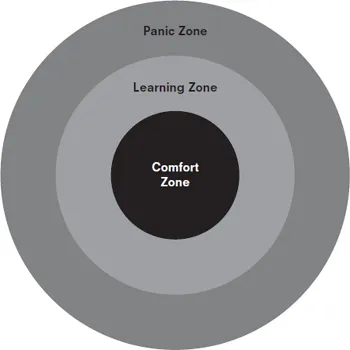
Without understanding that you must leave your comfort zone in order to achieve behavioural change, you will struggle to let go of the majority of the non–income generating tasks that are holding you and your company back. Figure 1.1 shows the different zones.
Figure 1.1 the comfort, learning and panic zones
The comfort zone
We have all heard the term 'comfort zone' used in business in some way or another. It is where many business owners operate from. Put simply, it's where our natural skills and abilities lie. For many business owners, their comfort zone is filled with big lists of what they need to do, which tend to be lower value tasks that have high urgency. When I first start working with a business owner their comfort zone rarely consists of focusing on tasks that will move them towards their goals faster.
It is important to note that if you choose to spend the majority (if not all) of your time in the comfort zone you will make little progress, if any. This is because your comfort zone consists of things you can already do quite easily. You are unable to learn and build new skills in the comfort zone.
The panic zone
Quite often the people I work with make a decision to jump out of their comfort zone to move towards their goals. This is often after reading a book, attending a seminar or hearing someone inspiring that fires them up. Their challenge is they jump so far out of their comfort zone that they become stressed, anxious and even overwhelmed, which often leads to inactivity (the opposite of what they are trying to achieve!). We refer to this as the panic zone. When you are in the panic zone every activity or task feels tough and unachieveable. You will find yourself in a state of confusion or panic and feeling so uncomfortable that achieving the tasks is near impossible.
Like the comfort zone, you can't make progress from the panic zone. I find a lot of business owners enter the panic zone when they take on too many new tasks or projects. Your goals and dreams will not be realised from the panic zone.
The learning zone
The learning zone is the zone between the comfort zone and the panic zone. This is where real progress is made. The learning zone is where new skills are learned and mastered. It is where you will gather forward momentum towards your goals and often see great revenue and profit improvements in your business.
To be honest, while the learning zone is the more appropriate name for this zone, I personally like to call it the 'earning' zone. In the earning zone you will feel a little uncomfortable. This is good: growth cannot occur in your comfort zone. The easiest way to explain this is a simple metaphor. If you have ever trained with weights in the gym you will understand that if you choose:
easy weights to lift you will make no progress
weights that are too heavy you will more than likely injure yourself
weights that challenge you to the point where you can safely do 10 repetitions and physically cannot push another one out, you will achieve growth.
This is the learning zone.
Identifying the learning zone
Many business owners don't know where their comfort zone ends and their learning zone begins. Because progress can only be achieved by performing tasks within the learning zone, we must first define the boundaries of this zone. ‘So how do I know which zone I am in?' you may ask.
Well let's start with your comfort zone. If you don't find yourself challenged and rely largely on habit or past experience, chances are you are working inside your comfort zone. Start to take note of the tasks you naturally choose to do, or tasks that don't stress you out. Please note that you don't want to avoid performing tasks in your comfort zone; in fact, at times it may be beneficial to the business. But you want to avoid spending all of your time in the comfort zone.
On the opposite end, the panic zone is quite easy to identify. Tasks or activities in the panic zone often create high levels of stress, do not come naturally to you, and are often short-lived because of the amount of ‘pain' they create for you. An example of the panic zone is adults learning to swim. Often the student is stressed and unsure, causing their body to tense right up. This stressed state makes it impossible for them to learn and often causes them to struggle and be unable to stay above the water. It's only when the student begins to relax and understand how to get their body to float that they can begin to learn how to swim.
So, if we know that in the comfort zone things appear to be predictable or too easy, and the panic zone is characterised by high stress or feeling frantic, the learning zone is easier to define. This growth zone is where we perform optimally and begin to enjoy tasks, putting us in a prime physical and emotional state for both absorbing and retaining information — not too stressed, not too relaxed. Now I'm not saying that it's going to be easy! You will feel a little stretched at times and even bordering on the panic zone. But in my personal experience (and the experience of my clients) the learning zone will return you 10 times your effort if you are persistent. Being able to recognise which zone you are operating in and understanding the physical and emotional corrections required to reach the learning zone results in ongoing progress and personal development.
Get comfortable feeling uncomfortable
With the zones continually morphing it can be difficult to remain within the learning zone. You therefore need to embrace being uncomfortable, knowing you are primed for progress in this state.
When you take on new and challenging tasks, you will notice with repetition they become familiar, transitioning you from the learning zone to the comfort zone. Similarly, tasks once tackled in the panic zone will become more manageable and descend into the learning zone, and so the process continues.
Implementing the Stop Doing List system might send you into the panic zone if you try and stop everything all at once. You will repeat old behaviours and thought patterns that will cause you to think ‘It's easier if I just keep doing this' or ‘I'll never be able to find someone who can do this as well as I can.'
In order to prevent this from happening, we want to start slow. The Stop Doing List system is designed to assist you to take a step back into the learning zone and do some preparation, research or documentation. This process develops new skills and abilities, which move you from the panic zone into the learning zone, and ultimately (by making regular, conscious efforts) into the comfort zone.
You've got to understand you have to do things differently; you have to let go. You can allow people to perform many of the tasks on your to-do...
Table of contents
COVER
TITLE PAGE
COPYRIGHT
ABOUT THE AUTHOR
ACKNOWLEDGEMENTS
FOREWORD BY SIIMON REYNOLDS
INTRODUCTION
PART I: YOUR MINDSET
PART II: CREATE YOUR STOP DOING LIST
PART III: HOW TO STOP DOING
CONCLUSION
RESOURCES: WHAT TO STOP DOING
INDEX
AN INVITATION FROM MATT …
MATT MALOUF KEYNOTE SPEAKING
EULA
Trusted by 375,005 students
Access to over 1.5 million titles for a fair monthly price.
Study more efficiently using our study tools.
Frequently asked questions
Yes, you can cancel anytime from the Subscription tab in your account settings on the Perlego website. Your subscription will stay active until the end of your current billing period. Learn how to cancel your subscription
No, books cannot be downloaded as external files, such as PDFs, for use outside of Perlego. However, you can download books within the Perlego app for offline reading on mobile or tablet. Learn how to download books offline
Perlego offers two plans: Essential and Complete
Essential is ideal for learners and professionals who enjoy exploring a wide range of subjects. Access the Essential Library with 800,000+ trusted titles and best-sellers across business, personal growth, and the humanities. Includes unlimited reading time and Standard Read Aloud voice.
Complete: Perfect for advanced learners and researchers needing full, unrestricted access. Unlock 1.5M+ books across hundreds of subjects, including academic and specialized titles. The Complete Plan also includes advanced features like Premium Read Aloud and Research Assistant.
Both plans are available with monthly, semester, or annual billing cycles.
We are an online textbook subscription service, where you can get access to an entire online library for less than the price of a single book per month. With over 1.5 million books across 990+ topics, we’ve got you covered! Learn about our mission
Look out for the read-aloud symbol on your next book to see if you can listen to it. The read-aloud tool reads text aloud for you, highlighting the text as it is being read. You can pause it, speed it up and slow it down. Learn more about Read Aloud
Yes! You can use the Perlego app on both iOS and Android devices to read anytime, anywhere — even offline. Perfect for commutes or when you’re on the go. Please note we cannot support devices running on iOS 13 and Android 7 or earlier. Learn more about using the app
Yes, you can access The Stop Doing List by Matt Malouf in PDF and/or ePUB format, as well as other popular books in Business & Business generale. We have over 1.5 million books available in our catalogue for you to explore.