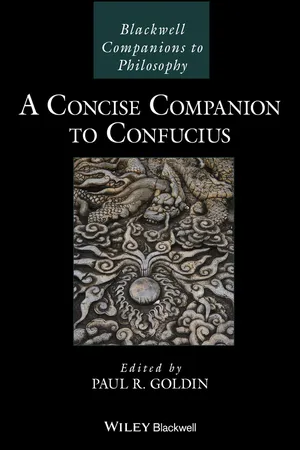
A Concise Companion to Confucius
eBook - ePub

A Concise Companion to Confucius

  1. English
  2. ePUB (mobile friendly)
  3. Available on iOS & Android
eBook - ePub

A Concise Companion to Confucius

About this book

This authoritative collection surveys the teachings of Confucius, and illustrates his importance throughout Chinese history in one focused and incisive volume.

A Concise Companion to Confucius offers a succinct introduction to one of East Asia's most widely-revered historical figures, providing essential coverage of his legacy at a manageable length. The volume embraces Confucius as philosopher, teacher, politician, and sage, and curates a collection of key perspectives on his life and teachings from a team of distinguished scholars in philosophy, history, religious studies, and the history of art. Taken together, chapters encourage specialists to read across disciplinary boundaries, provide nuanced paths of introduction for students, and engage interested readers who want to expand their understanding of the great Chinese master.

Divided into four distinct sections, the Concise Companion depicts a coherent figure of Confucius by examining his diverse representations from antiquity through to the modern world. Readers are guided through the intellectual and cultural influences that helped shape the development of Confucian philosophy and its reception among late imperial literati in medieval China. Later essays consider Confucius's engagement with topics such as warfare, women, and Western philosophy, which remain fruitful avenues of philosophical inquiry today. The collection concludes by exploring the significance of Confucian thought in East Asia's contemporary landscape and the major intellectual movements which are reviving and rethinking his work for the twenty-first century.

An indispensable resource, A Concise Companion to Confucius blazes an authoritative trail through centuries of scholarship to offer exceptional insight into one of history's earliest and most influential ancient philosophers.

A Concise Companion to Confucius:

  • Provides readers with a broad range of perspectives on the ancient philosopher
  • Traces the significance of Confucius throughout Chinese history—past, present, and future
  • Offers a unique, interdisciplinary overview of Confucianism
  • Curated by a team of distinguished scholars in philosophy, history, religious studies, and the history of art

A Concise Companion to Confucius is an ideal text for undergraduate and graduate courses on Confucius and Confucianism. It is also fascinating and informative reading for anyone interested in learning more about one of history's most influential philosophers.

Frequently asked questions

Yes, you can cancel anytime from the Subscription tab in your account settings on the Perlego website. Your subscription will stay active until the end of your current billing period. Learn how to cancel your subscription.
No, books cannot be downloaded as external files, such as PDFs, for use outside of Perlego. However, you can download books within the Perlego app for offline reading on mobile or tablet. Learn more here.
Perlego offers two plans: Essential and Complete
  • Essential is ideal for learners and professionals who enjoy exploring a wide range of subjects. Access the Essential Library with 800,000+ trusted titles and best-sellers across business, personal growth, and the humanities. Includes unlimited reading time and Standard Read Aloud voice.
  • Complete: Perfect for advanced learners and researchers needing full, unrestricted access. Unlock 1.4M+ books across hundreds of subjects, including academic and specialized titles. The Complete Plan also includes advanced features like Premium Read Aloud and Research Assistant.
Both plans are available with monthly, semester, or annual billing cycles.
We are an online textbook subscription service, where you can get access to an entire online library for less than the price of a single book per month. With over 1 million books across 1000+ topics, we’ve got you covered! Learn more here.
Look out for the read-aloud symbol on your next book to see if you can listen to it. The read-aloud tool reads text aloud for you, highlighting the text as it is being read. You can pause it, speed it up and slow it down. Learn more here.
Yes! You can use the Perlego app on both iOS or Android devices to read anytime, anywhere — even offline. Perfect for commutes or when you’re on the go.
Please note we cannot support devices running on iOS 13 and Android 7 or earlier. Learn more about using the app.
Yes, you can access A Concise Companion to Confucius by Paul R. Goldin in PDF and/or ePUB format, as well as other popular books in Philosophy & Eastern Philosophy. We have over one million books available in our catalogue for you to explore.

Information

Part I
Representations of Confucius

1
Early Sources for Confucius

MICHAEL HUNTER
No discussion of Kongzi’s 孔子 life, thought, or significance in the ancient Chinese context can proceed without first confronting two basic problems: (1) what are the earliest sources for Kongzi; and (2) which, if any, of these sources can be relied on for accurate information about him? How one goes about answering the latter question determines to a large extent the version of Kongzi one ends up with. Let us take each question in turn.1

The Sources

The simplest way to measure Kongzi’s impact on the early textual record (with “early” defined as the period ending with the fall of the Eastern Han dynasty in 220 CE) is to count the number of sources2 that include Kongzi sayings, stories, and testimonia. Such an approach yields a remarkably large and diverse assortment of texts that might be grouped into the categories below.

Kongzi‐centric Anthologies

Far and away the most important collection of Kongzi material in the Chinese tradition is the Lunyu 論語 (Analects), a heterogeneous mix of stand‐alone zi yue 子曰 (the Master says) sayings, mini‐dialogues featuring Kongzi’s followers and contemporaries, third‐person descriptions of Kongzi’s character and conduct, and sayings attributed to his followers. The Lunyu comprises approximately 16,000 characters across 500 or so entries in twenty chapters. (For more on the Lunyu, see below.)
The received version of the Kongzi jiayu 孔子家語 (Family Sayings of Confucius), a much larger compendium (56,600 characters) of early Kongzi traditions, was compiled by Wang Su 王肅 (195–256) in the third century CE but contains a significant amount of material from earlier sources. Another third‐century compilation that likely includes earlier material is the Kong congzi 孔叢子 (Kong Masters Anthology).
The “Kongzi shijia” 孔子世家 (“Hereditary House of Kongzi”) and “Zhongni dizi liezhuan” (“Biographies of Zhong Ni’s Disciples”), chapters 47 and 67 of Sima Qian’s 司馬遷 (d. c. 86 BCE) Shiji 史記 (Grand Scribe’s Records), also warrant special mention. As the earliest extant biography of Kongzi, the “Kongzi shijia” in particular has often been relied on to contextualize Kongzi sayings and stories found in other sources.

Canonical Traditions

The classic most closely associated with Kongzi in the early period, and the text most often said to have been “composed” (zuo 作) by Kongzi himself (e.g., at Mengzi 3B/9), is the Chunqiu 春秋 (Annals). However, the Chunqiu’s value as a source of Kongzi material is limited given that extant versions of the Chunqiu mention Kongzi only once. The version of the Chunqiu within the Zuozhuan 左傳 (Zuo Traditions) recension includes only a brief entry appended to the end of the text and dated to the sixteenth year of the reign of Duke Ai of Lu 魯哀剬, or 479 BCE: “Summer, the fourth month, on the day jichou: Kong Qiu died” (夏四月己丑: 孔丘卒). Two other Chunqiu recensions, those of the Gongyang 剬羊 and Guliang 榖梁 commentarial traditions, include the line “Kongzi was born” (孔子生) in brief entries dated to 552 BCE (note that Sima Qian dated Kongzi’s birth to 551, the twenty‐second year of Duke Xiang’s 襄剬 reign, not 552).3 Of the three Chunqiu commentarial traditions, the Zuozhuan (fourth century BCE?)4 quotes Kongzi most extensively (×43) and also includes a number of anecdotes in which Kongzi features as a character; the Gongyang and Guliang quote Kongzi only several times apiece.
The Zhouyi 周易 (Zhou Changes) includes about thirty quotations prefaced with the zi yue 子曰 (“the master said”) quotation marker, material that has traditionally been interpreted as quotations of Kongzi despite the lack of any overt references to him. These quotations are clustered within two sections of the text, the Wenyan 文言 (Patterned Words) commentary to the first hexagram (qian 乾) and the Xici zhuan 繫辭傳 (Commentary to the Appended Phrases).
The richest source of Kongzi material among the classics is the Liji 禮記 (Ritual Records). Although the Liji anthology was probably compiled toward the end of the Western Han period (Baker 2006), the pre‐imperial provenance of at least two of its chapters – “Zi yi” 緇衣 (“Black Robes”) and “Zhongni xianju” 仲尼閒居 (“Zhong Ni at Leisure”) – has been confirmed by recent manuscript finds. Twenty‐two chapters of the Liji quote or reference Kongzi, with four chapters – “Zengzi wen” 曾子問 (“Zengzi Asked”), “Ai gong wen” 哀剬問 (“Duke Ai Asked”), “Zhong Ni yanju” 仲尼燕居 (“Zhong Ni at Leisure”), and “Kongzi xianju” 孔子閒居 (“Kongzi At Rest”) – consisting exclusively of Kongzi material. Three additional chapters – “Fang ji” 坊記 (“Embankment Record”), “Biao ji” 表記 (“Exemplary Record”), and “Zi yi” 緇衣 (“Black Robes”) – are collections of zi yue 子曰 (the Master says) sayings. All told, the Liji includes more than 300 statements prefaced with zi yue or Kongzi yue (Kongzi said). The Yili 儀禮 (Etiquette and Ritual), another canonical ritual compendium, contains only a single Kongzi saying.
The Xiaojing 孝經 (Classic of Filial Piety) is a much shorter, 2,000‐character, dialogue between Kongzi and his disciple Zengzi 曾子 on the subject of xiao 孝 (filial piety).
From the mid‐Western Han (202 BCE–9 CE) onward, the belief that Kongzi was responsible for compiling and editing the canonical traditions of the Yi, Shu 書 (Documents), Shi 詩 (Odes), Li 禮 (Rituals), Yue 樂 (Music), and Chunqiu into a single, unified canon meant that all of the classics could, in theory, be read as sources of Kongzi’s wisdom, regardless of whether they quoted or mentioned him.

Commentaries and Other Scholastic Texts

Within the Yi 易 (Changes) tradition, these include the several Kongzi yue and zi yue commentaries discovered in the Mawangdui 馬王堆 manuscript find dated to the early part of the Western Han period (see below), in addition to the zi yue commentary layers within the Zhouyi itself.
Within the Shi 詩 tradition, the largest source of Kongzi material is the Hanshi waizhuan 韓詩外傳 (Outward Commentary to the Han Odes), attributed to Han Ying 韓嬰 (second century BCE). The Hanshi waizhuan includes more than seventy sections with Kongzi sayings, stories, and testimonia. The commentary of the Mao Shi 毛詩 (Mao Odes) also includes a handful of Kongzi sayings. Among pre‐Han sources, the so‐named “Kongzi shilun” 孔子詩論 (“Kongzi on the Odes”) manuscript from the looted Shanghai Museum collection presents Kongzi as a source of miscellaneous commentaries on the Shi.
Within the Shu 書 tradition, the Western Han Shangshu dazhuan 尚書大傳 (Great Commentary to the Exalted Documents), a text traditionally attributed to Fu Sheng 伏勝 (third–second century BCE), contains a few dozen Kongzi quotations. Chapter two of the Kong congzi, “Lun shu” 論書 (“Discussing the Documents”), consists of several dialogues between Kongzi and his disciples on the subject of the Shu.
Extant commentaries dating to the Eastern Han period, including Zhao Qi’s趙岐 (110–201 CE) Mengzi commentary to the Mengzi, Wang Yi’s王逸 (fl. c. 120 CE) Chuci 楚辭 (Verses of Chu) commentary, and the several commentaries attributed to Zheng Xuan 鄭玄 (127–200 CE), frequently invoke Kongzi but tend to borrow overwhelmingly from the Lunyu. Other scholastic texts that make liberal use of Kongzi include Xu...

Table of contents

  1. Cover
  2. Title Page
  3. Table of Contents
  4. Notes on Contributors
  5. Introduction
  6. Part I: Representations of Confucius
  7. Part II: Confucian Ideas
  8. Part III: The Legacy of Confucius in Imperial China
  9. Part IV: Confucius and New Confucianisms in Modern East Asia
  10. Index
  11. End User License Agreement