The book deals with novel applications of plant derived natural agents and their derivatives in the food, textile dyeing, medicinal, and environmental areas.
Plant based natural products and their derivatives have strong influence on our everyday lives. They are needed for many everyday applications ranging from food, medicine, agriculture, textiles, and healthcare. This new book presents significant research advances about the use of plant-based natural products, mainly dyes and pigments, bioactive compounds and other plant extracts in the textile coloration, food, medicine, bioremediation and environmental applications. The topics of the ten informative chapters in Plant-Based Natural Products include the following: potential resurgence of natural dyes in applied fields; natural colorants from indigoid rich plants; phytochemical and pharmacological aspects of Butea monosperma plant; irradiation as novel pretreatment methods to improve wash fastness properties of plant derived natural dyes; dyeing studies with colorants extracted from the Lawsonia inermis plant; effect of drumstick leaf powder incorporation on quality of khakhra; physico-chemical properties of pineapple pomace powder and its incorporation in buffalo meat products; synthesis of curcumin complexes for medicinal and other industrial uses and phyto-remediation of toxic arsenic from wastewaters.
Over the past decades, the industries around the globe have been involved in providing sustainable products to its consumers. Their synthesis and application have a much importance owing to their benefits for ecosystem. Plant-derived natural dyes are the substances that are gaining much popularity in the fields of food, pharmaceutical, textile, cosmetics, etc. owing to their health and environmental benefits. Their extraction using novel methods adds more aesthetic value to be used in different fields. This chapter describes the potential efficacy of natural colorants in applied fields. Hopefully, this chapter would satisfy the needs of natural dye reader, researchers, and industrialists who are trying to acquire new sources, their stability, and sustainability in fields other than textiles.
Natural dyes are those colorants that are obtained from natural renewable sources such as minerals, plants, animals, and micro-organisms. These are highly environmental friendly and pose no serious threat to human life as well as ecosystem. These different resources are granted with highly colored substances that can be applied and fixed on materials commonly known as substrate and act as dye for textiles. These dyes contain an aromatic ring which have an auxochrome, responsible for resonance, and become able to impart color. Natural dyes were used to dye and print the substrate since the prehistoric times but their application down fall in 1856 with the accident discovery of synthetic dye (mauveine) by W.H. Perkin. Then synthetic dyes become superior over natural one owing to their availability at economical price with bright color, good fastness properties, and their reproducibility [1]. However, studies motivated the revitalization of natural dyes due to the toxic wastes, carcinogenic effects, and skin allergies caused by synthetic dyes [2, 3]. It was confirmed by many researchers that synthetic dyes contain 118 of the azo and benzidine dyes and when are photolytically degraded, their waste products release toxic aromatic amines. Most of the synthetic colorant (about 10–35%) cannot be fixed on the fabric properly and their effluents when become part of ecosystem, disturb the eco-balance [4, 5]. These factors bring awareness and urge many countries especially EU, USA, Canada, Germany, India, Pakistan, and other countries to completely ban on their frequent usage in different applied fields such as textile, food, cosmetics, and flavor [6, 7]. Hence, resurgence of natural dye is being welcomed around the globe.
1.1.1 Types of Natural Dyes
Natural dyes are of two types, i.e.,
Substantive dyes
Adjective dyes
1. Substantive Dyes
These dyes have good fastness properties and need no additional chemical (mordant) to fix it on materials. Fastness properties may refer to the resistance of the loss of colorant from the substrate. In textile industry color fastness to light, rubbing fastness and washing fastness are considered as effective properties of dyed fabric, while mordant are those chemicals that create strong bonding between fibers and dye molecule e.g., tannic acid [8]. These dyes will not only create affinity between fabric and dye molecule but also give a wide spectrum of color [9, 10].
2. Adjective Dyes
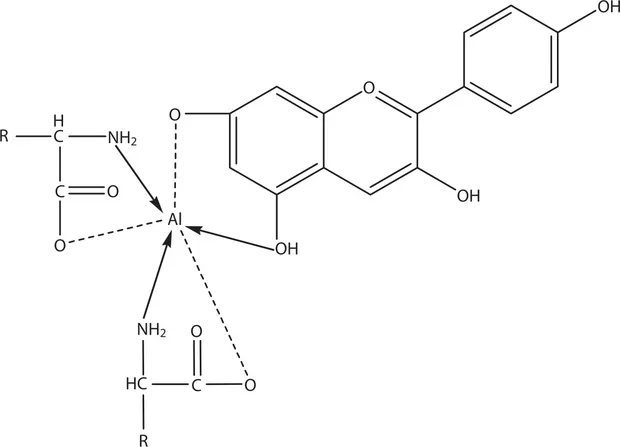
These dyes have poor fastness properties and need mordant to increase fixation of dye on substrate as shown in Figure below. In natural dyeing process, both synthetic (chemical) and biomordant are used. In chemical mordants, salts of aluminum, potassium, copper, iron, tin, etc. and even rare-earth metals are used [11, 12]. Biomordants are those substances that can obtain from natural sources (i.e. plants, animals, etc.) such as myrobolan (Terminalia chebula), tannin, tannic acid, guava, and banana leaves ash. [13]. However, it was suggested by many researchers that biomordant is safer and effective to use than chemical mordant [14]. As biomordants are easily biodegradable and eco-frienldy, while metal mordants such as Cu, Sn, and Cr may pose serious health hazards during handling and dyeing processes [15–17].
Complex formation among dye (pelargonidin), fabric (silk), and mordant (Al)
1.2 History
Natural dyes have been used extensively since long periods. Excavation and written records shows the interest of ancient people toward natural dye. They used natural colorant from soil, plants, animal, insects, and minerals. Some of these historical examples are given below:
People of Stone Age used metal to color their body and hair during hunting to gain magic power.
Firstly, they protect themselves with severe weather using tanned skin and later they used textiles.
Ancient Egyptian cuneiform texts also confirm the usage of natural organic colorant in their cloth dyeing.
People of Phoenicians Ages used purple dye from murex shells and this dye was so costly that Asiatic rulers can only wear purple colors. And after 17th century when Turks conquered Byzantium, the use of purple went declines and kermes were the only choice to dye their clothes.
Until the discovery of America kermes was used as a source of red color however, later it was replaced with cochineal.
Similarly, saffron was a good source of golden color used by Arabian and Chinese people [18].
Indigo dye (blue dye source) has been used since 640–320 BC and was only used for painting by Roman and Greeks.
Egyptian people used alizarin from madder for dyeing purpose.
Fustic in past was used to dye wool fabric.
Cotton textile industry used such cheap natural dyes since medieval period.
1.3 Advantages of Natural Dyes
Natural dyes contain numerous beneficial characteristics that make it superior again over synthetic dyes. Some of these advantages are mentioned below:
Handling of natural dyes is safer and noncarcinogenic during its application and processes.
Natural dyes have better biodegradability and generally have higher compatibility with the environment.
These dyes are nontoxic, nonallergic to skin, and noncarcinogenic [19].
They are renewable and sustainable product [20].
These dyes have wide range of shades depends on the part of plant used and type of mordant applied [21].
Most of natural dyes adsorb the industrial toxic wastes that help to clean the environment from pollution [22].
These dyes are a big source of income for poor through viable harvesting and sales of these plants that also provide rich and different sources of dyestuff.
Natural dyes are bestowed with numerous beneficial properties such as inse...
Table of contents
Cover
Title page
Copyright page
Preface
Chapter 1: Potential Resurgence of Natural Dyes in Applied Fields
Chapter 2: Natural Dyes from Indigoid-Rich Plants: An Overview
Chapter 3: Phytochemical and Pharmacological Aspects of Butea monosperma L.
Chapter 4: Radiation Pretreatment: A Potential Novel Technology to Improve Fastness Properties of Plant-Derived Natural Dyes
Chapter 5: Natural Colorant from Lawsonia inermis Leaves: Reflectance Spectroscopy-Induced Optimal Conditions of Extraction and Dyeing
Chapter 6: Plant Food By-products and their Application in Food Industry
Chapter 7: Effect of Drumstick Leaves (Moringa oleifera) Incorporation on Quality of Khakhra
Chapter 8: Curcumin and Its Derivatives – Isolation, Synthesis, and Applications
Chapter 9: Investigating the Functional Properties of Pineapple Pomace Powder and Its Incorporation in Buffalo Meat Products
Chapter 10: Green Adsorbents from Plant Sources for the Removal of Arsenic: An Emerging Wastewater Treatment Technology
Index
End User License Agreement
Trusted by 375,005 students
Access to over 1.5 million titles for a fair monthly price.
Study more efficiently using our study tools.
Frequently asked questions
Yes, you can cancel anytime from the Subscription tab in your account settings on the Perlego website. Your subscription will stay active until the end of your current billing period. Learn how to cancel your subscription
No, books cannot be downloaded as external files, such as PDFs, for use outside of Perlego. However, you can download books within the Perlego app for offline reading on mobile or tablet. Learn how to download books offline
Perlego offers two plans: Essential and Complete
Essential is ideal for learners and professionals who enjoy exploring a wide range of subjects. Access the Essential Library with 800,000+ trusted titles and best-sellers across business, personal growth, and the humanities. Includes unlimited reading time and Standard Read Aloud voice.
Complete: Perfect for advanced learners and researchers needing full, unrestricted access. Unlock 1.5M+ books across hundreds of subjects, including academic and specialized titles. The Complete Plan also includes advanced features like Premium Read Aloud and Research Assistant.
Both plans are available with monthly, semester, or annual billing cycles.
We are an online textbook subscription service, where you can get access to an entire online library for less than the price of a single book per month. With over 1.5 million books across 990+ topics, we’ve got you covered! Learn about our mission
Look out for the read-aloud symbol on your next book to see if you can listen to it. The read-aloud tool reads text aloud for you, highlighting the text as it is being read. You can pause it, speed it up and slow it down. Learn more about Read Aloud
Yes! You can use the Perlego app on both iOS and Android devices to read anytime, anywhere — even offline. Perfect for commutes or when you’re on the go. Please note we cannot support devices running on iOS 13 and Android 7 or earlier. Learn more about using the app
Yes, you can access Plant-Based Natural Products by Shahid Ul Islam, Shahid Ul-Islam,Shahid Ul Islam, Shahid Ul-Islam in PDF and/or ePUB format, as well as other popular books in Scienze fisiche & Chimica organica. We have over 1.5 million books available in our catalogue for you to explore.