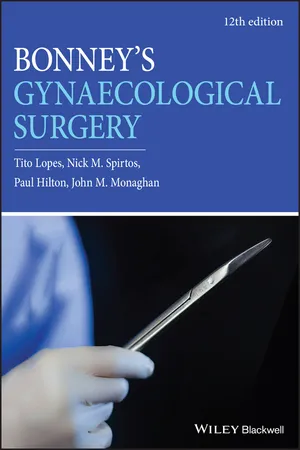
Surgery is a core element of the clinical practice of gynaecology. Bonney's Gynaecological Surgery has been a firm favourite for gynaecological surgical practice since 1911. Specifically tailored for trainees in obstetrics and gynaecology, the text focuses on the most commonly performed procedures. The 12th edition will include a colour photo section. With greater emphasis on fundamental clinical skills and major updates on laparoscopic and robotic surgery, this classic text will be brought right up to date for the current trainee or junior consultant physician. Each chapter follows a consistent plan, guiding the reader through each procedure from anatomy and indications to post-op considerations and complications. The text is also accompanied by surgical illustrations of unparalleled quality, ensuring that this volume will remain a valuable resource for all clinicians specializing in gynaecological surgery.
- English
- ePUB (mobile friendly)
- Available on iOS & Android
eBook - ePub
Bonney's Gynaecological Surgery
About this book
Information
PART 1
General
CHAPTER 1
Introduction and prologue
Surgery remains only as safe as those wielding the scalpel.Tito Lopes
Introduction
Surgical training
Surgical training in gynaecology has seen dramatic changes in both the UK and the USA over the past 20–30 years. When the current editors were in training, there were no restrictions on the number of hours that they could be asked to work. It was common to be resident on call every third night in addition to daytime work, which often resulted in a working week in excess of 110 hours. In the UK, the European Working Time Directive was extended to junior doctors in 2004 thereby reducing the working week to an average of 48 hours. In the United States, the Accreditation Council for Graduate Medical Education in 2003 required duty hours to be limited to 80 hours per week.
Although the reduction in working hours is important for one’s work–life balance as well as patient safety, it inevitably has had a major impact on surgical training. The concept of the surgical team or firm to which a trainee was attached has all but disappeared. The introduction of shift systems has made it difficult, and in some cases impossible, for trainees to attend the surgical and clinical sessions of their team. This has resulted in some trainees failing to comprehend the continuity of care of a surgical patient, running the risk of producing technicians rather then doctors.
At the same time, there has been a marked reduction in the number of hysterectomies performed as a result of more conservative management options for dysfunctional uterine bleeding. In the nine‐year period from 1995 to 2004, there was a 46% reduction in the number of hysterectomy operations performed in NHS hospitals in England and between 2008 and 2012 there was a further 7% fall in hysterectomies in the UK.
With the increasing use of laparoscopic surgery in elective gynaecology, including for hysterectomy, the ‘open’ approach to gynaecological surgery, traditionally the surgical ‘bread and butter’ for trainees, is also on the decline. Equally, a large number of ectopic pregnancies are now managed conservatively meaning that trainees are lacking exposure to emergency laparoscopic surgery for tubal pregnancies.
It is vital that standard safe techniques continue to be taught to all trainees. Thus, although many procedures have been translated into minimal access operations the principles and practice of the open version must be learned alongside the minimal access approach. This is especially relevant wherever a minimal access procedure has to be translated into an open procedure because of difficulties and complications experienced during the operation. It is a concern of the editors that the ‘unusual’ is not being experienced on a satisfactory scale by trainees. Nothing can replace time spent in the operating room for building up skills and confidence in dealing with the unusual and unexpected. A recent comment by a president of a Royal College compared the time limited training of a surgeon to the limitless time application of an Olympic athlete. Very few gold medals would be won if the Working Time Directive was followed!
Gynaecology training
Current training in the UK is a competency‐based process and it is envisaged that the majority of trainees will take seven years to complete the programme. In the last two years of training, the trainees are required to undertake a minimum of two of twenty available advanced training skills modules or they can apply for subspecialty training in gynaecological oncology, maternal and fetal medicine, reproductive medicine or urogynaecology. It is disappointing that as part of the current training programme the trainee must be deemed competent in opening and closing a transverse incision at caesarean section before commencing his or her second year but need only be assessed as competent for opening and closing a vertical abdominal incision if undertaking the advanced module for benign surgery in years six and seven.
Basic skills and training opportunities
Trainees wishing to develop as gynaecological surgeons should attend appropriate courses, including cadaver and live animal workshops. However, these are no substitutes for learning the basic surgical skills and picking up good habits, early in training; bad habits are difficult to lose at a later stage. As assistants, they should question any variations in technique among the surgeons. As surgeons, they should review every operation they perform to assess how they could have done better.
In relation to laparoscopic surgery, there is no excuse for trainees not practising with laparoscopic simulators, which are often readily available and easy to construct. It is readily apparent to trainers which trainees have spent adequate time on simulators.
Sadly, a consequence of the new training is an inevitable lack of knowledge and experience of the ‘unusual’, with the all too frequent result of difficulties for both the patient and the surgeon. These difficulties are often manifest in an almost complete failure to appreciate the wide range of possibilities for management. Previous editors of this text have advocated that any surgery should be tailored to the specific needs of the patient and her condition. Unfortunately, modern patients are in real danger of being treated by surgeons with a limited experience and a narrow range of skills which may be applied in a ‘one size fits all’ pattern. In this text, we have attempted to provide a wide range of options for management, which we would encourage all trainees to practise assiduously to give their patients the very best possible chance of a successful outcome.
Despite the recent changes in gynaecological training, the essence of surgery remains essentially unchanged. The editors have, as with previous editions, felt it appropriate to retain the prologue written for the 9th and 10th editions by JM Monaghan based on that of the 1st edition of this series, A Text‐book of Gynaecological Surgery, published in 1911 by Comyns Berkeley and Victor Bonney. It remains just as relevant today as it was a century ago.
Prologue: after Comyns Berkeley and Victor Bonney, (JM Monaghan)
The bearing of the surgeon
A surgeon when operating should always remember that the character of the work of his subordinates will be largely influenced by his own bearing. While it is impossible to lay down definite rules suitable for all temperaments, nevertheless there are certain considerations which will prove useful to those embarking on a gynaecological career. Anyone who has taken the trouble to study the work of other operators cannot fail to have observed how variously the stress and strain of operating is borne by different minds and will deduce from a consideration of the strong and weak points of each operator some conception of the ideal...
Table of contents
- Cover
- Table of Contents
- Preface
- PART 1: General
- PART 2: Anatomical
- PART 3: Urogynaecology
- PART 4: Oncology
- PART 5: Operations on other organs
- Index
- End User License Agreement
Trusted by 375,005 students
Access to over 1.5 million titles for a fair monthly price.
Study more efficiently using our study tools.
Frequently asked questions
Yes, you can cancel anytime from the Subscription tab in your account settings on the Perlego website. Your subscription will stay active until the end of your current billing period. Learn how to cancel your subscription
No, books cannot be downloaded as external files, such as PDFs, for use outside of Perlego. However, you can download books within the Perlego app for offline reading on mobile or tablet. Learn how to download books offline
Perlego offers two plans: Essential and Complete
- Essential is ideal for learners and professionals who enjoy exploring a wide range of subjects. Access the Essential Library with 800,000+ trusted titles and best-sellers across business, personal growth, and the humanities. Includes unlimited reading time and Standard Read Aloud voice.
- Complete: Perfect for advanced learners and researchers needing full, unrestricted access. Unlock 1.5M+ books across hundreds of subjects, including academic and specialized titles. The Complete Plan also includes advanced features like Premium Read Aloud and Research Assistant.
We are an online textbook subscription service, where you can get access to an entire online library for less than the price of a single book per month. With over 1.5 million books across 990+ topics, we’ve got you covered! Learn about our mission
Look out for the read-aloud symbol on your next book to see if you can listen to it. The read-aloud tool reads text aloud for you, highlighting the text as it is being read. You can pause it, speed it up and slow it down. Learn more about Read Aloud
Yes! You can use the Perlego app on both iOS and Android devices to read anytime, anywhere — even offline. Perfect for commutes or when you’re on the go.
Please note we cannot support devices running on iOS 13 and Android 7 or earlier. Learn more about using the app
Please note we cannot support devices running on iOS 13 and Android 7 or earlier. Learn more about using the app
Yes, you can access Bonney's Gynaecological Surgery by Tito Lopes,Nick M. Spirtos,Paul Hilton,John M. Monaghan in PDF and/or ePUB format, as well as other popular books in Medicine & Gynecology, Obstetrics & Midwifery. We have over 1.5 million books available in our catalogue for you to explore.