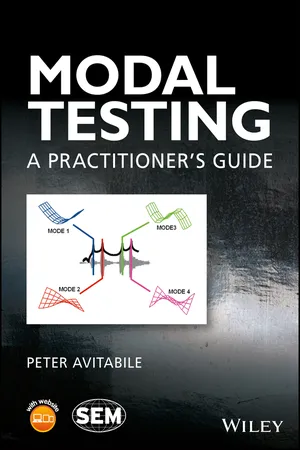
The practical, clear, and concise guide for conducting experimental modal tests
Modal Testing: A Practitioner's Guide outlines the basic information necessary to conduct an experimental modal test. The text draws on the author's extensive experience to cover the practical side of the concerns that may arise when performing an experimental modal test. Taking a hands-on approach, the book explores the issues related to conducting a test from start to finish. It covers the cornerstones of the basic information needed and summarizes all the pertinent theory related to experimental modal testing.
Designed to be accessible, Modal Testing presents the most common excitation techniques used for modal testing today and is filled with illustrative examples related to impact testing which is the most widely used excitation technique for traditional experimental modal tests. This practical text is not about developing the details of the theory but rather applying the theory to solve real-life problems, and:
• Delivers easy to understand explanations of complicated theoretical concepts
• Presents basic steps of an experimental modal test
• Offers simple explanations of methods to obtain good measurements and avoid the common blunders typically found in many test approaches
• Focuses on the issues to be faced when performing an experimental modal test
• Contains full-color format that enhances the clarity of the figures and presentations
Modal Testing: A Practitioner's Guide is a groundbreaking reference that treats modal testing at the level of the practicing engineer or a new entrant to the field of experimental dynamic testing.
Part I Overview of Experimental Modal Analysis using the Frequency Response Method
Chapter 1 Introduction to Experimental Modal Analysis: A Simple Non-mathematical Presentation
All structures and systems have operating conditions that cause them to respond due to these excitations. The loadings are generally not just static. Just about any structure is exposed to both static and dynamic loads, and it is the dynamic loads that are of concern to a structural dynamics or vibrations engineer. These excitations cause responses that may not be acceptable for the intended operation of the structure. When this is the case, the engineer must determine what if, anything, can be done to minimize or eliminate the undesirable response in the structure. Sometimes this can be very difficult if the cause of the unwanted response is unknown.
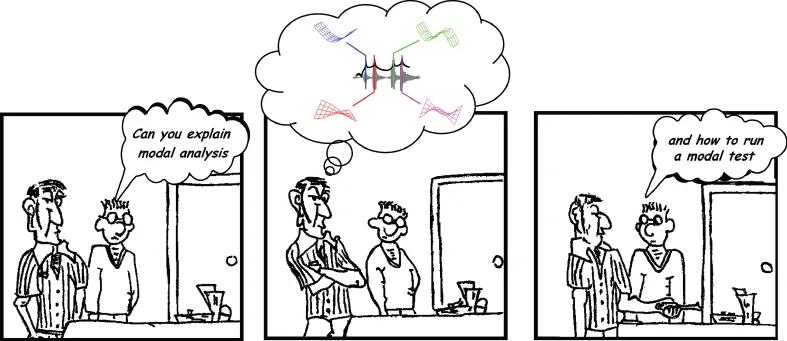
Now structural dynamics is the study of the response of a system to applied loads. These loads can cause responses at different frequencies depending on the dynamic characteristics of the structure. These dynamic characteristics are the frequency, damping and mode shapes. Each of the modes of the structure may contribute in varying degrees to the response of the system and it is sometimes very difficult to understand how the structure responds from the total response of all the modes of the system. So looking at the complete picture may not provide an insight as to how to fix a particular problem. This is where modal analysis comes in.
Modal analysis is the study of the dynamic character of a system that is defined independently from the loads applied to the system and the response of the system. Each of the modes of a system has a certain frequency, with a particular damping, and, most importantly, the characteristic deformation that the structure will undergo given an excitation at its natural frequency. This deformation is related to the mode shape characteristic for the particular mode. Modal analysis, by itself, can only identify the characteristics and not the actual physical deformations. The actual response and physical deformation can only be identified if loads are known and applied to the structure. This is sometimes confusing to many people, but let's put it in perspective with a simpler case.
Let's consider a cantilever beam. Now the beam can be described in terms of its characteristics. These might be the length, width, weight, density, Young's modulus, cross-sectional area, and moment of inertia. But given these characteristics, the deformation of the beam cannot be identified, nor can it be determined if the beam is going to fail in a particular application. This can only be done if the load is known: loads must be identified to determine the deformation, stress, or strain. But once loads are identified, and then the displacement, stress and strain can be determined. But even at this point, the usefulness of the beam for a particular application cannot be determined until the design specification is identified. This specification will identify the relevant design criteria (such as allowable deflection, allowable stress, and allowable strain) and then an engineering judgment can be made as to the suitability of the cantilever beam for the intended use.
Well, modal analysis falls into this same situation. The frequency, damping, and mode shapes are just characteristics of a structure. But whether or not these are good or bad cannot be stated until the intended application is identified, loads identified, and design specification identified. So modal analysis, by itself, is not sufficient to decide if a structure is acceptable or not; the loads and design specification must be identified. (But it is important to point out that in solving many vibration problems, there is sometimes very little understood about the actual loading and often there is no relevant specification available; this is the reality of real-world engineering.)
However, understanding the modal characteristics of a structure can be very useful when performing a structural dynamic analysis. Depending on how the structural dynamic analysis is performed, the underlying modal characteristics may be used for the determination of the response, which helps in gaining an understanding of which modes, how many modes, and to what degree the modes all contribute to the response of the system. Suffice it to say that modal analysis is a very important part of gaining an understanding of a structural dynamic system.
Figure 1.1 shows a computer cabinet, which has responses to a variety of inputs: disk drive inputs, fan inputs and of course any external inputs that “excite” the system. The response comprises the response to all of these individual excitations. The structural...
Table of contents
Cover
Title Page
Copyright
Dedication
Table of Contents
Preface
About the Companion Website
Part I: Overview of Experimental Modal Analysis using the Frequency Response Method
Part II: Practical Considerations for Experimental Modal Testing
Part III: Collection of Sets of Modal Data Collected for Processing
Index
End User License Agreement
Trusted by 375,005 students
Access to over 1.5 million titles for a fair monthly price.
Study more efficiently using our study tools.
Frequently asked questions
Yes, you can cancel anytime from the Subscription tab in your account settings on the Perlego website. Your subscription will stay active until the end of your current billing period. Learn how to cancel your subscription
No, books cannot be downloaded as external files, such as PDFs, for use outside of Perlego. However, you can download books within the Perlego app for offline reading on mobile or tablet. Learn how to download books offline
Perlego offers two plans: Essential and Complete
Essential is ideal for learners and professionals who enjoy exploring a wide range of subjects. Access the Essential Library with 800,000+ trusted titles and best-sellers across business, personal growth, and the humanities. Includes unlimited reading time and Standard Read Aloud voice.
Complete: Perfect for advanced learners and researchers needing full, unrestricted access. Unlock 1.5M+ books across hundreds of subjects, including academic and specialized titles. The Complete Plan also includes advanced features like Premium Read Aloud and Research Assistant.
Both plans are available with monthly, semester, or annual billing cycles.
We are an online textbook subscription service, where you can get access to an entire online library for less than the price of a single book per month. With over 1.5 million books across 990+ topics, we’ve got you covered! Learn about our mission
Look out for the read-aloud symbol on your next book to see if you can listen to it. The read-aloud tool reads text aloud for you, highlighting the text as it is being read. You can pause it, speed it up and slow it down. Learn more about Read Aloud
Yes! You can use the Perlego app on both iOS and Android devices to read anytime, anywhere — even offline. Perfect for commutes or when you’re on the go. Please note we cannot support devices running on iOS 13 and Android 7 or earlier. Learn more about using the app
Yes, you can access Modal Testing by Peter Avitabile in PDF and/or ePUB format, as well as other popular books in Technology & Engineering & Mechanical Engineering. We have over 1.5 million books available in our catalogue for you to explore.