Microstructural Geochronology
  1. English
  2. ePUB (mobile friendly)
  3. Available on iOS & Android
eBook - ePub

About this book

Microstructural Geochronology

Geochronology techniques enable the study of geological evolution and environmental change over time. This volume integrates two aspects of geochronology: one based on classical methods of orientation and spatial patterns, and the other on ratios of radioactive isotopes and their decay products.

The chapters illustrate how material science techniques are taking this field to the atomic scale, enabling us to image the chemical and structural record of mineral lattice growth and deformation, and sometimes the patterns of radioactive parent and daughter atoms themselves, to generate a microstructural geochronology from some of the most resilient materials in the solar system.

  • First compilation of research focusing on the crystal structure, material properties, and chemical zoning of the geochronology mineral archive down to nanoscale
  • Novel comparisons of mineral time archives from different rocky planets and asteroids and their shock metamorphic histories
  • Fundamentals on how to reconstruct and date radiogenic isotope distributions using atom probe tomography

Microstructural Geochronology will be a valuable resource for graduate students, academics, and researchers in the fields of petrology, geochronology, mineralogy, geochemistry, planetary geology, astrobiology, chemistry, and material science. It will also appeal to philosophers and historians of science from other disciplines.
Frequently asked questions

Yes, you can cancel anytime from the Subscription tab in your account settings on the Perlego website. Your subscription will stay active until the end of your current billing period. Learn how to cancel your subscription.
At the moment all of our mobile-responsive ePub books are available to download via the app. Most of our PDFs are also available to download and we're working on making the final remaining ones downloadable now. Learn more here.
Perlego offers two plans: Essential and Complete
  • Essential is ideal for learners and professionals who enjoy exploring a wide range of subjects. Access the Essential Library with 800,000+ trusted titles and best-sellers across business, personal growth, and the humanities. Includes unlimited reading time and Standard Read Aloud voice.
  • Complete: Perfect for advanced learners and researchers needing full, unrestricted access. Unlock 1.4M+ books across hundreds of subjects, including academic and specialized titles. The Complete Plan also includes advanced features like Premium Read Aloud and Research Assistant.
Both plans are available with monthly, semester, or annual billing cycles.
We are an online textbook subscription service, where you can get access to an entire online library for less than the price of a single book per month. With over 1 million books across 1000+ topics, we’ve got you covered! Learn more here.
Look out for the read-aloud symbol on your next book to see if you can listen to it. The read-aloud tool reads text aloud for you, highlighting the text as it is being read. You can pause it, speed it up and slow it down. Learn more here.
Yes! You can use the Perlego app on both iOS or Android devices to read anytime, anywhere — even offline. Perfect for commutes or when you’re on the go.
Please note we cannot support devices running on iOS 13 and Android 7 or earlier. Learn more about using the app.
Yes, you can access Microstructural Geochronology by Desmond E. Moser, Fernando Corfu, James R. Darling, Steven M. Reddy, Kimberly Tait, Desmond E. Moser,Fernando Corfu,James R. Darling,Steven M. Reddy,Kimberly Tait in PDF and/or ePUB format, as well as other popular books in Physical Sciences & Geology & Earth Sciences. We have over one million books available in our catalogue for you to explore.

Part I
Chemical Microstructure/Zoning

1
Zircon as Magma Monitor: Robust, Temperature‐Dependent Partition Coefficients from Glass and Zircon Surface and Rim Measurements from Natural Systems

Lily L. Claiborne1, Calvin F. Miller1, Guillherme A. R. Gualda1, Tamara L. Carley2, Aaron K. Covey1, Joseph L. Wooden3, and Marc A. Fleming1
1 Department of Earth and Environmental Sciences, Vanderbilt University, Nashville, Tennessee, USA
2 Department of Geology and Environmental Geosciences, Lafayette College, Easton, Pennsylvania
3 U.S. Geological Survey, Menlo Park, California, USA

ABSTRACT

Analysis of natural mineral/host glass pairs provides robust zircon‐melt partition coefficients applicable to natural systems. We analyzed zircon rims (outer ~15 µm of grain interiors) or surfaces (1–2 µm deep pits on crystal faces) and glasses in tholeiitic, calc‐alkaline, and alkaline dacites and rhyolites from diverse settings (continental extension, AZ‐NV, USA; hot spot/spreading center, Iceland; continental arc, Mount St. Helens (MSH), WA, USA). MSH Kds are based on eruption‐age surfaces with adhering glass, which should closely approach crystal‐melt equilibrium. We parameterize trivalent rare earth element (REE) Kds by X*[Ti]y for Sm to Lu, Nb, Th, and U, where X = 2.5–3600 and y = āˆ’0.73 to āˆ’1.3 for Sm to Lu. Kds for all elements span more than an order of magnitude but are highly coherent. REE Kds fit lattice strain model parabolas well, and all Kds show strong negative correlations with T indicators. Useful Kds for zircon can be estimated from Tizircon‐Kdelement correlations. MSH Kds based on surface analyses are consistent with those from conventional rim analysis. When paired with zircon ages, modeled compositions of MSH melts corroborate and strengthen previous conclusions regarding history and evolution of the MSH magmatic system through time.

1.1. INTRODUCTION

Zircon has become the primary tool of choice for many studies aiming to elucidate the evolution of and processes within Earth’s crust [e.g., Valley et al., 2005; Watson and Harrison, 2005; Kemp et al., 2007; Harrison, 2009; Condie et al., 2011; Bell et al., 2014; Hawkesworth et al., 2016]. In addition to being a reliable and durable geochronometer that can yield precise crystallization ages ranging from thousands of years to the time of the planet’s formation, its isotopic and elemental compositions provide time‐stamped records of its origins and conditions of growth [e.g., Claiborne et al., 2006, 2010; Kemp et al., 2006; Schmitt et al., 2010; Barboni et al., 2016]. We focus here on elemental compositions. Concentrations of elements in zircon crystals, when combined with reliable partition coefficients (Kds: concentration of element in crystal/concentration in coexisting melt) can reveal the compositions of melts from which the crystals have grown, even when no other record of their host magmas exists. This capability is most obviously relevant to detrital zircon grains, which are totally divorced from their original host materials: most dramatically represented by >4 Ga Hadean crystals, older than any known rocks, that are found in sandstones [e.g., Froude et al., 1983; Compston and Pidgeon, 1986; Maas et al., 1992; and many more over the past quarter century]. It is equally relevant to interiors of zircon crystals which, even when found in recently erupted volcanic rocks, may record information about growth in magmas that were very different from those that transported them to the surface [Claiborne et al., 2010].
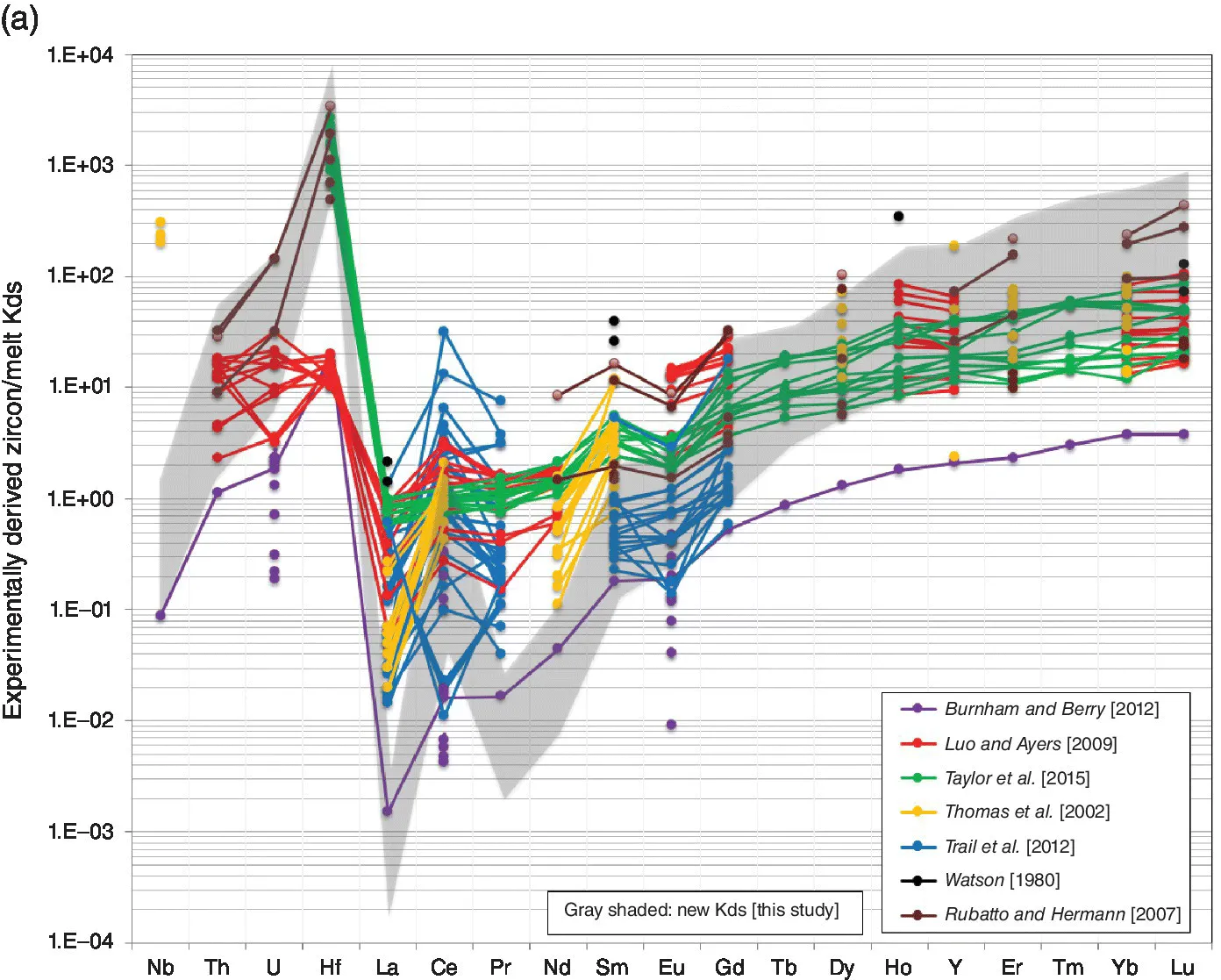
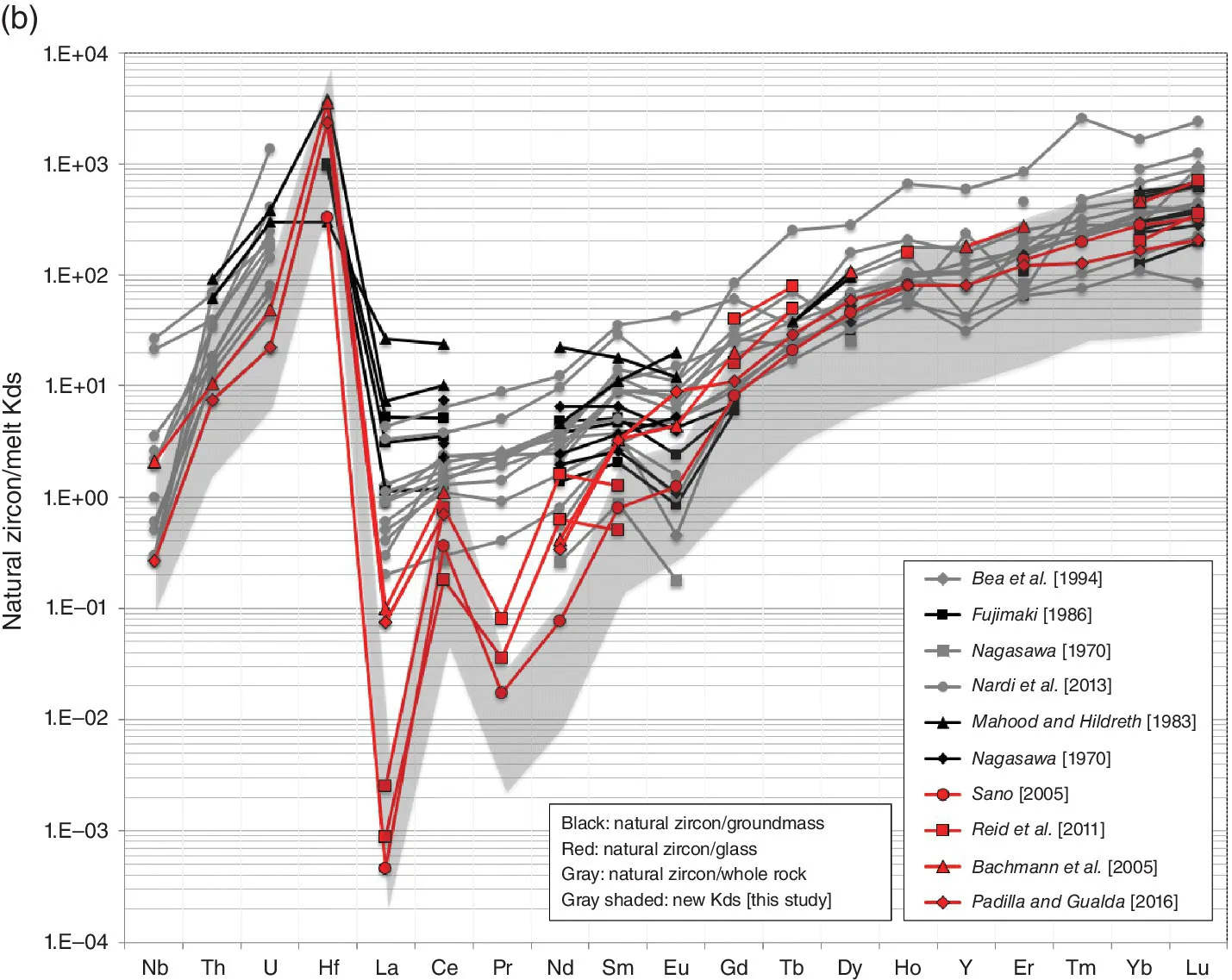
Robust zircon Kds have, however, proven elusive: experiments are conducted with materials that do not reflect natural compositions and/or with durations that are too short for growth and equilibration of analytically tractable crystals; because zircon crystals are commonly strongly zoned and contain small inclusions, analyses do not reflect a composition that equilibrated with melt; and most Kds from natural materials are hampered by the fact that melt compositions from which zircons grew are unknown. Figure 1.1 illustrates existing zircon Kds from the literature: for individual elements, they vary by three to five orders of magnitude. Although patterns are similar (subparallel) in a very general way, in detail patterns fan and cross each other. These characteristics of the published Kd data set raise the following questions: (i) Which existing studies reflect valid Kds, and for which elements? (ii) How much of this apparent extreme variability is real? [e.g., Hanchar and van Westrenen, 2007] (iii) Assuming that at least some of the variability is real, what controls it? (iv) If the controls of true variability can be identified, can this lead to selection of useful values that can be applied to specific zircon compositions?
Image described by caption.

Image described by caption.
Figure 1.1 Compilation of zircon‐melt Kds from the literature. The gray field represents the range of Kds calcu...

Table of contents

  1. COVER
  2. TITLE PAGE
  3. TABLE OF CONTENTS
  4. CONTRIBUTORS
  5. PREFACE
  6. Part I: Chemical Microstructure/Zoning
  7. Part II: Orientation Microstructure
  8. Part III: 3D Nanostructure
  9. INDEX
  10. END USER LICENSE AGREEMENT