Mechanics of Aeronautical Composite Materials
eBook - ePub

Mechanics of Aeronautical Composite Materials

  1. English
  2. ePUB (mobile friendly)
  3. Available on iOS & Android
eBook - ePub

Mechanics of Aeronautical Composite Materials

About this book

This book presents the principles of composite laminate sizing widely used for composite structures. The focus is on aeronautics in particular, including the concepts of limit loads and ultimate loads.

After a brief overview of the main composite materials used in aeronautics, the basic theory of laminated plates and the associated rupture criteria are given. The author presents two fundamental cases of the sizing of aeronautical composite structures: the calculation of the holed structures and their subsequent multi-bolt joints, and the calculation of the buckling.

The concept of damage tolerance is also explored, with a focus on its application for tolerance to impact damage. These notions are fundamental for understanding the specificities of the sizing of aeronautical composite structures.

The book also contains corrected exercises for the reader to test their understanding of the different topics covered.
Frequently asked questions

Yes, you can cancel anytime from the Subscription tab in your account settings on the Perlego website. Your subscription will stay active until the end of your current billing period. Learn how to cancel your subscription.
At the moment all of our mobile-responsive ePub books are available to download via the app. Most of our PDFs are also available to download and we're working on making the final remaining ones downloadable now. Learn more here.
Perlego offers two plans: Essential and Complete
  • Essential is ideal for learners and professionals who enjoy exploring a wide range of subjects. Access the Essential Library with 800,000+ trusted titles and best-sellers across business, personal growth, and the humanities. Includes unlimited reading time and Standard Read Aloud voice.
  • Complete: Perfect for advanced learners and researchers needing full, unrestricted access. Unlock 1.4M+ books across hundreds of subjects, including academic and specialized titles. The Complete Plan also includes advanced features like Premium Read Aloud and Research Assistant.
Both plans are available with monthly, semester, or annual billing cycles.
We are an online textbook subscription service, where you can get access to an entire online library for less than the price of a single book per month. With over 1 million books across 1000+ topics, we’ve got you covered! Learn more here.
Look out for the read-aloud symbol on your next book to see if you can listen to it. The read-aloud tool reads text aloud for you, highlighting the text as it is being read. You can pause it, speed it up and slow it down. Learn more here.
Yes! You can use the Perlego app on both iOS or Android devices to read anytime, anywhere — even offline. Perfect for commutes or when you’re on the go.
Please note we cannot support devices running on iOS 13 and Android 7 or earlier. Learn more about using the app.
Yes, you can access Mechanics of Aeronautical Composite Materials by Christophe Bouvet in PDF and/or ePUB format, as well as other popular books in Physical Sciences & Mechanics. We have over one million books available in our catalogue for you to explore.

Information

Publisher
Wiley-ISTE
Year
2017
Print ISBN
9781786301147
eBook ISBN
9781119459088
Edition
1
Subtopic
Mechanics

1
Presentation of an Aeronautical Unidirectional Composite

1.1. Introduction

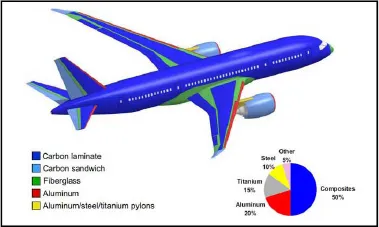
As it stands, the two main materials in use in aircraft structures are aluminum and a carbon fiber-based material. These two materials make up approximately 70% of the mass of the structure of a typical commercial plane such as the Boeing 787 (Figure 1.1).
image
Figure 1.1. Material breakdown of the Boeing 787 (according to http://www.boeing.fr). For a color version of this figure, see www.iste.co.uk/bouvet/aeronautical2.zip
The remaining structural materials are glass fiber-based composites, sandwich structures (a honeycomb core covered with two composite sheets), titanium, steel, etc.
Keep in mind that the weight ratio of composite materials is of over 50% of the overall mass for the Boeing 787 or the Airbus A350, but more standard commercial aircrafts such as the Airbus A320 or A380 are primarily composed of aluminum alloy, which makes up over 60% of its mass.

1.2. Carbon/epoxy composite T300/914

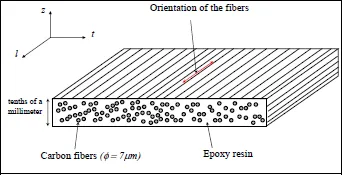
We will now look at a carbon/epoxy composite that is widely used in aircraft structures, called T300/914. The T300 portion of the name refers to a carbon fiber produced by Toray® [TOR 16], while 914 is a reference to an epoxy resin produced by Hexcel® [HEX 16]. T300/914 is a first generation carbon/epoxy composite that is 50% (in volume) carbon fiber and 50% epoxy resin. It takes the form of a thin fabric (less than a millimeter thick) that can subsequently be cut and draped to obtain a desired thickness (Figures 1.2 and 1.3).
image
Figure 1.2. Unidirectional carbon/epoxy laminate
image
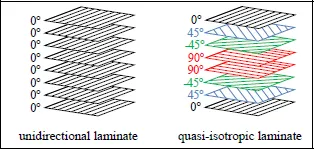
Figure 1.3. Unidirectional and quasi-isotropic laminate
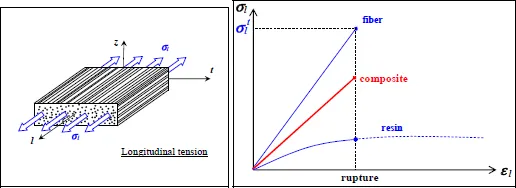
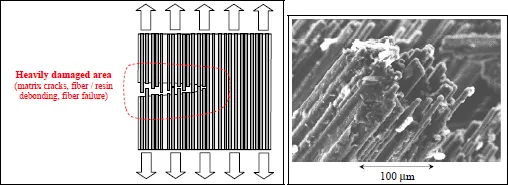
Performing a test along the direction of the fibers, also called the longitudinal direction, we can observe a brittle elastic behavior comparable to the fibers. The elastic limit is obviously lower than that of the fibers, since approximately 50% of the resin has been added, which has a relatively low elastic limit (Figure 1.4). This resin is necessary in order to obtain a less brittle material and to shape it. The carbon fibers are indeed thoroughly interesting elements from the aspect of their mechanical characteristics but cannot be used to adopt a desired geometry. Furthermore, when a crack appears in the material and propagates perpendicularly to the fibers, it will cause a lot of fiber failures and fiber debonding, thus requiring an elevated dissipation of energy; the material will therefore be less brittle (Figure 1.5). In practice, a crack would travel parallel to the fibers if it could, which is why there are plies in other directions, so as to reinforce the material in different orientations of loading (in practice, we can demonstrate that four directions 0°, +45°, −45° and 90° are enough). It is then a case of a composite laminate, as opposed to a composite with fibers facing only one direction, which is called a unidirectional composite (Figure 1.3).
image
Figure 1.4. Tension along the longitudinal direction of a composite: behavior of fiber, resin and composite. For a color version of this figure, see www.iste.co.uk/bouvet/aeronautical2.zip
image
Figure 1.5. Tension along the longitudinal direction: damaged area
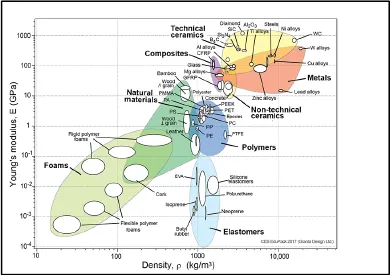
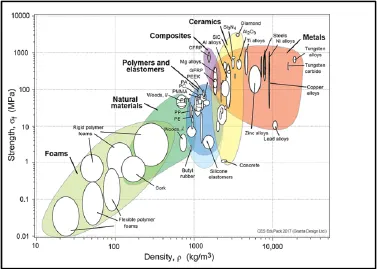
Comparing Young’s modulus and the strength of the main structural materials according to density, we note that composite materials are very well positioned compared to the metals (Figures 1.6 and 1.7). Ceramic materials are also very interesting but often too brittle for any structural use.
image
Figure 1.6. Young’s modulus according to density [ASH 00a] CFRP: carbon fiber reinforced plastic; GFRP: glass fiber reinforced plastic. For a color version of this figure, see www.iste.co.uk/bouvet/aeronautical2.zip
image
Figure 1.7. Strength according to density [ASH 00a] CFRP: carbon fiber reinforced plastic; GFRP: glass fiber reinforced plastic. For a color version of this figure, see www.iste.co.uk/bouvet/aeronautical2.zip
The way to better understand a composite material is to take a close look at its composition and microstructure, in particular for epoxy resin.

1.3. Polymers

The epoxy matrix is part of the polymer family commonly referred to as plastics. The word plastic comes from the mechanical behavior of polymers that present plastic strains, i.e. the deformation does not return to its original point when loading is released.
Polymers are composed, as indicated by the name, of chains of monomers linked together with covalent bonds. In this particular work, we will limit ourselves to organic polymers. Keep in mind that organic matter is created by living creatures (plants, mushro...

Table of contents

  1. Cover
  2. Table of Contents
  3. Title
  4. Copyright
  5. Foreword
  6. Preface
  7. Introduction
  8. 1 Presentation of an Aeronautical Unidirectional Composite
  9. 2 Characteristics of UD Ply
  10. 3 Characteristics of a UD Ply in a Given Direction
  11. 4 Fracture of a Laminated Composite
  12. 5 Fracture Criteria of a UD Ply
  13. 6 Membrane Behavior of a Laminated Composite Plate
  14. 7 Bending Behavior of a Laminated Composite Plate
  15. 8 The Fracture Criterion of a Laminate
  16. 9 Damage Tolerance
  17. 10 Interlaminar and Out-of-Plane Shear Stress
  18. 11 Holed and Bolted Plates
  19. 12 Buckling
  20. 13 Miscellaneous Rules for Stacking
  21. 14 Exercises
  22. 15 Solutions to the Exercises
  23. Bibliography
  24. Index
  25. End User License Agreement