
- English
- ePUB (mobile friendly)
- Available on iOS & Android
eBook - ePub
Veterinary Guide to Animal Breeds
About this book
Veterinary Guide to Animal Breeds offers a comprehensive reference for accurately recognizing small animal, exotic, and large animal breeds, with color photographs to aid in identification and important information for delivering veterinary care.
- Provides a reliable, veterinary-based guide to accurately recognizing breeds
- Covers small, large, and exotic animal breeds
- Emphasizes information targeted at daily veterinary practice
- Presents full-color photographs for comparison and identification
- Includes access to a companion website offering teaching materials, including worksheets and teaching PowerPoints
Frequently asked questions
Yes, you can cancel anytime from the Subscription tab in your account settings on the Perlego website. Your subscription will stay active until the end of your current billing period. Learn how to cancel your subscription.
No, books cannot be downloaded as external files, such as PDFs, for use outside of Perlego. However, you can download books within the Perlego app for offline reading on mobile or tablet. Learn more here.
Perlego offers two plans: Essential and Complete
- Essential is ideal for learners and professionals who enjoy exploring a wide range of subjects. Access the Essential Library with 800,000+ trusted titles and best-sellers across business, personal growth, and the humanities. Includes unlimited reading time and Standard Read Aloud voice.
- Complete: Perfect for advanced learners and researchers needing full, unrestricted access. Unlock 1.4M+ books across hundreds of subjects, including academic and specialized titles. The Complete Plan also includes advanced features like Premium Read Aloud and Research Assistant.
We are an online textbook subscription service, where you can get access to an entire online library for less than the price of a single book per month. With over 1 million books across 1000+ topics, we’ve got you covered! Learn more here.
Look out for the read-aloud symbol on your next book to see if you can listen to it. The read-aloud tool reads text aloud for you, highlighting the text as it is being read. You can pause it, speed it up and slow it down. Learn more here.
Yes! You can use the Perlego app on both iOS or Android devices to read anytime, anywhere — even offline. Perfect for commutes or when you’re on the go.
Please note we cannot support devices running on iOS 13 and Android 7 or earlier. Learn more about using the app.
Yes, you can access Veterinary Guide to Animal Breeds by Beth Vanhorn in PDF and/or ePUB format, as well as other popular books in Medicine & Veterinary Medicine. We have over one million books available in our catalogue for you to explore.
Information
1
Dog Breed Identification
OBJECTIVES
Upon completion of this chapter, the reader should be able to:
- recognize common breeds of dog species;
- identify and describe American Kennel Club (AKC) recognized dog breeds;
- discuss and describe the seven classes of dogs.
1.1 Introduction
Dogs are direct descendants of the wolf. The wolf is classified as Canis lupus and the dog as Canis familiaris. Dogs have become the second most popular animal in pet ownership, with over 73 million pet dogs in the United States alone. It is estimated that there is on average one dog per household in half of all American family homes. There are over 230 known pure breeds of dogs recognized by the American Kennel Club (AKC). The purpose of the AKC is to uphold the integrity dog breeds, promoting purebred dogs and breeding for type and function. Founded in 1884, the AKC advocates the purebred dog as a family companion, advancing canine health and well-being, working to protect the rights of all dog owners, and promoting responsible dog ownership.
Points to remember. There are over 230 recognized pure dog breeds.
1.2 Characteristics of Dogs
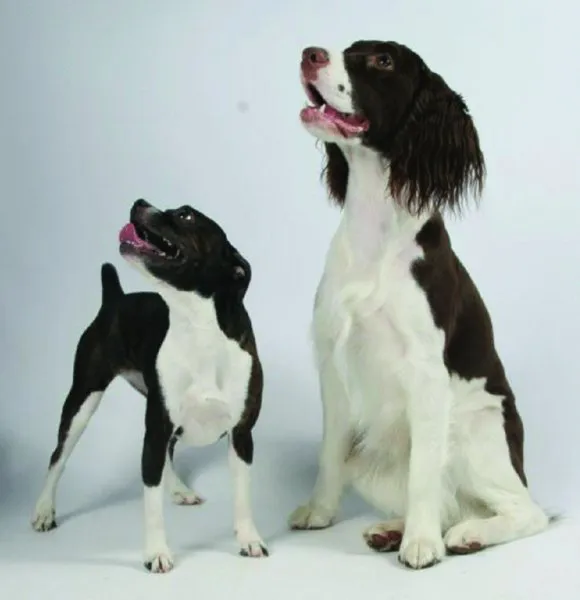
Dogs have a large variety of size ranges (height to weight). The height of dogs at the shoulder ranges from 6 to 40 inches and weight varies from 2 to over 200 pounds. Life expectancy ranges from 9 to 15 years, with some dogs now living into their early 20s. Small dogs have a longer life expectancy than large and giant breeds (Figure 1.1). Dogs share the following common traits:
- shedding hair once per year;
- non-retractable claws;
- 42 adult teeth, 28 baby teeth;
- pointed canine teeth;
- sweat glands located on nose and feet;
- panting;
- hearing two times better than in humans and at higher frequencies;

Figure 1.1 Small breed dogs have a longer average life expectancy than large and giant breeds. The larger the dog breed, the shorter the life span. Source: Courtesy of Shari Krause.
1.3 Classes of Breeds
Dog breeds are classified by the reason for their development and purpose or use. There are seven groups of dogs that have been organized based on the dog's original purpose and the traits it possesses in today's world (Table 1.1).
Points to remember. There are seven groups of dogs based on their reason for development.
Table 1.1 Groups of dogs.
| Group | Breeds | Purpose |
| Herding | Shepherds, Collies, Sheepdogs, Corgi | Driving, moving, and containing livestock |
| Hound | Beagle, Greyhound, Foxhound, Bloodhound | Use of senses for hunting and tracking, such as hearing, sight, and smell |
| Non-sporting | Dalmatian, Bulldog, Poodle, Boston Terrier | Pets and companions |
| Sporting | Retrievers, Pointers, Setters, Spaniels | Active hunting by scents in the air and ground |
| Terrier | Airedale, Schnauzer, West Highland, Scottish | Catching and flushing out rodents and small game |
| Toy | Chihuahua, Pug, Pomeranian, Shih Tzu | Pets and companions |
| Working | Boxer, Mastiffs, St Bernard, Rottweiler | Guarding, guiding, herding and obedience |
1.3.1 Herding Group
The herding group develope...
Table of contents
- Cover
- Title Page
- Copyright
- Preface
- About the Companion Website
- 1: Dog Breed Identification
- 2: Cat Breed Identification
- 3: Rabbit Breed Identification
- 4: Guinea Pig Breed Identification
- 5: Pocket Pet Breed Identification
- 6: Avian Breed Identification
- 7: Reptile Species Identification
- 8: Amphibian Species Identification
- 9: Cattle Breed Identification
- 10: Equine Breed Identification
- 11: Swine Breed Identification
- 12: Sheep Breed Identification
- 13: Goat Breed Identification
- 14: Poultry Breed Identification
- 15: Alternative Production Animal Breed Identification
- Appendix
- Index
- EULA