1 “Can’t You Do Anything Right?”: The Shocking Realization That I Was Not Perfect
My father likes to introduce me as the vet who put the parrot’s leg on backwards.
Having invested so much emotional and financial capital in my education, I am perplexed that my parents should find amusement in this embarrassing moment of my budding veterinary career. Surely they should inform their friends of my years of training, or all the letters following my name, or my position as a professor of surgery. But I am doomed to being defined in my family’s eyes by one small yet highly visible complication (I think there were extenuating circumstances, but you can make up your own mind later).
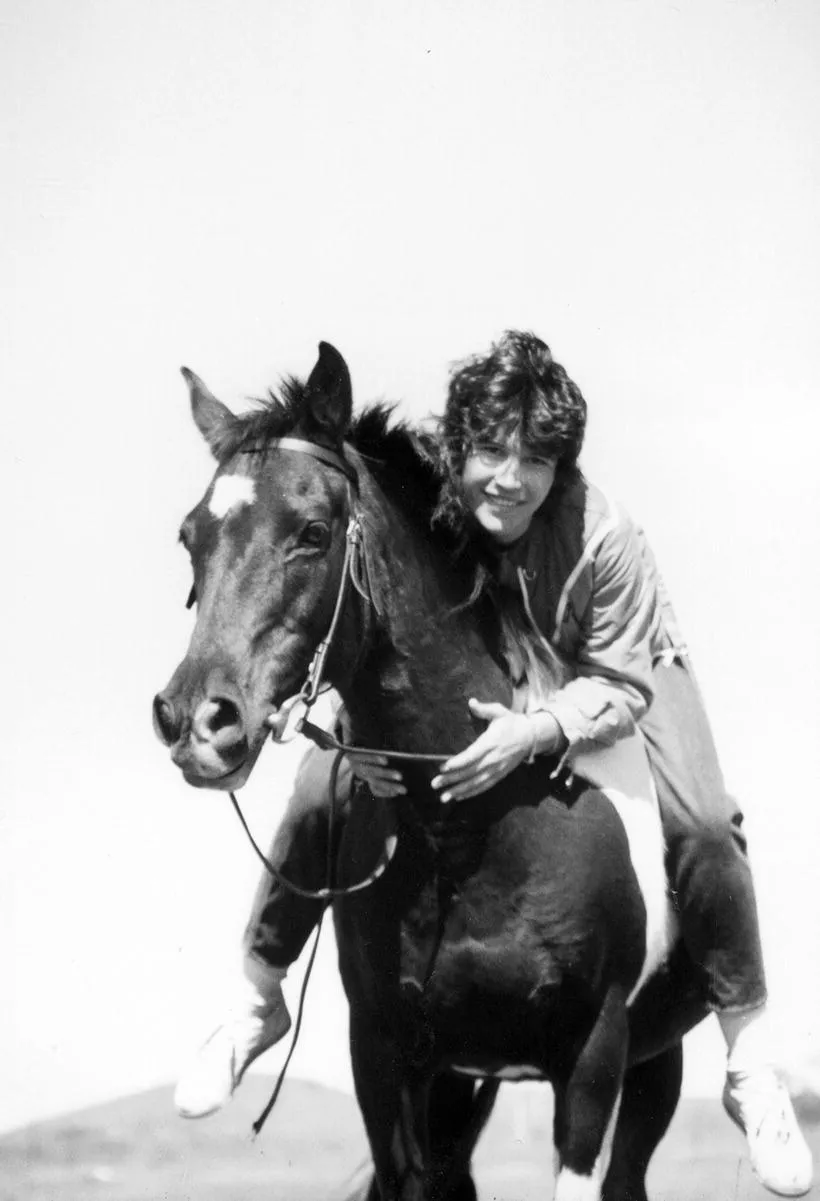
Having evolved from a childhood dream of palaeontology (which lost its appeal once I realized dinosaurs and humans never cohabited the planet), I cycled through visions of African exploration to becoming a marine scientist, a forensic pathologist and – finally – a jet‐setting equine veterinarian (Figure 1.1). Veterinary science would suit me, I decided. I preferred animals to people: people were too focused on themselves, they held silly ideas and misconceptions, and they complained too much. Ironic then, that the first harsh criticism of my career came directly from one of my animal patients.
Figure 1.1 A young “Dr. Hunt,” quite obviously destined to become a small animal surgeon.
Mrs. Sofel was a long‐term client of the small animal practice that employed me immediately after graduation. She was probably only in her mid‐sixties but looked about a hundred to a young veterinarian fresh out of university. Our relationship did not get off to a particularly good start, as she took one look at me when I entered the consulting room and wanted to know what I had “done with Dr. Davidson.”
“Dr. Davidson is on holiday for 2 weeks,” I replied.
“Well, I suppose you’ll just have to do, then,” she sniffed. She usually came in trailing a Cushingoid Maltese with more warts than teeth, but this time she swung a large birdcage onto the examination table. I realized her frail appearance belied great strength; a conclusion that did little to sooth my new‐graduate nerves. The birdcage contained a huge, sulphur‐crested cockatoo.
“Oscar has a lump,” said Mrs. Sofel.
For a moment, I was speechless; not because Oscar was a bird, or because his beak resembled a large pair of garden shears, but because he was almost completely bald. I quickly diagnosed him as suffering from beak and feather disease. Actually, it was just about the only disease I could remember from my avian medicine lectures at that particular moment. I stared at Oscar, who stared back; his beady black eye encircled by leathery grey skin. He looked little like a bird, and much more like some form of mutant dinosaur. The effect was complete when he raised the lone yellow feather on the crest of his head, and screeched. I practically hit the ceiling.
“It needs to be removed,” Mrs. Sofel announced.
My heart already pounding, I was further horrified to realize she was talking not about the single head feather which had so captured my attention, but about a large, egg‐shaped mass protruding from Oscar’s rump.
My main comfort at this point was that I had so little experience I did not yet know what to be frightened of. I knew how to anesthetize birds: we had knocked out chickens in a practical class at uni and successfully woken most of them up again. And I’d had a good training in basic surgery, so I had a rough idea of how to remove lumps. I wasn’t quite sure how I was going to get Oscar out the cage in order to do either of the above, but I was sure I could cross that hurdle when I came to it.
“Well, um, yes … we can do that,” I said.
“When and how much?” These were the days before computerized medical records, appointment systems, or account‐keeping programs, so I made a quick escape to the reception desk to find the answers. Thank goodness for Theresa, our wonderful receptionist and long‐term backbone of the practice. She gave me the information I needed (I suspect she would also have been able to tell me what drugs and surgical instruments to use, had I only asked).
Mrs. Sofel and I agreed on a price, and a date when Dr. Davidson was back in clinic, and she swept Oscar’s cage up and turned on her heel. But Oscar was not finished. He craned his neck to look back at me, and the crest feather slowly elevated again. I braced myself for the parting screech, but instead Oscar said in his parrot’s voice (closely resembling that of an old woman), “Can’t you do anything right?”
I stared at Mrs. Sofel, who said nothing. I had the uncanny sense that Oscar and his owner had formed a telepathic bond. Mrs. Sofel sniffed again and sailed from the waiting room, leaving me struggling for words. I suspect that particular phrase was heard frequently by those in her company, and never received a satisfactory answer.
Whatever the explanation, Oscar’s question proved sadly prophetic when we masked him down two weeks later, and he promptly died. In retrospect, we should have asked Theresa to do it. She later told me that parrots “always died” when anesthetized and left me wondering how many times Dr. Davidson had proven that particular theory.
Needless to say, Mrs. Sofel blamed me for Oscar’s death simply by virtue of my proximity to the saintly Dr. Davidson on the fateful day, and refused to allow me near any of her “other pets ever again.” Although such banishment was a blow to my ego, it was not an entirely unwelcome outcome, all things considered.
After incubation in primary school, hatching from high school, and being “fledged” at university, I had spent 18 years in the educational nest, so to speak. Surely that rendered me capable of doing a lot of things “right,” contrary to Oscar’s observation? Having finally launched into my career with the tenuous belief I would become airborne, I quickly realized I had not flown from the nest so much as staggered out of it, and been fortunate enough to bounce when I hit the ground.
I am sure I was a great success at many things in my early days as a veterinarian. But for some reason the comfort of our successes fades quickly, while our failures remain to irritate us, as surely as Oscar’s diseased feathers had irritated him. At least Oscar was able to pull his feathers out. Looking back on all those mystery patients, unfathomable clients, the questions for which the textbooks provided no answer, all those mistakes I made, and all the things I had to learn the hard way, I do wonder how different my years of practice might have been if I had the knowledge then that I have now.
If only I had known!
We acquire knowledge in many different ways. We have different learning styles. We memorize things by rote, but we truly learn them when we have the chance to apply them. Our profession is a fluid mix of thinking and “doing”; very much dependent on the type of case and its unique circumstances. Some patients fit the textbook description perfectly, whereas others break all the rules. Clients have particular needs and restrictions when managing their pets, and there is always the issue of finance. Sometimes, I suspected the tides or phase of the moon dictated whether things went according to plan. Were the stars aligned? Did I wear my lucky socks to work that morning? Faced with such a complex system, there is only so much our university professors and textbooks can teach us.
Our successes involve a large portion of “seat of our pants” intuition and good luck. Scientific and evidence‐based as our profession has become, we will always have to learn some things by trial and error, by simply seeing what works and what does not. Textbooks give us a definitive description, a clear way to proceed with diagnosis and treatment, and a neat explanation for cause and effect. We try to make cases fit the textbook description, or vice versa, and mentally file away inconvenient pieces of information that don’t fit in the hope that the abnormalities will either go away on their own or make sense once the patient gets better, or maybe when we’ve got more experience. What textbooks usually don’t show us, though, is the process their authors went through to evolve the crisp conclusions they share in print. They tell us about the sum total of their experience, and tend not to dwell on the cases that broke the rules.
Speaking to a group of general practitioners in rural Australia some years ago, I shared the story of a truly perplexing case. This case had no fairy tale ending, we made many mis‐steps along the way, and the ultimate answer was only revealed in the postmortem room. Standing beside me in the lunchtime coffee line, one of the older vets said:
“I liked your lecture. It gave me a lot of hope.”
“That’s good to hear. And why was that?”
“I realized you specialists don’t have all the answers, either.”
I have heard this many times since; from students, junior academics and vets in practice. There is an impression that after a certain level of training, when you achieve fellowship or diplomate status, somehow you know all there is to know, and you never screw up.
It is comforting to the people reading the textbooks, and listening to the lectures, that they aren’t the only ones who scratch their heads, find test results that defy explanation, draw the wrong conclusion, agonize over their treatment plan, or struggle for ideas when their plans don’t work.
When I ask my colleagues in specialty practice whether they have made mistakes, most of them are quick to say, “Hell, yes!” or “My oath!” (depending on which side of the Pacific they come from). But that is not always the impression we give when we deliver our lectures or write our textbook chapters. We talk about our successes, show the best photographs, sanitize our complications, and generally present a stylized version of what can be a slow, frustrating, confusing, and sometimes downright messy process.
Unpalatable as it is to admit, our cases don’t always go well. Most of us are happy to learn from someone else’s mistakes, but it is particularly intimidating to confront your own mistakes honestly. Gruelling as it can be, through my years as an academic and a teacher of veterinarians, I have reaped an ironic reward from sharing my low moments with others and thus allowing them to learn.
Of course, being a veterinarian is not just about the animals. In a perfect world, desperate clients would bring an ailing pet to us and take a healthy one home again after showering us with gratitude and admiration, and full payment of their bill. Reality, however, is not quite so Disneyesque. My experience with Mrs. Sofel was more than simply a lesson in how easily I could fall foul of others. In Mrs. Sofel, I had my first encounter with the client whose sole aim seemed to be to make my life miserable. These clients rarely had a kind word to say, and were capable of finding fault in the most benign of circumstances (Oscar’s death aside, which was understandably devastating for everyone). I wondered what it was about me that caused some people to be so very difficult, and I wanted so very badly to defend myself. Couldn’t they see that I was trying my best to help them and their pets? Where was the gratitude? The admiration? How dare they tell me how to treat their pet after I spent five years in veterinary school?
I stormed into the treatment room one day after being lectured on how to clip a Yorkshire Terrier’s nails.
“Looks like that appointment went well,” my nurse, Karen, ...
Table of contents
Cover
Title Page
Table of Contents
Notes on Contributors
Acknowledgments
Preface
1 “Can’t You Do Anything Right?”
2 Beastly Bellies
3 The Friday Night Special
4 Between a Rock and a Hard Place
5 Courage, Mystery, and Awe
6 Placed on Earth to Test Us
7 “Oops!”
8 Learning the Hard Way
9 “But I Don’t Want to Look Stupid …”
10 “It Didn’t Look Like That on Paper!”
11 “It Will Be Interesting to See Whether That Works”
12 When the Unthinkable Happens
13 Things Went South – Now What?
14 “There’s Got to Be a Morning After”1
15 One Leg Too Many
16 Reconstruction Rescue
17 “Why Is Sam Straining?”
18 “An Alien in My Waiting Room”
19 Rewind
Index
End User License Agreement
Trusted by 375,005 students
Access to over 1.5 million titles for a fair monthly price.
Study more efficiently using our study tools.
Frequently asked questions
Yes, you can cancel anytime from the Subscription tab in your account settings on the Perlego website. Your subscription will stay active until the end of your current billing period. Learn how to cancel your subscription
No, books cannot be downloaded as external files, such as PDFs, for use outside of Perlego. However, you can download books within the Perlego app for offline reading on mobile or tablet. Learn how to download books offline
Perlego offers two plans: Essential and Complete
Essential is ideal for learners and professionals who enjoy exploring a wide range of subjects. Access the Essential Library with 800,000+ trusted titles and best-sellers across business, personal growth, and the humanities. Includes unlimited reading time and Standard Read Aloud voice.
Complete: Perfect for advanced learners and researchers needing full, unrestricted access. Unlock 1.5M+ books across hundreds of subjects, including academic and specialized titles. The Complete Plan also includes advanced features like Premium Read Aloud and Research Assistant.
Both plans are available with monthly, semester, or annual billing cycles.
We are an online textbook subscription service, where you can get access to an entire online library for less than the price of a single book per month. With over 1.5 million books across 990+ topics, we’ve got you covered! Learn about our mission
Look out for the read-aloud symbol on your next book to see if you can listen to it. The read-aloud tool reads text aloud for you, highlighting the text as it is being read. You can pause it, speed it up and slow it down. Learn more about Read Aloud
Yes! You can use the Perlego app on both iOS and Android devices to read anytime, anywhere — even offline. Perfect for commutes or when you’re on the go. Please note we cannot support devices running on iOS 13 and Android 7 or earlier. Learn more about using the app
Yes, you can access Pitfalls in Veterinary Surgery by Geraldine B. Hunt in PDF and/or ePUB format, as well as other popular books in Medicine & Veterinary Medicine. We have over 1.5 million books available in our catalogue for you to explore.